
Heating Services in Salt Lake County
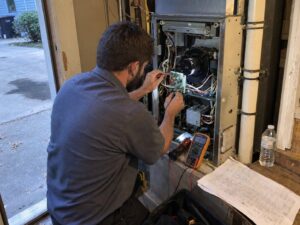
Salt Lake winters aren’t average. The valley sits in a bowl ringed by the Wasatch and Oquirrh mountains, and that geography produces persistent winter inversions that trap cold air at the valley floor for days or weeks at a time. Temperatures below zero are routine. Sub-freezing weather stretches for weeks. The Utah Division of Air Quality documents air quality during inversions reaching dangerous levels, which means windows stay closed and furnaces run harder, longer, and more continuously than they would in most other climates. Heat exchangers on Salt Lake Valley furnaces accumulate more operating hours per year than equipment elsewhere in the country, and that drives different maintenance patterns and different replacement timing.
Below are the heating services we provide across West Valley City, Kearns, Magna, Taylorsville, West Jordan, and Salt Lake City. Every furnace install includes combustion analysis at commissioning. Every diagnostic includes real measurements — combustion analysis (CO, O2, draft pressure, temperature rise), gas pressure verification at the manifold, ignition system diagnostic, and heat exchanger inspection where possible. Older homes get attention to atmospheric draft conditions, mid-efficiency furnaces, and venting paths that often weren’t reviewed by the original installer.
Heating Services We Offer
Furnace Installation
New furnace installation, gas and electric, ranging from single-stage 80% mid-efficiency through modulating variable-speed 98% high-efficiency. Every install includes elevation-corrected Manual J load calculation, ductwork audit, venting evaluation, and combustion analysis at commissioning. Trane, Carrier, Lennox, Goodman, Rheem, Bryant equipment installed by factory-trained crew.
Furnace Repair
Diagnostic and repair on residential and commercial furnaces — ignition system failures, control board issues, gas valve problems, blower motor failures, inducer motor failures, limit switch trips, flame sensor problems, heat exchanger inspections. Emergency response under 2 hours during sub-freezing weather, faster for households with vulnerable occupants.
Furnace Tune-Up
Fall seasonal service before heating season. Combustion analysis (CO ppm at high and low fire, draft pressure, temperature rise), heat exchanger inspection, ignition system service, gas pressure verification at the manifold, blower compartment cleaning, electrical inspection. Manufacturer warranties typically require documented annual maintenance to remain valid.
Heat Pumps
Heat pump installation, repair, and dual-fuel configuration. Cold-climate Mitsubishi Hyper-Heat and similar inverter-driven systems rated for full capacity at -13°F. Dual-fuel pairings with high-efficiency gas furnaces — heat pump handles most of the heating season; furnace takes over below the economic breakeven temperature.
Heat Exchanger Repair
Heat exchanger inspection, crack testing, leak isolation, and replacement on covered warranty units. Cracked heat exchangers are a safety hazard — carbon monoxide can pass from the combustion side into the supply air stream. We use combustion analysis, visual inspection with borescope, and where indicated, isolation testing to identify failures.
Boiler Installation
Hydronic boiler installation for older Salt Lake homes with radiator or baseboard heat. Cast iron, stainless steel, and aluminum block boilers from major manufacturers. Sizing by heat loss calculation accounting for the actual radiator capacity, not a furnace BTU rule of thumb that produces poor results in radiator-heated homes.
Boiler Repair
Boiler diagnostics — circulator pumps, expansion tanks, zone valves, aquastats, low-water cutoffs, pressure relief valves, draft inducers on power-vented units. Most boiler failures in the valley involve circulator pumps (typically 8–15-year service life), expansion tanks (can fail in 5–10 years), or zone valve actuators.
Gas Line Installation
New gas line runs for HVAC equipment — relocated furnaces, new ranges associated with kitchen remodels paired with HVAC work, gas line modifications for high-efficiency furnace installs requiring different sizing. Performed by our Utah journeyman plumber endorsement holder (Travis Hollings) per Utah Mechanical Code and Utah Plumbing Code requirements.
What’s Different About Heating in the Salt Lake Valley
Persistent Winter Inversions
Salt Lake’s geography creates conditions where cold air settles in the valley basin and warm air aloft acts as a lid, preventing the normal vertical air mixing that disperses pollutants and equalizes temperatures. Inversions can last days or weeks, with temperatures at the valley floor often 10–20°F colder than at the foothills 1,000 feet above. The Utah Division of Air Quality regularly documents PM2.5 readings during inversion episodes well above EPA healthy thresholds.
For HVAC, this means: furnaces in this valley run more hours per heating season than equipment in less inversion-prone climates. Heat exchangers accumulate more thermal cycling. Combustion air supply matters more (closed homes during inversion mean less natural air infiltration, which can starve atmospheric-vent furnaces of combustion air). Indoor air quality systems do more meaningful work here than in cleaner-air climates.
Elevation Affects Combustion
At 4,300 feet, atmospheric pressure is about 86% of sea level. Gas furnaces designed for sea-level operation often run rich at altitude (too much fuel for available oxygen), which produces elevated CO emissions and reduces combustion efficiency. Manufacturers publish altitude-correction specifications and many furnaces require specific orifice changes or input adjustments for installation at our elevation. Furnaces installed without this correction operate inefficiently and can produce dangerous CO levels.
We verify altitude correction on every furnace install and every diagnostic visit. Combustion analysis at commissioning catches improper altitude correction before it becomes a safety problem.
Older Housing Stock Has Atmospheric-Vent Furnaces
Pre-1990s Salt Lake homes (common in Salt Lake City, older West Valley neighborhoods, parts of Kearns and Magna) often still run 80% atmospheric-vent furnaces that draw combustion air from the surrounding space and vent through masonry chimneys or B-vent. These systems have specific service requirements — chimney inspection, draft testing, spillage testing — that newer condensing furnaces don’t need. Many local contractors aren’t comfortable with atmospheric-vent service. We are.
Newer Construction Has Tight Building Envelopes
Homes built since approximately 2000 have significantly tighter building envelopes than older construction. This is generally good for energy efficiency but creates HVAC implications: less natural air infiltration during inversion season, which means furnace combustion air needs to be addressed (sealed combustion or makeup air); humidity control becomes more important; ventilation strategies (ERV or HRV systems) become more relevant.
Dominion Energy Service Area
Natural gas service across Salt Lake County is provided by Dominion Energy. Gas pressure standards, meter sizing, and customer-side piping all follow Dominion Energy requirements coordinated with Utah Mechanical Code. We coordinate with Dominion Energy on installs requiring meter upgrades, new service runs, or pressure regulation changes — common on high-efficiency furnace installs that may require different gas pressure than the existing equipment.
How We Approach Heating Service Calls
Every diagnostic visit on gas heating equipment includes the same baseline measurements:
- Combustion analysis — CO ppm at high-fire and low-fire (target: under 100 ppm air-free in flue gas, ideally under 50), O2 percentage, flue gas temperature
- Draft pressure verification at the inducer or atmospheric draft hood
- Gas pressure at the manifold against manufacturer specification (typically 3.5″ w.c. for natural gas residential furnaces; some high-efficiency models specify different values)
- Temperature rise across the heat exchanger against manufacturer specification (typically a range like 35–65°F for residential furnaces; readings outside the range indicate airflow or combustion issues)
- Static pressure across the air handler — same diagnostic we run on cooling systems, equally important on heating
- Electrical readings — blower motor amp draw, inducer motor amp draw, capacitor microfarads
- Ignition system inspection — hot surface igniter resistance, flame sensor cleanliness and microamp draw, pilot system on older atmospheric units
- Heat exchanger visual inspection with mirror and flashlight where accessible; borescope inspection on closed cabinets where indicated
- Limit switch and safety control verification — proper operation, no jumpering, correct settings
- Venting inspection — flue connections, draft, condensate handling on condensing units, clearance to combustibles, termination clearances
You see the readings as we take them. The diagnostic produces a written report with measurements, identified issues, and quoted repairs — not guesses, not pressure-based estimates, not “you need a new furnace” without justification.
Repair vs. Replace on Older Furnaces
The repair-vs-replace decision on heating equipment follows similar logic to cooling, with some heating-specific considerations:
- Furnace age under 12 years: Repair almost always wins. Equipment has substantial useful life remaining; major components often still under warranty.
- Furnace age 12–18 years: Depends on the repair cost and what’s failing. A blower motor or inducer motor replacement at 15 years still favors repair; a heat exchanger crack at 15 years usually triggers replacement.
- Furnace age over 18 years: Most furnaces are at or past typical useful life. Major component failures usually trigger replacement.
- Heat exchanger failures at any age: Special case. A cracked heat exchanger can leak carbon monoxide into the supply air stream — a genuine safety hazard. We don’t recommend “patching” or operating a furnace with a known cracked heat exchanger. Replacement of the heat exchanger (if covered by warranty) or replacement of the furnace is the only safe answer.
- Atmospheric-vent furnaces showing draft problems: Sometimes the issue is chimney lining or termination rather than the furnace itself. We investigate before recommending replacement.
We provide repair-vs-replace math in writing for borderline cases, modeling current repair cost, projected near-term repair costs, energy efficiency gains from replacement, and remaining equipment life — so the decision is yours with full information.
Brands We Install and Service
We’re brand-agnostic. We install Trane, Carrier, Lennox, Goodman, Rheem, Bryant, and Daikin furnaces and heat pumps. Patrick is a Trane Comfort Specialist and Mitsubishi Electric Diamond Contractor — the top dealer designations for each. We service those plus most major HVAC heating brands — American Standard, York, Coleman, Heil, Tempstar, Comfortmaker, Amana, Ruud, Payne, and older brands still common in the valley. Boiler service covers Weil-McLain, Burnham, Lochinvar, Buderus, Navien, and most major hydronic heating brands.
Typical Heating Project Costs in Salt Lake County
- Furnace repair calls — typically $150–$1,200 depending on failed component. Common ranges: flame sensor cleaning $150–$250, hot surface igniter replacement $275–$450, blower motor replacement $500–$1,200, inducer motor replacement $400–$800, control board replacement $400–$900, gas valve replacement $500–$1,100.
- Furnace installation — $4,500–$7,500 for basic 80% efficiency single-stage; $7,000–$11,000 for high-efficiency 96–98% AFUE two-stage; $9,500–$14,000 for modulating variable-speed premium equipment.
- Heat pump installation — $6,500–$10,500 for standard single-stage; $9,000–$14,000 for two-stage; $14,000–$22,000 for cold-climate variable-capacity inverter-driven systems.
- Heat exchanger replacement (covered warranty, labor only) — $800–$1,800 depending on furnace model and access.
- Boiler repair — $250–$1,500 depending on component (circulator pump $400–$650, expansion tank $300–$500, zone valve $250–$450, aquastat $300–$600).
- Boiler installation — $7,500–$15,000 depending on capacity, efficiency tier, and complexity.
- Gas line installation — $400–$1,500 depending on length, complexity, and access.
- Furnace tune-up — $99–$179.
Financing is available for qualified customers through Synchrony Bank and Service Finance Company, including 0% APR promotional plans and longer-term fixed-rate options. Dominion Energy Therm-Wise rebates apply to qualifying high-efficiency furnaces and combination systems; federal 25C tax credit applies up to $600 on qualifying furnaces and up to $2,000 on qualifying heat pumps. We model all available incentives into install quotes so you see real net cost.
Carbon Monoxide Safety
Combustion appliances — furnaces, boilers, water heaters, gas ranges — can produce carbon monoxide under certain failure conditions. CO is colorless and odorless; symptoms of exposure (headache, nausea, drowsiness, confusion) can be mistaken for flu. Severe exposure can be fatal.
Every Aegis furnace service call includes CO testing in the flue gas stream and ambient CO testing in the mechanical room. Every install includes verification of proper combustion (CO under 100 ppm in flue gas, ideally under 50, with proper draft and combustion air supply). We strongly recommend functioning CO detectors on every level of any home with combustion appliances — battery-powered or hardwired, replaced every 5–7 years per manufacturer specifications. If you don’t have CO detectors or they’re past their service life, we’ll mention it on every service visit.
Frequently Asked Questions
- How long do furnaces last in Salt Lake County?
- Properly sized and maintained furnaces typically last 15–20 years in our climate. The Salt Lake Valley’s inversion-driven extended heating seasons accumulate more operating hours than less inversion-prone climates, which can shorten useful life slightly. Atmospheric-vent furnaces (older 80% AFUE units) tend toward the lower end of that range; high-efficiency condensing furnaces toward the upper end when properly maintained.
- When should I schedule furnace tune-up service?
- Fall, before the first sub-freezing weather. Most furnace failures show up the first time the system runs under real heating load. Tune-ups in September or October catch marginal igniters, dirty flame sensors, low gas pressure, and other issues before they become a 2am-emergency call in January.
- Is it dangerous to keep running an old furnace?
- Generally no, if the furnace is being maintained and combustion analysis shows normal CO levels. Older furnaces are less efficient (more expensive to operate) but not inherently more dangerous than newer equipment. The genuine safety concern is a cracked heat exchanger, which can occur at any age but is more common on older furnaces. Annual maintenance with heat exchanger inspection catches problems before they become safety issues. Functioning CO detectors are essential regardless of furnace age.
- Should I switch from a gas furnace to a heat pump?
- For most Salt Lake Valley homes, the right answer is dual-fuel — a heat pump paired with a backup gas furnace. The heat pump handles 80% of the heating season efficiently (typically the milder mid-fall through mid-spring months); the furnace takes over below the heat pump’s economic breakeven temperature (usually around 25–35°F depending on your electricity-to-gas rate ratio). Pure heat pumps work in this climate if your home has adequate electrical capacity and good envelope insulation, but dual-fuel is the lower-risk, lower-bill answer for most existing homes. We model the comparison in writing as part of any heating replacement quote.
- What’s wrong if my furnace is short-cycling?
- Most common causes: oversized equipment (the furnace is too big for the home’s heat loss, so it heats too quickly and shuts off), restricted airflow causing overheating that trips the limit switch, dirty flame sensor causing intermittent flame detection, faulty thermostat, or a heat exchanger problem. A diagnostic visit identifies the actual cause in 30–60 minutes.
- How fast can you get to me for an emergency no-heat call?
- During sub-freezing weather, typical response time for emergency calls is under 2 hours for calls placed before noon. After-hours emergency calls — particularly for households with elderly residents, infants, or medically vulnerable members — get same-day arrival on the vast majority of cases. Pipe freeze risk in sub-zero weather is treated as a safety emergency.
- Do I need to replace my furnace and AC at the same time?
- Not necessarily, but it’s often the better economic call when both are approaching end-of-life. Replacing together typically saves on labor (one trip, one set of refrigerant line modifications, one commissioning), ensures heating and cooling are properly matched for efficiency, and consolidates manufacturer warranties. Replacing separately makes sense when only one unit is failing and the other has 5+ years of useful life remaining. We model both scenarios in any replacement quote.
Schedule Heating Service
Whether you need an emergency furnace repair, a fall tune-up, a quote on a new system, or a second opinion on a quote from another contractor, call us. During sub-freezing weather, we prioritize no-heat calls and triage based on safety — vulnerable household members, pipe-freeze risk, and CO concerns first.
- Phone: (385) 250-0687
- Email: info@aegisheatingandair.xyz
- Address: 4454 Manhattan Ct, West Valley City, UT 84120