
Furnace Repair in Salt Lake County
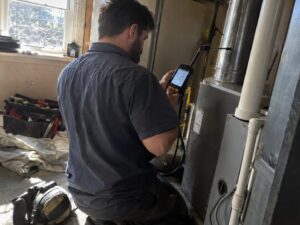
A furnace that won’t start on a 10°F morning isn’t really an HVAC problem — it’s a household crisis. Pipes start freezing within hours. Elderly residents, infants, and anyone medically vulnerable face genuine health risks from cold exposure. The phone call to the HVAC contractor isn’t a service request; it’s an emergency. We treat it that way. During sub-freezing weather, our typical response time on no-heat calls is under 2 hours for calls placed before noon, and we prioritize triage by safety — households with vulnerable members, pipe-freeze risk, and CO concerns get same-day arrival regardless of when the call comes in.
Most furnace no-heat calls in this valley fall into a handful of common failure patterns. We’ve seen them many times. The truck arrives with the parts that fix 75% of common no-heat calls already on board: hot surface igniters in standard sizes, flame sensors, common control boards for major brand lineups, inducer motors, capacitors, blower motors for residential equipment, condensate pumps, and the diagnostic equipment to identify the rest — combustion analyzer, manometer, multimeter with capacitance measurement, megohmmeter, and borescope.
Below is what we actually do when we arrive, what the common failures look like, what they typically cost to repair, and when repair stops making sense relative to replacement.
What Happens on a Furnace Repair Call
Every diagnostic visit follows the same baseline regardless of what you described on the phone:
- Visual inspection at the furnace. Cabinet condition, venting connections, gas line connections, condensate handling on condensing units, status code blinks from the control board LED if visible. Sometimes the diagnosis is visible from a quick walk around — a tripped service switch, a clogged filter packed so tight the furnace can’t pull return air, a condensate trap full of biological growth, a venting connection that has fallen apart.
- Status code reading. Most modern furnaces produce status code blinks from a small LED visible through an inspection port on the front. The code maps to specific failure conditions per the manufacturer’s diagnostic chart. We start there — the furnace usually tells us what failed before we measure anything.
- Electrical readings. 24V at the thermostat connections, 120V at the line connections, blower motor capacitor reading, inducer motor amp draw, hot surface igniter resistance (typically 40–80 ohms when healthy), flame sensor microamp draw when proving flame (typically 0.5–10 µA in normal operation).
- Gas-side measurements. Gas pressure at the inlet and at the manifold against manufacturer specification, gas line continuity to the meter, valve operation under thermostat call.
- Combustion analysis. CO in the flue gas at high-fire and low-fire (target under 100 ppm air-free, ideally under 50), O2 percentage, flue gas temperature, draft pressure at the inducer. Combustion analysis is the diagnostic that separates real furnace troubleshooting from guessing.
- Heat exchanger visual inspection through inspection ports with mirror and flashlight; borescope inspection where access allows. Cracked or rusted heat exchangers are safety hazards and trigger a different conversation than ordinary repair.
- Static pressure measurement across the air handler. High static pressure (above 0.5–0.7″ w.c.) usually points to a duct system problem — undersized return air, dirty filter, kinked flex duct — that’s been slowly destroying the equipment.
- Walk you through findings. You see what we’re measuring. The diagnosis is a conversation about which component failed and why, not a verdict delivered without context. Written repair quote before any work is performed.
Common Furnace Repair Calls We See
Dirty Flame Sensor
The flame sensor is a small metal rod inserted into the furnace’s flame path. It works by detecting the rectified DC current that flows through an ionized flame. When the sensor surface oxidizes (which happens over years of operation), the rectification signal weakens. Eventually the control board can’t detect the flame and shuts the furnace down as a safety precaution — even though the burner is actually firing.
- Symptoms: Furnace ignites, you hear the burner light, then shuts down within 5–10 seconds. Tries again, ignites, shuts down. Eventually the control board locks out after 3–5 failed attempts and displays a “flame failure” status code.
- Diagnosis: Microamp reading on the flame sensor when the burner is firing. Below 0.5 µA usually means a dirty sensor; readings near 0 µA after cleaning indicate sensor replacement is needed.
- Typical repair cost: $150–$250 for cleaning; $200–$350 if sensor replacement is needed. Most common repair on furnaces 5–10 years old.
Failed Hot Surface Igniter
Modern furnaces use a hot surface igniter (a silicon carbide or silicon nitride element that glows red-hot to ignite the gas) rather than the standing pilot lights common on older equipment. Igniters fail from thermal cycling stress — eventually the element cracks or breaks completely.
- Symptoms: Furnace control board calls for ignition, you hear the inducer running, but no burner ignition. After 3 attempts the board locks out. Status code typically indicates “ignition failure.”
- Diagnosis: Resistance measurement across the igniter terminals. Healthy igniters read 40–80 ohms (varies by manufacturer). Open circuit or very high resistance means the igniter is broken.
- Typical repair cost: $275–$450 including diagnostic, igniter, and labor. Most replacements complete in under an hour with parts stocked on our trucks for major brand furnaces.
Failed Inducer Motor
The inducer motor pulls combustion air through the burners and pushes combustion gases through the flue. On 90%+ condensing furnaces, it also pulls combustion air from outside. Inducer failure means the furnace can’t satisfy its pressure switch safety circuit and will refuse to ignite.
- Symptoms: Furnace gets a thermostat call but the inducer doesn’t run. No ignition attempt. Status code typically indicates “pressure switch open” or “inducer not running.”
- Diagnosis: Visual confirmation that inducer isn’t running, voltage check at inducer terminals during call for heat, amp draw against nameplate.
- Typical repair cost: $400–$800 including diagnostic, inducer assembly, and labor. Higher-end of range for variable-speed ECM inducers found on premium modulating equipment.
Failed Blower Motor
The blower motor moves heated air through the duct system. Failures show up as the burner firing but no air at the registers, or as motor overload trips that shut the furnace down on high temperature limit.
- Symptoms: Furnace ignites, burns for a few minutes, then shuts down on high temperature limit (heat exchanger overheats without airflow to remove the heat). Or: furnace runs but no air comes from the supply registers. ECM (variable-speed) motors sometimes fail with a fault code rather than a hard failure.
- Diagnosis: Visual confirmation, amp draw against nameplate, capacitor microfarad reading (PSC motors), ECM module diagnostic (variable-speed motors), motor bearing test.
- Typical repair cost: $500–$1,200 depending on motor type. PSC motors run lower in the range; ECM variable-speed motors run higher. Most replacements complete same-day with parts available through local supply houses.
Failed Control Board
The control board is the furnace’s brain — managing ignition sequencing, blower control, safety circuits, and communication with the thermostat. Failures show up in unpredictable ways depending on which control board functions are affected.
- Symptoms: Erratic operation, status codes that don’t match reality, intermittent operation, no thermostat response. Sometimes the control board’s onboard LED is dark or rapidly flashing fault codes that don’t match a single failure mode.
- Diagnosis: Power-on test of control board, voltage measurements at various test points, visual inspection for burned components or damaged traces.
- Typical repair cost: $400–$900 depending on board complexity and equipment. Universal control boards work in many older systems; communicating boards on premium multi-stage equipment cost more and must match the equipment exactly.
Failed Gas Valve
The gas valve opens to allow gas flow to the burners when the control board calls for heat. Valves fail in two modes — fails closed (no gas flow, no ignition) or sticks open (gas flows when it shouldn’t, safety hazard).
- Symptoms: Inducer runs, igniter glows, but no flame at the burners. Gas pressure reading at the manifold confirms no gas flow when the valve is energized. Sometimes audible click of the valve trying to open without actual mechanical response.
- Diagnosis: Voltage at gas valve terminals during call for heat (should see 24V on most residential valves), manifold gas pressure reading when valve should be open (should match manufacturer spec, typically 3.5″ w.c. for natural gas).
- Typical repair cost: $500–$1,100 including diagnostic, gas valve, and labor.
Cracked Heat Exchanger
The heat exchanger separates combustion gases (flue gas containing CO, CO2, water vapor, and trace combustion products) from the supply air that circulates through the home. A cracked heat exchanger allows combustion gases — including potentially dangerous levels of CO — to enter the supply air stream. This is a genuine safety hazard.
- Symptoms: Sometimes none obvious to the homeowner. May include: rust accumulation in burner area, soot deposits, elevated CO readings in supply air or living space, CO alarm activation, family members reporting flu-like symptoms that improve when away from home.
- Diagnosis: Visual inspection of heat exchanger surfaces through inspection ports, borescope inspection where access allows, combustion analysis (elevated CO with otherwise normal combustion settings is a red flag), sometimes isolation pressure testing of the heat exchanger.
- Important: We don’t recommend operating a furnace with a confirmed cracked heat exchanger. The fix is either heat exchanger replacement (often covered by manufacturer warranty for 20 years or lifetime) or furnace replacement if the unit is at end-of-life. Some unethical contractors will tell customers a cracked heat exchanger can be “sealed” or “patched” — we don’t, and we recommend against any contractor who suggests it.
- Typical repair cost: Heat exchanger replacement under warranty $800–$1,800 (labor only, manufacturer covers part). Out-of-warranty heat exchanger replacement often triggers full furnace replacement instead at $4,500–$14,000 depending on equipment tier.
Dirty Filter / Restricted Return Air
The single most common cause of furnace failures we see — not because the filter itself fails, but because restricted airflow causes the heat exchanger to overheat and trip the limit switch repeatedly, eventually damaging the limit switch, the heat exchanger, or both.
- Symptoms: Furnace ignites, runs for a few minutes, shuts down on high limit. Cycles repeatedly without satisfying the thermostat. Sometimes the blower runs continuously between cycles.
- Diagnosis: Visual filter inspection (often the filter is so dirty it’s collapsed inward from negative pressure), static pressure measurement at the filter rack, temperature rise across the heat exchanger.
- Typical repair cost: $0 for the fix (replace the filter, we’ll show you how) plus the diagnostic fee. We show you how to prevent it. Customers who maintain filter changes monthly during heating season see far fewer no-heat calls.
When Repair Stops Making Sense
The honest answer involves math, not pressure. Repair-vs-replace logic on furnaces:
- Furnace under 8 years: Repair almost always wins. Equipment has substantial useful life remaining; major components often still under manufacturer warranty.
- Furnace 8–15 years: Repair-vs-replace depends on the repair cost. Repair cost exceeding 30% of replacement cost starts to favor replacement; under 30% usually favors repair.
- Furnace over 15 years: Major component failure (heat exchanger, control board on premium equipment, blower assembly) typically tips toward replacement. Minor repairs (flame sensor, igniter, capacitor) still favor repair.
- Furnace over 20 years: Most furnaces are at or past typical useful life. Repair usually buys 1–3 more seasons at most.
- Cracked heat exchanger: Special case. The repair cost is either heat exchanger replacement under warranty (if applicable) or furnace replacement. Operating with a known cracked heat exchanger isn’t a safe option regardless of cost.
When we run the math, you see the numbers — current repair cost, projected near-term repair costs, energy efficiency savings from a new system (modeled against your actual gas bills if available), and remaining equipment lifespan. You make the call. We don’t pressure either direction.
Same-Day and Emergency Response
During sub-freezing weather (typically November through March), our dispatch prioritizes:
- Emergencies — no heat in homes with elderly residents, infants, medically vulnerable members; pipe-freeze risk in sub-zero weather; suspected CO problems; gas leak suspicion
- Same-day non-emergency — no-heat calls without immediate safety concerns, typically scheduled within 2–4 hours of the call
- Next-day scheduled — less urgent issues or when same-day capacity is full
Our service trucks stock the parts that fix the majority of common no-heat calls — flame sensors in major brand styles, hot surface igniters in 80V and 120V varieties, common capacitors, inducer motors for major brand lineups, condensate pumps, gas valves for common residential applications, and pressure switches in the most common configurations. Most repairs complete on the first visit.
Brands We Service
We service most major HVAC heating brands — Trane, Carrier, Lennox, Goodman, Rheem, Bryant, Daikin, American Standard, York, Coleman, Heil, Tempstar, Comfortmaker, Amana, Ruud, Payne, Maytag, and Frigidaire HVAC equipment. Boiler service covers Weil-McLain, Burnham, Lochinvar, Buderus, Navien, and most major hydronic heating brands. Older or obscure brands are typically serviceable; parts lead times may vary.
What We Don’t Do on Repair Calls
- We don’t condemn equipment that’s still functional. If diagnostic measurements show your furnace is healthy, we tell you that and leave. Some contractors find a “problem” on every service call. We don’t.
- We don’t “patch” or “seal” cracked heat exchangers. Heat exchanger cracks are safety hazards. Replacement or furnace replacement is the only safe answer.
- We don’t operate furnaces with elevated CO readings. If combustion analysis shows CO outside acceptable range, we red-tag the furnace, recommend specific corrective work, and inform you of safety implications. Continuing to operate a furnace with dangerous CO output is something we won’t do regardless of customer preference.
- We don’t pressure-sell new systems on a $300 repair. If your furnace has 5 good years left and the repair makes economic sense, we recommend the repair.
Carbon Monoxide Safety
Every furnace service call includes ambient CO testing in the mechanical room and combustion analysis at the flue. If we measure CO that suggests a furnace problem, we’ll show you the readings, explain what they mean, and recommend specific corrective work. CO from a malfunctioning furnace can build up to dangerous levels — particularly in tightly-sealed modern homes during winter when windows stay closed.
We strongly recommend functioning CO detectors on every level of any home with combustion appliances. Battery-powered or hardwired, replaced every 5–7 years per manufacturer specifications. If you don’t have CO detectors or they’re past their service life, we’ll mention it on the service call. CO detectors are inexpensive insurance against a genuinely dangerous failure mode.
Frequently Asked Questions
- How much does a furnace repair cost in Salt Lake County?
- Most common repairs run $150–$1,200. Specific common ranges: flame sensor cleaning $150–$250, hot surface igniter replacement $275–$450, inducer motor replacement $400–$800, blower motor replacement $500–$1,200, control board replacement $400–$900, gas valve replacement $500–$1,100. Heat exchanger issues are special-case and often trigger repair-vs-replace conversations.
- Do you charge a diagnostic fee?
- Yes — we charge a diagnostic fee to come out and properly assess the furnace with real measurements (combustion analysis, electrical readings, status code interpretation, visual inspection). The diagnostic fee is applied toward any repair work we perform that same visit. We quote the exact diagnostic fee when you call so there are no surprises.
- How fast can you get to me for an emergency no-heat call in winter?
- During sub-freezing weather, typical response is under 2 hours for calls placed before noon. Emergency calls with vulnerable household members (elderly, infants, medically vulnerable) or pipe-freeze risk are prioritized. After-hours emergency calls get same-day arrival on the vast majority of cases. We treat no-heat in sub-freezing conditions as a safety emergency.
- Why is my furnace short-cycling?
- Most common causes: oversized equipment (too big for the home’s heat loss, satisfies thermostat too quickly), restricted airflow causing overheating that trips the limit switch, dirty flame sensor causing intermittent flame detection, faulty thermostat, undersized return air, or a heat exchanger problem. A diagnostic visit identifies the actual cause in 30–60 minutes.
- My furnace was working last week and now it’s not. What happened?
- Most common sudden no-heat causes: dirty filter restricting airflow (limit switch trips and locks out), failed flame sensor, failed hot surface igniter, tripped service switch, dead thermostat batteries, condensate drain blockage on condensing units (pressure switch trips on water in trap), or failed pressure switch. A diagnostic visit identifies the actual cause in 30–60 minutes.
- Can I run my furnace if a technician says the heat exchanger might be cracked?
- No, we don’t recommend it. A cracked heat exchanger can release CO into the supply air stream, creating a serious safety hazard. If we suspect a cracked heat exchanger, we’ll perform additional testing (visual inspection with borescope, combustion analysis showing elevated CO patterns) to confirm. If confirmed, the fix is heat exchanger replacement (often covered under warranty for newer equipment) or furnace replacement. Operating a furnace with a confirmed cracked heat exchanger isn’t a risk we’d take with our own families and isn’t one we’d recommend to customers.
- What’s the difference between furnace repair and furnace tune-up?
- Repair addresses something that’s broken right now. Tune-up is preventive maintenance — combustion analysis, heat exchanger inspection, flame sensor cleaning, gas pressure verification, electrical inspection, filter replacement — done annually before peak heating season to catch marginal components before they fail. Tune-ups are scheduled and cheaper; repairs are reactive and more expensive. Customers who maintain annual tune-ups have fewer emergency calls.
Schedule Furnace Repair
If your furnace isn’t heating and you’re in Salt Lake County, we can almost certainly get to you today. Call (385) 250-0687 or email info@aegisheatingandair.xyz. For after-hours emergencies, the same number routes to our on-call technician.
- Phone: (385) 250-0687
- Email: info@aegisheatingandair.xyz
- Address: 4454 Manhattan Ct, West Valley City, UT 84120