
Boiler Repair in Salt Lake County
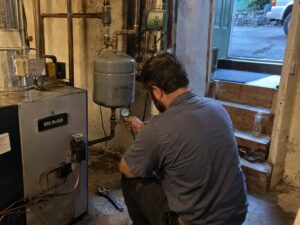
Boiler failures aren’t like furnace failures. A furnace either fires or it doesn’t, and most no-heat calls on forced-air equipment have a relatively short list of common diagnoses. Boilers add complexity: there’s a water system in addition to the combustion system, distribution pumps and zone controls in addition to blowers, expansion management in addition to airflow, and an entire category of failure modes (water leaks, circulation problems, pressure issues) that don’t exist on furnace equipment. A no-heat call on a boiler can trace to combustion, water flow, electrical control, or distribution — and identifying which one requires a different diagnostic approach than forced-air troubleshooting.
Most local HVAC contractors don’t do significant boiler work. Hydronic heating requires both gas piping expertise and water piping expertise, and most forced-air shops aren’t set up for the plumbing side. We are. Patrick learned boilers early in his career on Salt Lake’s older housing stock, our service trucks carry the parts that fix most common boiler failures (circulator pumps in major brand sizes, expansion tanks, zone valves, aquastats, gas valves, pressure relief valves, low-water cutoffs), and Travis Hollings holds the Utah journeyman plumber endorsement required for serious water and gas line work.
Below is how we approach boiler repair calls, what the common failure modes look like, what they typically cost to fix, and when repair stops making sense relative to replacement.
What Happens on a Boiler Repair Call
Every diagnostic visit follows the same baseline approach, regardless of what you described on the phone:
- System overview and history. Boiler age, last service date, recent changes or work performed by others, specific symptoms the customer has observed. Boilers age differently than furnaces — a 30-year-old cast iron boiler can be in better shape than a 10-year-old condensing boiler depending on water quality and maintenance history.
- Visual inspection. Boiler exterior condition, water leakage indicators (rust streaks, mineral deposits, active dripping), expansion tank condition, pressure gauge reading, water level (in steam boilers), zone valve and pump assembly condition, venting connections, gas line connections.
- Pressure and temperature readings. System pressure (should typically be 12–25 PSI cold on residential systems), supply water temperature, return water temperature, temperature differential across boiler, temperature differential across each zone.
- Combustion analysis (on gas-fired boilers). CO ppm in flue gas, O2 percentage, flue gas temperature, draft pressure at the inducer or atmospheric draft hood. Boiler combustion analysis follows the same principles as furnace combustion analysis but with different optimization targets for the boiler’s heat exchanger design.
- Electrical readings. 24V at thermostat connections, 120V at line connections, circulator pump amp draw, zone valve operation, aquastat function, low-water cutoff operation, control board status codes if equipped.
- Heat exchanger inspection through inspection ports — visible cracks, rust accumulation, water leakage from the boiler section, scale buildup on cast iron boilers.
- Distribution system check. Each zone’s supply and return temperatures verified, radiators or baseboards inspected for air binding (cold tops, hot bottoms typical), zone valve operation verified, circulator pump impeller rotation observed if possible.
- Walk you through findings. Written repair quote before any work is performed. You see what’s failed, why, and what the repair will involve.
Common Boiler Repair Calls We See
Failed Circulator Pump
The most common boiler component to fail. Circulator pumps move heated water through the distribution system to radiators or baseboards. Service life depends on water quality, run-time hours, and pump quality — typically 8–15 years on standard cast-iron-impeller pumps, sometimes longer on high-quality wet-rotor designs.
- Symptoms: Boiler fires and heats water, but radiators or baseboards stay cool. Some zones may be unaffected if multiple pumps are installed and only one has failed. Sometimes audible bearing noise from the pump assembly before complete failure.
- Diagnostic: Visual inspection of pump operation through the impeller sight glass (when equipped), amp draw against nameplate, voltage check at pump terminals, listening for cavitation or bearing noise.
- Typical repair cost: $400–$650 for standard circulator pump replacement. Premium ECM circulator pumps with variable-speed operation run $550–$900 installed.
Failed Expansion Tank
The expansion tank accommodates water expansion as the system heats up. As water heats, it expands; the tank compresses an internal air bladder to absorb the expansion without driving system pressure to dangerous levels. When the bladder fails or the air pre-charge is lost, the tank can’t perform its function.
- Symptoms: System pressure climbs as boiler heats, often exceeding the pressure relief valve’s 30 PSI setpoint. Pressure relief valve drips or discharges visibly. After cooling, system pressure may drop below proper operating range (12–15 PSI cold).
- Diagnostic: Pre-charge pressure check on the expansion tank’s air valve (should match the system’s static fill pressure), visual inspection for water in what should be an air-filled portion of the tank (failed bladder), test by pressing the air valve briefly — water coming out indicates failed bladder.
- Typical repair cost: $300–$500 for standard expansion tank replacement, including system drain-down, replacement tank, refill, and pressure test.
Failed Zone Valve
Zone valves control water flow to specific zones (typically corresponding to thermostats in different parts of the home). When a zone valve fails, that zone either gets no heat (valve stuck closed) or constant heat (valve stuck open) regardless of thermostat call.
- Symptoms: One zone of the home doesn’t heat while others do; or one zone heats continuously while others operate normally; sometimes audible buzzing from the valve actuator without successful valve operation.
- Diagnostic: Visual inspection of valve position indicator, voltage check at actuator during thermostat call, sometimes manual valve operation test (most actuator assemblies allow manual override).
- Typical repair cost: $250–$450 for zone valve actuator replacement (the most common failure point); $400–$700 for full zone valve assembly replacement if the valve body itself is damaged.
Failed Aquastat
The aquastat is the boiler’s temperature controller — it tells the boiler when to fire to maintain target water temperature, when to shut off, and when to trigger high-limit safety shutdown. Aquastat failures can produce inadequate heating (low setpoint), excessive cycling (failed differential), or safety shutdowns.
- Symptoms: Boiler doesn’t fire despite thermostat call (aquastat says water is already hot enough when it isn’t), boiler short-cycles repeatedly, or boiler trips on high-limit safety without reaching dangerous temperature.
- Diagnostic: Aquastat function test — verifying the aquastat senses actual water temperature accurately and responds to setpoint correctly. Sometimes resistance check on the temperature sensor element.
- Typical repair cost: $300–$600 for aquastat replacement. Combination aquastat/control modules on modern boilers can run higher.
Pressure Relief Valve Discharge
The pressure relief valve is a safety device set to discharge water if system pressure exceeds 30 PSI. Visible water discharge from the relief valve indicates either a system pressure problem (failed expansion tank, fill valve allowing too much water, thermal expansion exceeding tank capacity) or a failed relief valve itself.
- Symptoms: Water dripping or running from the pressure relief valve discharge pipe, sometimes accompanied by hissing sound, mineral deposits accumulating at the discharge location.
- Diagnostic: Verify root cause — most discharges are caused by other components failing rather than the relief valve itself. Check expansion tank pre-charge, fill valve operation, system pressure under operating conditions.
- Typical repair cost: $150–$300 for pressure relief valve replacement alone; full diagnostic and repair of underlying causes (failed expansion tank, leaking fill valve) typically $400–$900.
Low-Water Cutoff Issues
The low-water cutoff is a safety device that shuts the boiler down if water level drops below safe operating range. Most modern boilers include this protection. False shutdowns can occur from sensor failures, system leaks reducing water level, or scale buildup affecting probe sensors.
- Symptoms: Boiler shuts down with low-water indication despite normal pressure gauge reading; intermittent shutdowns that clear after waiting; manual reset required to restart.
- Diagnostic: Verify actual water level vs. sensor reading, check probe condition (scale buildup on sensor element), verify sensor circuit continuity.
- Typical repair cost: $300–$600 for cutoff sensor cleaning or replacement, depending on type and access.
Burner and Ignition Problems
Boiler burners and ignition systems experience similar failure modes to furnace burners — flame sensor problems, igniter failures, gas valve issues, pilot system failures on older equipment with standing pilots.
- Symptoms: Boiler doesn’t fire despite call for heat, fires briefly then shuts down, audible click of ignition attempt without flame, status code indication of ignition failure.
- Diagnostic: Same as furnace ignition diagnostics — flame sensor microamp reading, igniter resistance measurement, gas pressure verification, ignition sequence observation.
- Typical repair cost: Similar to furnace pricing — flame sensor cleaning $150–$250, igniter replacement $275–$450, gas valve replacement $500–$1,100.
Heat Exchanger Failure
Cracked cast iron sections, corroded steel tubing, or failed gaskets on cast iron boilers. Cracked stainless steel or aluminum heat exchangers on condensing boilers. Heat exchanger failures usually trigger boiler replacement rather than repair on equipment over 15 years old.
- Symptoms: Visible water leakage from the boiler section, system pressure dropping faster than evaporation can account for, water dripping from the boiler cabinet, sometimes combustion problems on cracked heat exchangers in modern boilers.
- Diagnostic: Visual inspection, pressure isolation test on suspect sections, sometimes dye injection to identify specific leak locations.
- Typical repair cost: Section replacement on cast iron boilers $1,200–$3,000 when feasible; full heat exchanger replacement on condensing boilers typically not economical — triggers full boiler replacement at $7,500–$15,000 (see boiler installation page).
Air-Bound System
Hydronic systems can accumulate air over time, particularly after fresh water additions to the system. Air pockets in the distribution piping prevent water flow, creating zones with no heat despite the boiler firing.
- Symptoms: Specific radiators or baseboards stay cold while others heat normally, sometimes gurgling or knocking sounds from the affected zone, radiators with cold top sections (classic air-binding symptom).
- Diagnostic: Visual confirmation of cold zones, pressure check, sometimes bleeding individual radiators to confirm air accumulation.
- Typical repair cost: $175–$350 for system bleeding and pressure verification. Often combined with check of fill valve operation and air separator condition.
When Repair Stops Making Sense
The math on boiler repair vs. replacement:
- Boiler under 12 years (modern condensing) or 15 years (cast iron): Repair almost always wins. Equipment has substantial useful life remaining; major components may still be under warranty.
- Boiler 12–20 years (condensing) or 15–30 years (cast iron): Repair-vs-replace depends on the repair cost and the boiler’s overall condition. Pump or zone valve replacement at 20 years on a healthy cast iron boiler favors repair; heat exchanger issues at 15 years on a condensing boiler often trigger replacement.
- Cast iron boiler over 30 years: Surprisingly often still worth repairing. Many 1950s-1960s Salt Lake cast iron boilers are still in good condition and respond well to component replacement (circulator pump, expansion tank, controls) even at 50+ years old.
- Heat exchanger crack or major water leak from boiler section: Almost always triggers replacement. Heat exchanger replacements are rarely cost-effective compared to full boiler replacement.
- Multiple failures in short period on an aging boiler: typically tips toward replacement even if individual repairs would be economical in isolation.
When we run the math, you see the numbers in writing — current repair cost, projected near-term repair costs, energy efficiency savings from a new system, and remaining equipment lifespan. You make the call.
Brands We Service
We service most major residential boiler brands:
- Weil-McLain — full lineup from older cast iron (CGa, EG, GV series) through current condensing (Evergreen, Ultra)
- Burnham/U.S. Boiler — Independence and Series 3 cast iron, Aspen and Alpine condensing
- Lochinvar — Knight, KBN, and FTX series condensing boilers
- Buderus — GB142 and SSB series condensing boilers
- Navien — NCB and NFC combi-boilers
- Older brands — Crane, American Standard residential, Smith, Slant/Fin, Peerless, and various older cast iron brands still common in older Salt Lake homes. Parts availability varies by age and model.
Same-Day and Emergency Response
During sub-freezing weather, no-heat boiler calls are treated as emergencies on par with furnace no-heat calls. Pipe-freeze risk in hydronic systems is particularly significant because the heated water in distribution piping can freeze and burst the system if heat is lost for extended periods — damage that often costs more to repair than a new boiler.
Our service trucks stock common boiler parts including circulator pumps in popular sizes (Taco 007, 0010, 0011; Grundfos UP series), zone valves and actuators (Honeywell, Taco, White-Rodgers), expansion tanks (Amtrol Extrol), aquastats (Honeywell L8148 family), pressure relief valves, and pressure gauges. Most common repairs complete on the first visit.
What We Don’t Do on Boiler Repair Calls
- We don’t condemn boilers that are still functional. Many older cast iron boilers have significant useful life remaining when properly maintained. We don’t recommend replacement of working equipment to drive sales.
- We don’t “patch” cracked heat exchangers. Same principle as furnace heat exchangers — cracks create safety and reliability issues that can’t be reliably repaired.
- We don’t recharge systems with persistent leaks without finding the leak. Same principle as refrigerant leaks — adding makeup water repeatedly to a leaking system wastes water, accelerates internal corrosion, and ultimately doesn’t fix the problem.
- We don’t bypass safety controls. Pressure relief valves, low-water cutoffs, and high-limit aquastats are there for a reason. We replace failed safety devices rather than disabling them.
Boiler Repair Costs in Salt Lake County
- Boiler diagnostic call: $99–$199 (diagnostic fee applied toward repair or replacement)
- Circulator pump replacement: $400–$650 (standard); $550–$900 (ECM variable-speed)
- Expansion tank replacement: $300–$500
- Zone valve actuator replacement: $250–$450
- Zone valve full assembly replacement: $400–$700
- Aquastat replacement: $300–$600
- Pressure relief valve replacement: $150–$300
- Low-water cutoff service or replacement: $300–$600
- System bleeding and air removal: $175–$350
- Burner/ignition repairs: $150–$1,100 depending on component (similar pricing to furnace work)
- Cast iron section replacement (when feasible): $1,200–$3,000
- Full boiler replacement (when repair isn’t economical): $7,500–$18,000 depending on equipment tier (see boiler installation page)
Frequently Asked Questions
- How much does boiler repair cost in Salt Lake County?
- Most common repairs run $175–$900. Specific common ranges: circulator pump $400–$650, expansion tank $300–$500, zone valve actuator $250–$450, aquastat $300–$600, system bleeding $175–$350. Heat exchanger issues are special-case and often trigger replacement consideration rather than repair.
- Why is my boiler not heating?
- Most common causes: failed circulator pump (boiler fires but water doesn’t move), failed zone valve (specific zones stay cold), thermostat or aquastat issue (boiler doesn’t get the call to fire), low water pressure (boiler shuts down on safety), ignition failure (boiler tries to fire but can’t sustain flame), or air-bound system. A diagnostic visit identifies the specific cause.
- Why is my pressure relief valve dripping?
- Most common causes: failed expansion tank (system pressure climbs above relief valve setpoint), waterlogged expansion tank with failed air pre-charge, fill valve allowing too much water into the system, or thermal expansion exceeding tank capacity. Less commonly: failed relief valve itself. Dripping relief valves should be diagnosed promptly — they indicate system pressure problems that can damage other components.
- How long do circulator pumps last?
- Standard cast-iron-impeller circulator pumps typically last 8–15 years. Premium wet-rotor circulators and high-quality ECM variable-speed pumps often last 15–25 years. Service life depends heavily on water quality, run-time hours, and proper installation. Salt Lake’s hard water can shorten pump life compared to softer-water markets.
- Is my boiler under warranty?
- Depends on age and original installation. Most manufacturers warrant boiler heat exchangers for 10–20 years (some lifetime) when properly registered within 60–90 days of installation. Standard component warranties (pumps, controls, gas valves) are typically 1–5 years. If you don’t know your boiler’s age or warranty status, we can identify the equipment from the nameplate and check warranty registration during the diagnostic visit.
- Why are some of my radiators cold while others are hot?
- Most common cause is air binding — air pockets in the distribution piping or radiators preventing water flow to the cold sections. Other possibilities: failed zone valve on the cold zone, partially blocked piping, undersized circulator pump for the system layout, or unbalanced flow at the distribution manifold. System bleeding ($175–$350) often resolves air-binding issues; other causes require specific diagnostics.
- Should I replace my old cast iron boiler?
- Not necessarily. Many 30–50-year-old cast iron boilers are still in good operating condition and provide reliable service with periodic component replacement (circulator pump, expansion tank, controls). The efficiency penalty compared to modern condensing equipment is real (typically 80% AFUE vs. 95%+ AFUE), but the replacement cost is significant. We model the math — repair cost vs. replacement cost vs. operating cost savings — so you can decide with real numbers.
Schedule Boiler Repair
If your boiler isn’t heating and you’re in Salt Lake County, call (385) 250-0687. During sub-freezing weather, we prioritize no-heat calls and treat hydronic system pipe-freeze risk as a safety emergency.
- Phone: (385) 250-0687
- Email: info@aegisheatingandair.xyz
- Address: 4454 Manhattan Ct, West Valley City, UT 84120