
Whole-Home Air Purifier Installation in Salt Lake County
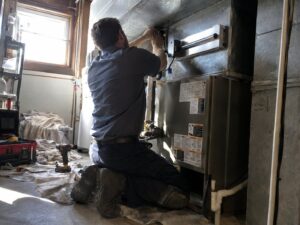
The air purifier market is a mess. Walk into a big-box store and you’ll find everything from $40 portable ionizers to $1,200 HEPA tower units to “bipolar ionization” systems marketed for COVID protection, with manufacturer claims that often have little to do with measured filtration performance. Most of what’s sold doesn’t actually clean air in any meaningful way — ionizers and ozone generators sometimes make indoor air quality worse — and most of what does work isn’t sold the way customers expect to buy it. The technology that actually reduces indoor particulate concentrations during a Salt Lake winter inversion is mature, boring, and proven: high-MERV media filtration integrated with your HVAC system. Not new. Not flashy. Just the technology that decades of independent testing has validated as effective.
Salt Lake winters give this technology more to do than in cleaner-air climates. The Utah Division of Air Quality regularly documents inversion-driven PM2.5 levels well above EPA healthy thresholds, sometimes for weeks at a time. Indoor air during these periods is contaminated by particulates that infiltrate through the building envelope — even in tight modern construction, some outdoor air gets in, and during inversions that air carries elevated pollutant loads. Without proper filtration, indoor PM2.5 levels during inversions can approach outdoor levels. With MERV-13 or higher whole-home filtration properly installed, indoor PM2.5 levels can drop 60–80% compared to outdoor levels, dramatically reducing exposure for the family members who spend the most time inside — particularly elderly residents, infants, children, people with asthma or respiratory conditions, and pregnant women.
Below is what actually works for whole-home air purification, what doesn’t (despite marketing claims), how to choose between filtration approaches, and what installation involves.
What Actually Works for Whole-Home Air Purification
MERV-13 Media Filtration
The single most cost-effective indoor air quality upgrade for most Salt Lake Valley homes. A media filter cabinet replaces the standard 1″ filter slot on your HVAC system with a 4–5″ deep cabinet that holds a high-capacity pleated filter rated MERV-13 (or higher in some configurations). The deeper filter media has substantially more surface area than a standard 1″ filter, allowing it to maintain proper airflow while capturing much finer particulates.
- What it captures: PM2.5 particles (the fine particulate that drives inversion air quality alerts), pollen, dust mite particles, pet dander, mold spores, bacteria-sized particles, smoke particles, and combustion byproducts
- What it doesn’t capture: Gases and odors (VOCs, ozone, formaldehyde), nanoparticles smaller than its rated size, and viruses (most viruses are smaller than MERV-13’s effective filtration range, though they often travel attached to larger droplets that the filter can capture)
- Performance: Properly installed MERV-13 filtration in a tightly-sealed cabinet typically reduces indoor PM2.5 by 60–80% compared to outdoor levels during inversion conditions
- Cost: $450–$900 for media cabinet installation plus initial filter; replacement filters $40–$80 typically every 6–12 months
- Lifetime cost: Among the lowest of any IAQ upgrade per dollar of measurable improvement
HEPA Bypass Filtration
For households requiring higher-grade filtration than MERV-13 provides — typically those with severe allergies, asthma, immunocompromised members, or specific sensitivity to fine particulates — HEPA bypass filtration adds a dedicated HEPA filtration loop alongside the main HVAC system. HEPA filters capture 99.97% of particles at 0.3 microns, including most viruses, most bacteria, and the finest particulates.
HEPA filters can’t be installed directly in the main HVAC airflow because the pressure drop across HEPA media is too severe for standard residential equipment — the system would struggle to maintain airflow against the filter resistance. Bypass installations route a portion of the air through the HEPA filter parallel to the main system, gradually cleaning the entire home’s air over time.
- What it captures: Everything MERV-13 captures plus most viruses, most bacteria, and the finest particulates down to 0.3 microns
- What it doesn’t capture: Gases and odors (same limitation as MERV media filtration)
- Performance: Significantly better than MERV-13 for particulate removal, particularly for fine particles and biological aerosols
- Cost: $1,500–$3,500 for typical HEPA bypass installation; replacement filters $150–$400 every 12–24 months
- Best for: Households with severe respiratory conditions, immunocompromised members, or specific medical guidance to maximize particulate filtration
Activated Carbon Filtration
For homes with gas/odor concerns (VOCs from cleaning products or building materials, cooking odors, pet odors, smoke odors after wildfire events), activated carbon filtration removes gaseous pollutants that media and HEPA filters can’t capture. Activated carbon adsorbs gas molecules onto its high-surface-area structure, effectively trapping them.
- What it captures: VOCs, odors, smoke gases, some chemical contaminants
- What it doesn’t capture: Particulates (no replacement for media or HEPA filtration)
- Performance: Effective for gases and odors but limited capacity per filter — carbon saturates and stops working when its adsorption sites are full
- Cost: $400–$1,200 for carbon filter installations; replacement filters every 3–6 months depending on contamination load
- Best for: Specific gas/odor problems, post-wildfire smoke remediation, homes with VOC sensitivity
What Doesn’t Work (Despite Marketing Claims)
Several technologies sold as “air purifiers” don’t actually clean air in ways that produce measurable benefit:
Ionizers and “Ionizing Air Purifiers”
Ionizers charge particles in the air stream, theoretically causing them to clump together and either fall out of the air or stick to nearby surfaces. The theory has limitations:
- Particles don’t actually disappear — they redistribute to walls, furniture, and floors, where they can be re-suspended by normal activity
- Many ionizers produce ozone as a byproduct, which is itself a respiratory irritant regulated as an air pollutant outdoors
- Independent testing consistently fails to demonstrate measurable indoor air quality improvement from ionization compared to baseline conditions
- Some studies have shown ionization can actually increase certain harmful particles by chemical reactions with VOCs in the air
We don’t install ionizers as standalone air purification because there’s no credible evidence they produce meaningful benefit, and some evidence they cause harm. We also don’t install hybrid HVAC products that bundle ionization with other technologies — the ionization component doesn’t help and sometimes hurts.
Ozone Generators
Sometimes marketed as “shock treatment” or “ozone purification,” ozone generators produce ozone gas, which is reactive enough to break down certain pollutants and kill some microorganisms. The problem: ozone is itself a respiratory irritant. The EPA explicitly warns against using ozone generators in occupied spaces. We don’t install ozone generators under any circumstances, and we recommend against any contractor proposing them for residential indoor air quality.
“Bipolar Ionization” or “Needlepoint Ionization”
Aggressively marketed during the COVID pandemic with claims of virus inactivation. Independent testing has produced mixed and often disappointing results — some bipolar ionization products work modestly under specific laboratory conditions but show negligible benefit in real-world residential applications. The technology also produces ozone and reactive byproducts that may have negative health implications. Like standard ionization, we don’t install bipolar ionization as an IAQ solution.
UV Light Sold as “Air Purification”
UV-C light does inactivate microorganisms when properly applied — but for HVAC applications, the appropriate use is treating surfaces (evaporator coils and condensate pans) where biological growth accumulates, not treating moving air streams where UV dwell time is too short to be effective. UV-C marketed as “kills 99% of viruses in your air” significantly overstates real-world performance. We do install UV-C systems for surface treatment of HVAC components (see UV light treatment), but we don’t install them as “air purifiers” because that’s not what they’re effective at.
Portable HEPA Units
Sometimes the right answer for specific situations isn’t whole-home installation. Portable HEPA air purifiers in individual rooms (typically bedrooms) can produce concentrated filtration for the rooms where they operate — sometimes achieving lower PM2.5 levels than whole-home filtration alone for the specific rooms occupants spend the most time in.
Good portable HEPA units (typically $300–$800 retail) have third-party-verified CADR (Clean Air Delivery Rate) ratings that confirm their actual particulate removal capacity. Brands like IQAir, Coway, Levoit (higher-end models), and Austin Air produce units with measured performance backed by independent testing. We don’t sell portable units (we’re an HVAC company, not a retailer), but we frequently recommend specific portable units as supplements to whole-home filtration for customers with severe respiratory concerns who want maximum filtration in bedrooms.
How to Choose the Right Approach
For Most Salt Lake Valley Homes
MERV-13 media filter cabinet replacement of the standard 1″ filter slot. Delivers measurable PM2.5 reduction during inversion season, captures household particulates year-round, has low ongoing cost, and works seamlessly with existing HVAC equipment. This is what we recommend for the vast majority of customers asking about indoor air quality improvements.
For Households with Significant Respiratory Conditions
MERV-13 media filtration plus HEPA bypass filtration plus portable HEPA in bedrooms. The combination produces the best particulate removal for sensitive individuals. Cost is higher but the math favors this approach for households where indoor air quality genuinely affects health outcomes.
For Homes with Specific Gas/Odor Problems
MERV-13 media filtration plus activated carbon filtration. The combination handles both particulates and gases. Common scenarios: post-wildfire smoke remediation, homes with significant VOC sensitivity, homes near industrial sources.
For Tightly Sealed Modern Homes
Higher-MERV filtration combined with mechanical ventilation (ERV/HRV systems). Tight construction reduces natural air exchange, which means whatever contaminants enter the home stay longer. Mechanical ventilation provides controlled fresh air exchange while filtration manages indoor air quality during recirculation.
Installation Considerations
Static Pressure Compatibility
Higher-MERV filtration creates more airflow resistance than standard filters. Before installing high-MERV filtration, we verify your HVAC system can handle the additional static pressure without compromising performance. We measure existing static pressure across the air handler, calculate the additional pressure the new filtration will add, and confirm total system pressure stays within manufacturer specifications.
Systems that can’t safely handle MERV-13 with current filter slot dimensions can usually accommodate it with media cabinet replacement (the 4–5″ deep media handles MERV-13 with less pressure drop than a 1″ MERV-13 filter would create). Very few residential systems can’t accommodate proper MERV-13 filtration in some configuration.
Filter Cabinet Selection
The right filter cabinet depends on existing filter slot dimensions, available space for cabinet installation, and the specific filter sizes available locally. Common cabinet sizes:
- 16x25x4-5″ (most common residential size) — fits standard 16×25 filter racks with cabinet replacement
- 20x25x4-5″ — fits standard 20×25 filter racks
- 20x20x4-5″ — less common but available
- Custom dimensions — for non-standard installations or very large systems
Aprilaire 213, Aprilaire 413, Honeywell F100, Honeywell F200, and various manufacturer-specific cabinets are common options. We size cabinets to existing filter slot dimensions and recommend specific equipment based on filter availability and customer preference.
Sealing and Bypass Prevention
A high-MERV filter only works if all the air actually passes through the filter media. Cabinet installations that don’t seal properly — gaps around the filter, poor cabinet-to-duct connections, leaking filter slots — allow air to bypass the filter, dramatically reducing real-world filtration performance. Proper installation includes mastic-sealed connections at every interface, gasketed filter mounting, and verification that filter slot dimensions match the filter properly.
Air Purifier Installation Costs in Salt Lake County
- MERV-13 media filter cabinet (Aprilaire 213/413, Honeywell F100/F200, or equivalent): $450–$900 installed including initial filter
- HEPA bypass filtration (separate HEPA loop installation): $1,500–$3,500 installed depending on equipment selection and complexity
- Activated carbon filtration (typically added to existing media cabinet): $400–$1,200 installed
- Combined MERV-13 + carbon filtration: $700–$1,500 installed
- Replacement filters: MERV-13 media filter $40–$80 every 6–12 months; HEPA bypass filter $150–$400 every 12–24 months; carbon filter $50–$200 every 3–6 months
- Service plan filter replacement: included in maintenance plans for some configurations
Replacement Filter Brands and Availability
For media cabinet installations, we recommend customers buy replacement filters in bulk to ensure consistent supply. Common reliable brands:
- Aprilaire filters for Aprilaire cabinets (most reliable supply chain, available through HVAC distributors and online)
- Honeywell filters for Honeywell cabinets
- FilterBuy and Nordic Pure — high-quality third-party manufacturers with online sales
- Generic-brand filters from local home improvement stores — variable quality, sometimes acceptable for less-demanding applications
For customers in our maintenance plan, we can stock replacement filters at our shop and replace them during scheduled service visits — eliminating the need for customers to remember filter schedules or store filters.
Frequently Asked Questions
- How much does whole-home air purifier installation cost?
- MERV-13 media filter cabinet $450–$900 (the most cost-effective option for most homes); HEPA bypass filtration $1,500–$3,500 (for severe respiratory concerns); activated carbon filtration $400–$1,200 (for gas/odor concerns); combined systems $700–$1,500 typical. Final cost depends on existing equipment and installation complexity.
- What MERV rating should I use?
- For most homes, MERV-13 in a proper 4–5″ media filter cabinet is the sweet spot — meaningful PM2.5 reduction during inversion season without compromising HVAC airflow. MERV-16 or HEPA bypass for households with severe respiratory conditions. MERV-8 or below is generally adequate only for protecting HVAC equipment, not for meaningful indoor air quality improvement. Higher isn’t always better — going beyond MERV-13 without proper system design can reduce airflow and harm equipment.
- Will an air purifier help during Salt Lake inversions?
- Yes, significantly, if it’s the right type. MERV-13 media filtration can reduce indoor PM2.5 levels 60–80% compared to outdoor levels during inversion conditions. HEPA bypass adds further reduction. Ionizers and ozone generators don’t help and may make indoor air quality worse. Whole-home filtration treats the entire home; portable HEPA units provide additional concentrated filtration for specific rooms.
- Are ionizers and bipolar ionization safe?
- The safety profile is concerning. Ionization produces ozone and other reactive byproducts that can themselves be respiratory irritants. The EPA explicitly warns against ozone generators in occupied spaces. Independent testing of bipolar ionization products shows mixed results on efficacy and some evidence of harmful byproduct production. We don’t install ionization technologies because we don’t believe they help and we have evidence they may harm.
- How often do I need to replace filters?
- MERV-13 media filters in 4–5″ cabinets typically last 6–12 months — much longer than standard 1″ MERV-8 filters which need monthly replacement. HEPA bypass filters last 12–24 months. Activated carbon filters last 3–6 months depending on contamination load. We provide reminder schedules at installation and stock replacement filters for maintenance plan customers.
- Will high-MERV filters damage my HVAC system?
- Not if properly installed. The concern with high-MERV filtration is static pressure — restrictive filters can reduce airflow and cause equipment to work harder than designed. Proper installation uses media cabinets that minimize pressure drop while delivering MERV-13 filtration. We measure existing static pressure before installation and verify the system can safely handle the new filter without compromising performance.
- Should I also use a portable HEPA filter in my bedroom?
- For most customers with whole-home MERV-13 filtration, portable HEPA in bedrooms isn’t necessary. For customers with severe respiratory conditions (asthma, severe allergies, COPD) or immunocompromised members, adding portable HEPA in the bedrooms produces additional concentrated filtration during sleep hours and is worth the modest cost. We recommend specific portable units (IQAir, Coway, Levoit higher-end models) when this approach makes sense for a customer’s situation.
Schedule Air Purifier Installation
If you’re concerned about indoor air quality — particularly during Salt Lake’s winter inversion season — call (385) 250-0687 for a free in-home assessment. We measure your existing filter slot, check static pressure, discuss your specific concerns and household sensitivities, and recommend the right filtration approach for your situation. We don’t push expensive equipment when basic upgrades would solve the problem.
- Phone: (385) 250-0687
- Email: info@aegisheatingandair.xyz
- Address: 4454 Manhattan Ct, West Valley City, UT 84120