
Duct Cleaning in Salt Lake County
Duct cleaning is one of the most over-marketed services in HVAC. National chains run discount specials at $79 for whole-house cleaning, send out a vacuum truck and a brush attachment, spend an hour swirling debris around the ductwork, and leave with a check. The customer feels like they got something done. The ducts look slightly cleaner where the technician could see. Studies on whether the service produces measurable indoor air quality improvement, however, consistently fail to demonstrate clear benefit for most homes.
That said, duct cleaning isn’t fake. Done correctly, with the right equipment, for specific situations where it matters, it produces real and measurable results. The question is whether your home falls into one of those situations. Most homes don’t need duct cleaning as routine maintenance. Some homes need it badly. Below is how to tell the difference, what real duct cleaning involves, what equipment we use and why, and what to expect from professional service.
When Duct Cleaning Actually Helps
Specific situations where duct cleaning produces measurable benefit:
After Major Construction or Renovation
Drywall dust, sawdust, and construction debris from remodeling work, additions, or basement finishing can heavily contaminate the duct system if the HVAC was running during construction or if the work involved opening up duct returns or supplies. Construction dust contains particulates that can take months to clear from the system through normal filter operation alone. Professional cleaning after construction work measurably accelerates the cleanup.
After Rodent or Insect Activity
If mice, rats, squirrels, or wasps have taken up residence in your ductwork (or in nearby attic or wall spaces where they could enter the duct system), the contamination requires removal — droppings, nesting material, and biological residue from rodent activity. Some of this is genuinely a health concern (hantavirus risk from rodent droppings, for example). Duct cleaning combined with rodent exclusion and remediation addresses the problem.
After Pet Hair and Dander Accumulation
Homes with multiple pets, particularly long-haired pets, can develop significant accumulation of pet hair and dander in the duct system over years. While the system filter catches most of this, some makes its way past the filter and accumulates in supply ducts, return ducts, and the air handler interior. Customers with severe pet allergies sometimes benefit from periodic deep cleaning beyond what normal filter replacement addresses.
After Mold or Biological Contamination
If mold has grown in the duct system (typically from water leaks, condensate problems, or chronic high humidity), professional cleaning combined with mold remediation may be appropriate. Mold contamination in ducts is genuine indoor air quality issue requiring professional response — not generic duct cleaning, but properly scoped mold remediation that includes the duct system.
In Older Systems Never Previously Cleaned
Systems that have been operating for 15–20+ years without ever having ductwork cleaned often accumulate significant debris — dust, lint, building dust from initial construction, fragments of insulation, sometimes drywall mud or other construction artifacts. A one-time deep cleaning on a long-neglected system can produce visible debris removal and modest IAQ improvement.
For Severe Respiratory Sensitivities
Households with severe asthma, severe allergies, or compromised immune systems sometimes benefit from periodic duct cleaning even without specific triggering events. The benefit varies — for some patients, duct cleaning produces noticeable symptom improvement; for others, no measurable difference. We don’t promise results we can’t measure, but for households with severe respiratory conditions, the cost-benefit math sometimes favors cleaning even when expected benefit is modest.
When Duct Cleaning Doesn’t Help
Equally important — when it isn’t worth the money:
- Routine “annual” or “biannual” maintenance. Most homes don’t accumulate enough debris in ductwork between cleanings to justify recurring service. ASHRAE and EPA guidance both recommend duct cleaning based on specific triggers (the situations above) rather than fixed schedules.
- To address general indoor air quality concerns. If you’re worried about indoor air quality in general — particulates, allergens, inversion-season pollution — proper filtration upgrades (MERV-13 media filters) deliver more measurable benefit than duct cleaning at lower cost. We’d rather install you a $700 MERV-13 media cabinet than perform a $700 duct cleaning that won’t produce the same IAQ improvement.
- To address smells you can’t otherwise locate. Sometimes customers request duct cleaning because they smell something musty or unpleasant. Often the actual source is elsewhere — a backed-up condensate drain producing biological growth in the air handler cabinet, a dead rodent in a wall cavity, or a problem in a specific room that’s getting distributed through the supply system. Duct cleaning rarely addresses these issues; finding and eliminating the source does.
- To improve HVAC efficiency. Marketing materials sometimes claim duct cleaning improves heating and cooling efficiency by 20% or more. Real studies show negligible efficiency impact from cleaning typical residential ductwork. Substantial efficiency improvements come from filter replacement (much cheaper) or system upgrades — not from duct cleaning.
What Real Duct Cleaning Looks Like
Done correctly, duct cleaning involves significant equipment and time investment. The process:
1. System Assessment
Before cleaning, we inspect the duct system to understand its layout, accessibility, and condition. Older systems with degraded insulation or compromised duct material may not be suitable for aggressive cleaning — the cleaning process itself can damage compromised ductwork. Newer systems in good condition can handle full cleaning without issue.
2. Sealing and Containment
All supply registers and return grilles are sealed except the one connected to the negative-pressure equipment. The system is sealed shut so that all airflow during cleaning passes through the truck-mounted vacuum equipment, capturing dislodged debris rather than letting it blow into the home.
3. Negative-Pressure Source Connection
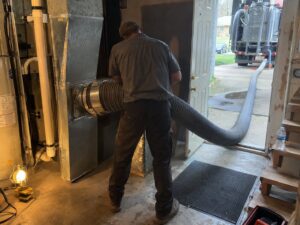
A high-volume vacuum is connected to the main trunk line (typically at the air handler). This creates negative pressure throughout the entire duct system, drawing all dislodged debris toward the vacuum’s collection system rather than allowing it to settle into supply registers or recirculate.
4. Mechanical Agitation
With negative pressure established, mechanical agitation tools (rotating brushes, compressed air whips, or air-driven agitators) are introduced into individual duct branches. The agitation dislodges accumulated dust and debris from the duct walls; the negative pressure pulls the dislodged debris toward the collection vacuum.
This is the step that low-cost duct cleaning operations often skip entirely. Without mechanical agitation, only loose surface debris gets vacuumed out — embedded dust and accumulated debris remains stuck to duct walls.
5. Component Cleaning
Beyond the ducts themselves, the air handler interior is accessed and cleaned — blower wheel (often the dirtiest single component in the system), evaporator coil exterior surfaces, condensate pan, and air handler cabinet. The blower wheel in particular accumulates significant debris over years and is responsible for a substantial portion of the dust that’s distributed throughout the home.
6. Return Air Cleaning
Return ducts (which often accumulate more debris than supply ducts because they carry household air with all its particulates back to the system) are cleaned through the same negative-pressure plus mechanical agitation process applied to supplies.
7. Air Handler Reassembly and Testing
Air handler is reassembled, system is unsealed, and operation is verified. Some customers request before-and-after photos of the cleaned components — we provide those on request.
What We Don’t Do
- “Chemical fogging” or “sanitizing sprays” inside ductwork after cleaning. These services are sometimes upsold as part of duct cleaning packages but have limited evidence supporting their efficacy and can introduce chemical residues into the air stream. EPA guidance doesn’t recommend routine chemical treatment of duct systems.
- “Whole-house disinfection” services. We’re an HVAC company, not a remediation contractor. If your situation requires mold remediation, biological contamination cleanup, or specialty remediation work, we’ll refer you to qualified specialists.
- $79 or $99 specials. Proper duct cleaning takes 4–6 hours and significant equipment. Operations advertising whole-house cleaning at $79 either aren’t performing the actual service required to produce results or are using the low price as a bait-and-switch for upsells. We charge what proper cleaning costs.
Duct Cleaning Costs in Salt Lake County
- Whole-home duct cleaning (single-system residential): $450–$850 depending on home size, system complexity, and condition
- Whole-home duct cleaning with air handler component cleaning (recommended for thorough service): $550–$1,000
- Additional system cleaning (for homes with multiple HVAC systems): typically $300–$500 per additional system
- Dryer vent cleaning (often paired with duct cleaning): $125–$225 additional
- Post-construction deep cleaning (more involved due to drywall dust and debris): $700–$1,400 depending on extent
- Mold-related cleaning requiring remediation coordination: priced case-by-case after assessment
Service typically takes 4–6 hours on-site for a standard residential cleaning. Most jobs complete in a single day.
What to Expect
Before service:
- You don’t need to do anything special — we move furniture as needed to access registers and returns
- Pets should be kept in a separate room during service for their comfort (vacuum equipment is noisy)
- Plan for the HVAC system to be off during the cleaning (typically 4–6 hours)
During service:
- Vacuum truck parked near the home (typically in the driveway or at the curb) with a flexible hose run to the air handler connection point
- Equipment is loud (similar to a leaf blower or shop vacuum running continuously)
- Technicians work systematically through the home, cleaning supply branches first, then returns, then air handler components
- Drop cloths protect floors where equipment travels
After service:
- Air handler is reassembled and tested
- New air filter installed (standard pleated, or higher-MERV if you’ve discussed it during the service)
- Before-and-after photos of cleaned components provided on request
- Recommendations for any follow-up service or upgrades (filter cabinet replacement, IAQ equipment, etc.)
Frequently Asked Questions
- How often should I have my ducts cleaned?
- For most homes, the answer is “when there’s a specific trigger” rather than on a fixed schedule. Triggers include: after major construction or renovation, after rodent or insect activity, after mold contamination, in older systems never previously cleaned, or for households with severe respiratory sensitivities. Without one of these triggers, duct cleaning every few years isn’t necessary or particularly beneficial.
- How much does professional duct cleaning cost?
- $450–$850 for standard whole-home cleaning; $550–$1,000 with air handler component cleaning included. Post-construction deep cleaning runs $700–$1,400 due to additional debris. Beware of $79–$99 specials — proper duct cleaning takes 4–6 hours and equipment that the cheap services don’t use.
- Will duct cleaning help with my allergies?
- Sometimes, sometimes not. For severe allergy sufferers, duct cleaning can provide some symptom relief — particularly if there’s significant pet dander, dust mite, or biological contamination in the system. For most allergy sufferers, however, MERV-13 media filtration upgrades produce more measurable benefit than duct cleaning. We’d often recommend filtration improvements over duct cleaning for allergy concerns unless there’s a specific contamination issue to address.
- Can duct cleaning damage my ductwork?
- Generally no, when performed correctly on systems in good condition. Compromised ductwork (degraded insulation lining, deteriorated flex duct, corroded sheet metal) can be damaged by aggressive cleaning. We assess duct condition before cleaning and recommend repair or replacement of compromised sections rather than risking damage during cleaning.
- What’s the difference between $79 specials and professional duct cleaning?
- The $79 specials typically involve a single vacuum hose and a brush attachment, 30–60 minutes of work, and minimal mechanical agitation. They produce mostly cosmetic results — visible registers look cleaner, but embedded debris in ductwork remains. Professional cleaning involves truck-mounted negative-pressure vacuums, mechanical agitation tools, 4–6 hours of work, and cleaning of air handler components in addition to ducts. The difference in actual results is substantial.
- How long does duct cleaning take?
- 4–6 hours for a typical residential system. Larger homes, multiple HVAC systems, or systems requiring extensive air handler component cleaning can take longer. We don’t rush — the value of duct cleaning is in the thorough mechanical agitation and component cleaning, which takes time to do correctly.
- Should I get my ducts cleaned before installing a new HVAC system?
- Sometimes yes. If the existing ducts are heavily contaminated, cleaning before new equipment installation prevents the new system from immediately picking up and recirculating accumulated debris. However, much of the debris in residential ductwork concentrates in the air handler interior (blower wheel, evaporator coil cabinet, condensate pan) — and these components will be replaced or extensively cleaned during new system installation regardless. We assess case-by-case and recommend duct cleaning during new system installation when there’s evidence it would produce benefit.
Schedule Duct Cleaning
If your home has experienced one of the specific situations where duct cleaning produces measurable benefit — major construction, rodent activity, mold contamination, severe respiratory sensitivities, or 15+ years without cleaning — call (385) 250-0687. We’ll assess your specific situation and provide an honest recommendation about whether cleaning would help.
- Phone: (385) 250-0687
- Email: info@aegisheatingandair.xyz
- Address: 4454 Manhattan Ct, West Valley City, UT 84120