
Furnace repair in Salt Lake City at a glance: Aegis Heating and Air, Utah DOPL S350 License 7482916-5501, has served Salt Lake City since 2017 from our shop at 4454 Manhattan Ct, West Valley City. Diagnostic visit $79–$129; most repairs $150–$900+, priced in writing before work starts. Emergency line answered live 24/7; arrival in Salt Lake City is typically under 60 minutes. Repairs carry a 12-month labor warranty. Own W-2 technicians, never subcontractors.
- Diagnostic $79–$129; most repairs $150–$900+. Emergency calls $149–$249.
- 12-month repair labor warranty (warranty)
- Arrival: typically under 60 minutes from our West Valley City shop (how arrival times work); emergency line answered live 24/7
- Utah DOPL S350 License 7482916-5501 · insured and bonded · NATE-certified and EPA 608 Universal technicians
(385) 250-0687 · All HVAC services in Salt Lake City · Pricing
Furnace repair in Salt Lake City means working across the full spectrum of residential heating equipment. The city’s housing stock includes hot-water boiler systems serving historic Avenues and Capitol Hill homes that have heated through cast-iron radiators for over a century, steam systems still operating in some original installations, atmospheric-vent furnaces in mid-century construction, modern condensing furnaces in newer construction and renovations, mini-split heat pump systems providing supplemental or primary heating in historic homes, and combinations of these systems in homes that have evolved over decades. Each equipment type requires different diagnostic approaches, different repair expertise, and different conversations about repair-vs-replace economics when older equipment reaches end of service life.
Our work in Salt Lake City reflects this equipment diversity. Service trucks carry inventory appropriate to the equipment landscape we encounter — furnace repair parts across multiple manufacturer generations, boiler components including circulator pumps and zone valves, mini-split heat pump diagnostic tools. Combustion analysis happens on every gas equipment service visit with altitude-corrected settings for Salt Lake’s 4,200–5,000 foot elevation range. CO testing verifies safe operation. Heat exchanger inspections receive documented attention rather than visual-only condemnations. We have experience on the older boiler systems that newer contractors sometimes won’t touch, and on the historic-home configurations that don’t fit standard residential HVAC patterns.
Below is what proper furnace repair involves, common failure modes we encounter in Salt Lake City, and what to expect from our service.
What Furnace Repair Actually Involves
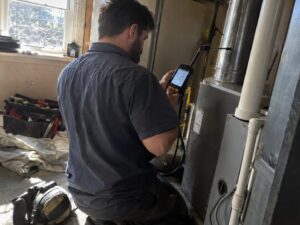
The Diagnostic Approach
Systematic measurement:
- Combustion analysis — CO ppm air-free (target <100, ideally <50), O2 percentage (6–9%), flue gas temperature, combustion efficiency, draft pressure
- Gas pressure verification — altitude-corrected settings
- Temperature rise across heat exchanger — target 35–65°F
- Flame sensor microamp reading — normal 0.5–10 µA
- Hot surface igniter resistance — typical 40–80 ohms
- Motor amp draws — inducer and blower
- Static pressure across air handler
- Safety control verification
For Boiler Systems
Diagnostic approach for hydronic systems in historic Salt Lake City homes:
- System pressure verification — target 12–15 PSI cold, relief at 30 PSI
- Supply and return water temperatures
- Combustion analysis on gas-fired boilers
- Circulator pump operation
- Zone valve operation
- Expansion tank charge
- Aquastat operation
- Bleed and venting — air management in hydronic loop
Most Common Furnace Repairs
- Flame sensor failure or fouling — most common. Repair: $150–$250.
- Hot surface igniter failure — second most common. Repair: $275–$450.
- Inducer motor failure — Repair: $400–$800.
- Pressure switch issues — Repair: $200–$400.
- Gas valve failure — Repair: $500–$1,100.
- Blower motor failure — Repair: $500–$1,200.
- Control board failures — Repair: $400–$900.
- Heat exchanger cracks — most serious. Requires documented diagnosis.
Most Common Boiler Repairs
- Circulator pump failure — Repair: $400–$650 standard, $550–$900 ECM
- Zone valve failure — actuator $250–$450
- Expansion tank failure — Repair: $300–$500
- Aquastat failure — Repair: $300–$600
- Pressure relief valve — Repair: $150–$300
- System bleeding — Repair: $175–$350
- Cast iron section replacement — Repair: $1,200–$3,000 per section
Salt Lake City-Specific Considerations
Boiler Service for Historic Homes
Substantial portions of Salt Lake City’s historic housing stock operate boiler systems with cast-iron radiators or (rarely) steam radiators. These systems range from original 1900–1920s installations to mid-century replacements to modern modulating condensing boiler conversions. Common service:
- Cast iron sectional boiler replacement — older atmospheric-vent boilers reaching end of service life
- Modern modulating condensing boiler conversions — replacing aging atmospheric equipment with current high-efficiency boilers
- Circulator pump replacement — original gravity-flow systems sometimes had pumps added later
- Zone valve installation — converting single-zone systems to zoned operation
- System flush and bleed — accumulated sediment and air management
- Radiator service — bleeding, replacement of failed radiators
We provide boiler service that newer-construction-focused contractors sometimes won’t handle. See our boiler repair page and boiler installation page.
Atmospheric-Vent Furnace Equipment
Mid-century Salt Lake City homes (1950s–1970s neighborhoods) often have atmospheric-vent furnaces with the same considerations as similar equipment elsewhere in the valley — heat exchanger condition on aging equipment, combustion air starvation in tightly weather-sealed homes, chimney venting deterioration on original masonry chimneys.
Modern Equipment in Newer Construction
Newer Salt Lake City construction (1980s onward) has modern equipment patterns including condensing furnaces, ECM blowers, modulating gas valves, and smart thermostat integration. Standard modern equipment diagnostics apply.
Mini-Split Heat Pump Heating
Some Salt Lake City historic homes use mini-split heat pumps for both cooling and supplemental heating. Mini-split heating diagnostics involve different procedures than central furnace service — inverter compressor operation, defrost cycle behavior, electric heat strip operation where applicable.
Neighborhood-Specific Response Times
Salt Lake City covers a large geographic area:
- Westside neighborhoods: 1.5–2.5 hours typical
- Central neighborhoods: 2–3 hours typical
- Avenues and Capitol Hill: 2–3 hours typical
- East Bench: 2–3 hours typical
- Upper Foothill: 2–4 hours depending on conditions
The Heat Exchanger Question
Heat exchanger condemnations are frequently used as upsell triggers when the actual exchanger is sound. Our approach: legitimate condemnations require documented evidence through visual inspection (with borescope), isolation pressure testing, and combustion analysis showing CO migration patterns consistent with heat exchanger failure. We don’t condemn working heat exchangers.
CO Safety in Historic Homes
Salt Lake City’s historic housing stock and older atmospheric-vent equipment make CO testing particularly relevant. Every furnace repair visit includes CO measurement at multiple points.
Furnace Repair Pricing in Salt Lake City
- Diagnostic visit: $99–$199 applied toward repair
- Flame sensor service or replacement: $150–$250
- Hot surface igniter replacement: $275–$450
- Inducer motor replacement: $400–$800
- Pressure switch replacement: $200–$400
- Gas valve replacement: $500–$1,100
- Blower motor replacement: $500–$1,200
- Control board replacement: $400–$900
- Heat exchanger inspection (standalone): $175–$275
- Heat exchanger isolation pressure test: $250–$400
- Heat exchanger replacement (warranty): $800–$1,800 labor
- Heat exchanger replacement (out of warranty): $1,400–$2,500
- Boiler circulator pump: $400–$650 standard, $550–$900 ECM
- Boiler zone valve actuator: $250–$450
- Boiler expansion tank: $300–$500
- Boiler aquastat: $300–$600
- Hydronic system bleeding: $175–$350
- CO testing (standalone): $175–$325
Frequently Asked Questions
How much does furnace repair cost in Salt Lake City? Varies by equipment type and failure mode. Flame sensor $150–$250 (most common furnace); HSI $275–$450; inducer motor $400–$800; gas valve $500–$1,100. Boiler repairs $175–$900 typical range for components. Diagnostic visit $79–$129 applied toward repair.
How fast can you respond to a Salt Lake City furnace emergency? Same-day response for emergencies during winter. Our emergency line is answered live 24/7. Inside West Valley City limits, Monday–Saturday 8 AM–5 PM, a technician arrives within 45 minutes of the call being answered; elsewhere in our service area, typically under 60 minutes. Our emergency line is answered live 24/7. Inside West Valley City limits, Monday–Saturday 8 AM–5 PM, a technician arrives within 45 minutes of the call being answered; elsewhere in our service area, typically under 60 minutes.
Do you work on boilers in old Avenues and Capitol Hill homes? Yes. Historic Salt Lake City homes with hot-water radiator heating systems are an area where we have substantial experience. We provide boiler service, component replacement (circulator pumps, zone valves, aquastats, expansion tanks), system flush and bleed, and full boiler replacement when existing equipment reaches end of service life.
My historic home has steam radiators. Can you service those? Yes, but steam systems are increasingly rare and full steam-to-hot-water conversions are often the right long-term answer when the existing steam boiler reaches end of service life. We can service operational steam systems and discuss conversion options when replacement is being considered.
Another contractor told me my heat exchanger is cracked. Should I get a second opinion? Yes. Heat exchanger condemnations are frequently used as upsell triggers when the actual exchanger is sound. We provide documented inspection — visual examination with borescope, isolation pressure testing, and combustion analysis. Independent verification is worth the diagnostic visit fee when major furnace replacement is on the table.
Should I repair my old furnace or replace it? General guidance: if repair costs more than 50% of replacement cost, replacement is usually the better economic decision. Equipment 18+ years old with major component failures typically favors replacement. Decision also depends on equipment type — older atmospheric-vent equipment typically favors replacement; well-maintained modern equipment can sometimes justify major repair.
Do you provide furnace repair maintenance plans? Yes. Maintenance plan customers receive priority scheduling, a reduced diagnostic fee on the Premium plan on emergency calls (saves $79–$129), and 10–15% discounts on parts and repair labor. Annual furnace tune-ups with full combustion analysis and CO testing included. Particularly valuable for Salt Lake City customers with older equipment or boiler systems.
Schedule Furnace Repair in Salt Lake City
Call our shop at (385) 250-0687 for furnace and boiler repair in Salt Lake City. Office hours Monday–Saturday 8 AM–5 PM; emergency response 24/7.
- Phone: (385) 250-0687
- Email: info@aegisheatingandair.xyz
- Address: 4454 Manhattan Ct, West Valley City, UT 84120
Book a visit in Salt Lake City, Utah
Aegis Heating and Air is a licensed HVAC contractor based in West Valley City. Our own technicians do the work. You see the price first.
- Diagnostic visit: $79–$129
- Repair priced before work starts
- 12-month repair labor warranty
- Common fixes: igniters, flame sensors, inducer motors, blocked condensate drains
- Typically under 60 minutes to Salt Lake City from our West Valley City shop
- Utah DOPL S350 License 7482916-5501 · insured and bonded
Helpful guides
Verify HVAC credentials
Our written diagnostic policy
- Diagnostic visit: $79–$129, told to you before we come out.
- We show you the readings and explain what failed before we quote.
- The repair price is in writing before work starts. Nothing is done without your approval.
- Diagnostic findings are warranted accurate for 30 days; repairs carry a 12-month labor warranty.