
Furnace Installation in Salt Lake County
Most furnace installations in the Salt Lake Valley start the same way: a homeowner gets three quotes, each contractor measures the square footage, each one recommends a furnace size based on rough rules of thumb (40 BTU per square foot, or maybe 30 if they’re feeling generous), and the homeowner picks whichever quote comes in lowest. Twelve years later that furnace is at the end of its useful life, the customer noticed the bedrooms upstairs were never warm enough, the gas bills were higher than the previous owner mentioned, and nobody ever explained that the equipment was oversized by 40% and short-cycled itself into early failure.
The Salt Lake Valley needs a different approach. At 4,300 feet of elevation, atmospheric pressure is roughly 86% of sea level. Gas combustion at altitude requires altitude-corrected input — most furnace manufacturers publish specific orifice or input adjustment requirements for installation above 2,000 feet. Manual J load calculations need elevation correction. Combustion air supply matters more in tight modern construction. Heat exchanger sizing affects long-term reliability in a climate that runs furnaces hard for 6+ months a year through extended inversions.
None of this is theoretical. It’s what determines whether your new furnace delivers comfort for 18 years or short-cycles itself into compressor-blower replacement at year 10. Below is how we approach furnace installation in this valley, what’s included in every quote, what happens on install day, and what your investment buys in long-term comfort and operating cost.
Our Furnace Installation Process
1. Free In-Home Estimate
An hour on-site. We run a Manual J load calculation accounting for your home’s actual square footage, window orientation and U-factor, insulation values, infiltration rate, internal heat gains, and elevation-corrected design temperatures. The Salt Lake Valley’s 99% winter design temperature is approximately 14°F at the valley floor, but neighborhoods at higher elevations or with significant cold-air drainage from canyons can run colder. We measure existing equipment dimensions, ductwork condition, gas line capacity, electrical service, and flue/venting paths.
Discussion of equipment options across price tiers — typically a value option (single-stage 80% or 96% AFUE), a mid-tier option (two-stage 96% AFUE), and a premium option (modulating variable-speed 96–98% AFUE) — with the tradeoffs spelled out. Quote arrives in your inbox within 24 hours, line-itemed.
2. Equipment Selection
The right furnace for your home depends on several factors:
- Heat load from Manual J — dictates the BTU range. Choose at the bottom of the range, not the top. Oversized furnaces short-cycle, cost more to operate, fail earlier, and produce worse comfort.
- Single-stage vs. two-stage vs. modulating — single-stage furnaces cycle full-on/full-off, which is cheaper to install but less efficient and produces temperature swings. Two-stage furnaces run on low-fire (typically 60–65% of capacity) most of the time for steady operation, switching to high-fire only when needed. Modulating furnaces continuously vary their input across a 35–100% range, producing the most consistent comfort and best efficiency.
- AFUE rating — 80% AFUE is the minimum for non-condensing equipment; 90–98% AFUE for condensing equipment. The DOE minimum for new equipment in northern climates including Utah is 95% AFUE for non-weatherized residential furnaces. Higher efficiency reduces operating cost but increases upfront cost — the payback depends on your gas rate and heating load.
- Vent type — 80% AFUE furnaces vent through B-vent or masonry chimneys (atmospheric or induced draft). 90%+ condensing furnaces vent through PVC pipe directly to outside, which often allows more flexible placement and eliminates dependence on existing chimney condition.
- Blower motor type — PSC motors (single-speed) are cheapest but use more electricity and produce limited airflow control. ECM motors (variable-speed) cost more but use significantly less electricity and provide superior comfort with multi-stage equipment.
- Heat exchanger material and warranty — varies by manufacturer. Most major brands now offer 20-year or lifetime heat exchanger warranties on premium equipment when properly registered.
3. Permit and Pre-Install Coordination
We pull required mechanical permits with the local jurisdiction. Most cities in Salt Lake County require permits for furnace installations and replacements, with inspections at completion. Permit fees are included in our written quote — we don’t itemize them as separate “pass-through” charges that magically appear on the final invoice.
For homes requiring Dominion Energy involvement (gas meter upgrades, pressure regulation changes for high-efficiency furnaces requiring different inlet pressure), we coordinate with Dominion directly. Equipment is ordered and delivered to our West Valley shop, then loaded for the install. You receive a confirmation 48 hours before install day with arrival window and crew assignment.
4. Install Day
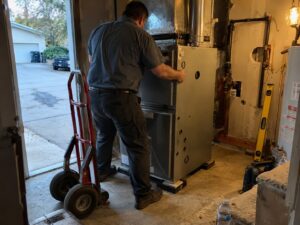
Typical residential furnace replacement runs one day, usually 6–8 hours on-site. The crew arrives within the confirmed window. Drop cloths down before tools come out. Old furnace recovered, disconnected (gas line capped, electrical disconnected, condensate drain disconnected on condensing units, flue disconnected), and removed. New equipment positioned, sometimes requiring sheet metal modification for proper fit in tight mechanical closets common in 1970s–1980s Salt Lake homes.
Critical workmanship details during install:
- Custom plenum and transition fabrication — we don’t reuse old plenums that don’t match the new furnace’s specifications. Travis fabricates new plenums and transitions on-site to fit the specific equipment.
- Sealed return drops — mastic-sealed at every joint, not tape-only. Return air leakage is the single most common cause of poor furnace performance.
- Gas line sizing verification — confirming the existing gas line is properly sized for the new furnace’s input rating. Some high-efficiency furnaces require larger gas lines than the equipment they replace.
- Gas line strapping — every 6 feet on horizontal runs per Utah Mechanical Code.
- Flue terminations — clearance to operable windows, fresh air intakes, gas meters, and property lines verified per code. Condensing furnace PVC venting routed with proper slope and properly supported.
- Combustion air supply — verified adequate for atmospheric-vent installations or proper sealed-combustion for condensing units.
- Condensate routing on condensing furnaces — pitched ¼” per foot to drain, properly trapped, neutralizer installed where required by local code or where condensate drains to materials sensitive to acidic condensate (cast iron drain lines, concrete floors).
- Electrical — properly sized circuit, surge protection where specified, low-voltage thermostat wiring routed cleanly.
- Altitude correction verified per manufacturer specification — orifice sizing or input adjustment for our 4,300-foot elevation. Most manufacturers publish specific instructions; we follow them on every install.
5. Commissioning
A furnace isn’t really “installed” until it’s commissioned. We measure:
- Combustion analysis at high-fire and low-fire — CO ppm in flue gas (target under 100 ppm air-free, ideally under 50), O2 percentage, flue gas temperature
- Draft pressure at the inducer or atmospheric draft hood against manufacturer specification
- Gas pressure at the manifold against manufacturer specification (typically 3.5″ w.c. for natural gas residential)
- Temperature rise across the heat exchanger against manufacturer specification (typically 35–65°F range)
- Static pressure across the air handler against manufacturer specification
- Blower motor amp draw against nameplate
- Inducer motor amp draw against nameplate
- Cycle test through all firing stages — verify proper sequencing on multi-stage equipment
- Thermostat staging configuration verified for the equipment installed
- Ambient CO test in the mechanical room and adjacent living space
You receive the commissioning data by email at job completion, along with photos of the finished install and combustion analysis printouts.
6. Walkthrough, Warranty Registration, and 30-Day Check-In
Before we leave, the lead technician walks you through the new system — how to operate the thermostat, where the gas shutoff is, where the disconnect is, what filter to use, what seasonal maintenance schedule we recommend, how to interpret status codes on the furnace control board if a problem ever arises. We register the manufacturer warranty on your behalf within a week. We also file Dominion Energy Therm-Wise rebate paperwork on qualifying high-efficiency equipment. Marisol or Rachel calls or emails 30 days after the install to verify everything’s running the way we promised.
Furnace Installation Costs in Salt Lake County
- 80% AFUE single-stage furnace replacement: $4,500–$7,500 installed
- 96% AFUE single-stage condensing furnace: $5,500–$8,500 installed
- 96% AFUE two-stage condensing furnace: $7,000–$11,000 installed
- 96–98% AFUE modulating variable-speed furnace: $9,500–$14,000 installed
- Full furnace + AC system changeout: $10,000–$22,000 depending on equipment tier (see AC installation page)
- Add-ons that affect price — custom plenum or transition fabrication, ductwork modifications, gas line upsizing, electrical upgrade, return-air modifications, vent rerouting for condensing equipment in homes with masonry chimneys
Available financing through Synchrony Bank and Service Finance Company includes 0% APR promotional plans (18 months) and fixed-rate options up to 120 months. Dominion Energy Therm-Wise rebates apply to qualifying high-efficiency equipment (typically 95% AFUE and above with ECM blower); federal 25C tax credit applies up to $600 on qualifying high-efficiency furnaces. We model all available incentives into the quoted price so you see real net cost after every available rebate and credit.
What’s Included in Every Furnace Install
- Elevation-corrected Manual J load calculation
- Permit filing and inspection scheduling with the local jurisdiction
- Recovery and disposal of old equipment
- New custom plenums, transitions, and return drops as needed
- Gas line modifications if required for the new equipment
- New venting for condensing equipment (or chimney inspection for atmospheric-vent equipment)
- New thermostat (with smart thermostat option available)
- New air filter
- Altitude correction per manufacturer specification
- Documented commissioning with combustion analysis printout emailed to you
- Photos of finished install for your records
- Manufacturer warranty registration filed on your behalf
- Dominion Energy Therm-Wise rebate filing on qualifying equipment
- Aegis labor warranty (in writing)
- 30-day post-install check-in
- First seasonal tune-up included on most full-system installs
Brands We Install
We’re brand-agnostic. We install Trane, Carrier, Lennox, Goodman, Rheem, Bryant, and Daikin furnaces. Patrick is a Trane Comfort Specialist — Trane’s highest dealer designation, with ongoing training and customer satisfaction requirements. Equipment recommendations are based on your home’s load, your budget, your efficiency priorities, and long-term parts availability in the Salt Lake market.
Furnace lineups we install most frequently:
- Trane S9V2-VS (96% AFUE two-stage variable-speed) and S9X1 (96% AFUE single-stage)
- Carrier Infinity 98 (98.5% AFUE modulating variable-speed) and Performance 96 (96% AFUE two-stage)
- Lennox SLP99V (99% AFUE modulating variable-speed, highest published efficiency available) and EL296V (96% AFUE two-stage variable-speed)
- Bryant Evolution 987M (98% AFUE modulating) and Preferred 96 (96% AFUE two-stage)
- Goodman GMVC96 (96% AFUE two-stage variable-speed)
- Rheem Prestige RGRT (96% AFUE modulating variable-speed)
Sizing Matters More at 4,300 Feet
The Salt Lake Valley’s 4,300-foot elevation affects furnaces in two important ways most contractors don’t address:
Combustion Performance
At reduced atmospheric pressure, less oxygen is available per cubic foot of combustion air. Gas furnaces designed for sea-level operation will run “rich” (too much fuel for available oxygen) when installed at altitude without correction. The result: elevated CO emissions, reduced efficiency, and incomplete combustion. Most manufacturers publish specific altitude-correction requirements:
- Some furnaces require physical orifice changes (different gas orifice for high-altitude installation)
- Some furnaces require manifold pressure adjustment
- Some furnaces require input rating de-rating (a 100,000 BTU furnace at sea level produces ~86,000 BTU at our altitude regardless of adjustment)
We follow each manufacturer’s specific altitude-correction procedure on every install. Combustion analysis at commissioning verifies the adjustment was correct — CO and O2 readings within manufacturer specifications confirm proper combustion.
Sizing for Actual Load
Manual J load calculations need elevation correction for accurate output. A home that requires 70,000 BTU/hour of heating capacity at sea-level reference might need 65,000–70,000 BTU/hour of nameplate input at our altitude after de-rating. Sizing without elevation correction often produces oversized equipment, which short-cycles and fails prematurely.
The combination of altitude correction and Manual J load calculation is why we routinely install furnaces 20–40% smaller than the previous equipment in the same home — and why those smaller furnaces produce better comfort, lower gas bills, and longer equipment life than the oversized predecessors.
Why Furnace Replacement Cost Varies So Much
Customers sometimes compare quotes and wonder why one contractor quoted $5,500 and another quoted $9,500 on the same house. The reasons:
- Equipment tier — single-stage 80% AFUE costs significantly less than modulating variable-speed 98% AFUE. Real difference, real performance gap.
- Sheet metal work — quotes that include custom plenum fabrication, return-air modifications, and proper transitions cost more than quotes that reuse existing sheet metal regardless of fit. The reused-sheet-metal approach causes static pressure problems and reduces equipment life.
- Venting scope — switching from 80% AFUE atmospheric-vent to 96%+ condensing requires new PVC venting routed to outside, which costs more than reusing the old B-vent.
- Gas line modifications — older homes may have gas lines too small for the new furnace’s input. Some contractors install the furnace anyway and hope for the best; we upsize the line.
- Altitude correction — taking the manufacturer’s altitude-correction step costs time. Contractors who skip it can finish faster (and produce furnaces that run improperly).
- Combustion analysis at commissioning — requires a combustion analyzer ($800–$2,000 in equipment) and time. Some contractors don’t own combustion analyzers; some who own them don’t use them.
- Permit filing — adds time and fee cost. Quotes that don’t include permits often skip them entirely, which creates problems at resale and can void manufacturer warranty.
A $5,500 furnace install is possible — for an 80% AFUE single-stage furnace replacement reusing existing sheet metal, venting, and gas line, with no altitude correction or commissioning, without permits. Sometimes that’s the right answer (a rental property, an older home being sold soon). Most of the time the additional $3,000–$4,000 buys real long-term value in better equipment, better workmanship, and longer life. We quote both options when relevant.
Frequently Asked Questions
- How long does furnace installation take?
- A typical residential furnace-only replacement runs one day, usually 6–8 hours of on-site work. Full system changeouts (furnace + AC + matched coil + thermostat) run one to two days depending on scope. Larger projects with ductwork modifications or venting changes may run longer. We confirm the timeline in the written quote and again 48 hours before install day.
- What’s the difference between 80% AFUE and 96% AFUE furnaces?
- AFUE (Annual Fuel Utilization Efficiency) measures the percentage of fuel energy converted to usable heat. An 80% AFUE furnace converts 80% of the gas to heat; 20% goes out the flue. A 96% AFUE furnace converts 96% of the gas to heat; only 4% loss. The difference in gas costs over the equipment’s life can be substantial — for an average Salt Lake home running $1,000/year on gas heat, a move from 80% to 96% saves roughly $170/year, or $2,500–$3,000 over 15 years. Whether that justifies the higher upfront cost depends on equipment price difference and your specific situation. We model the payback in your quote.
- What’s the difference between single-stage, two-stage, and modulating furnaces?
- Single-stage furnaces operate at one fixed input — either full-on or off. Two-stage furnaces have low-fire (60–65% of capacity) and high-fire stages, running on low-fire most of the time for steady operation. Modulating furnaces continuously vary their input across a 35–100% range, producing the most consistent comfort. Two-stage and modulating furnaces are more expensive upfront but produce better comfort, longer run times that improve filtration and humidity control, and longer equipment life from reduced cycling stress.
- Do I need to replace my AC at the same time as my furnace?
- Not necessarily, but often it’s the better economic call when both are approaching end-of-life. Replacing together saves on labor (one trip, one set of refrigerant line modifications, one commissioning), ensures heating and cooling are properly matched for efficiency, and consolidates manufacturer warranties. Replacing separately makes sense when only one unit is failing and the other has 5+ years of useful life remaining. We model both scenarios in any replacement quote.
- Can I install a high-efficiency condensing furnace if my current furnace vents through a chimney?
- Almost always yes. Condensing furnaces vent through PVC pipe routed directly through an exterior wall or roof, which usually allows installation in homes where the existing chimney was the only viable path for atmospheric venting. The venting modification adds cost compared to reusing existing chimney for an 80% AFUE replacement, but it eliminates dependence on chimney condition and often allows more flexible equipment placement. We evaluate venting options as part of every estimate.
- How much does a new furnace cost in Salt Lake County?
- Costs vary by equipment tier and home complexity. Typical ranges: 80% AFUE single-stage $4,500–$7,500; 96% AFUE single-stage condensing $5,500–$8,500; 96% AFUE two-stage $7,000–$11,000; 96–98% AFUE modulating variable-speed $9,500–$14,000. Full system changeouts (furnace + AC) typically run $10,000–$22,000 depending on equipment tier.
- How long should a new furnace last?
- Properly sized, installed, and maintained furnaces typically last 15–20 years in the Salt Lake climate. The valley’s inversion-driven extended heating seasons accumulate more operating hours than less inversion-prone climates, which can shorten useful life slightly. Atmospheric-vent 80% AFUE units tend toward the lower end; high-efficiency condensing furnaces toward the upper end when properly maintained. Annual maintenance is the single highest-leverage factor in extending equipment life.
Get a Free Furnace Installation Quote
Whether you’re replacing a failed furnace before winter, upgrading from atmospheric-vent to high-efficiency condensing equipment, or starting from scratch on new construction, we’d love to walk through your project. Free in-home estimates include a Manual J load calc, written line-item quote within 24 hours, and modeled rebates and tax credits so you see real net cost.
- Phone: (385) 250-0687
- Email: info@aegisheatingandair.xyz
- Address: 4454 Manhattan Ct, West Valley City, UT 84120