
AC Installation in Salt Lake County
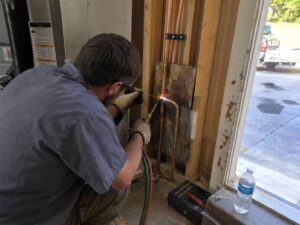
Most central AC installations in the Salt Lake Valley fail prematurely for one reason: the equipment was sized wrong. A condenser oversized for the actual cooling load short-cycles — it satisfies the thermostat too quickly, shuts off before it removes humidity from the air, then restarts a few minutes later. Over 12 years that’s millions of extra start cycles on a compressor designed for steady operation. Premature failure. Compressor replacement at year 10 instead of system replacement at year 18.
The root cause is sizing by square footage instead of load calculation. A “rule of thumb” estimate (500 sq ft per ton) might be roughly right for an average sea-level home. At our 4,300-foot elevation, with our lake-effect humidity gradient, in a home whose actual envelope might be unusually leaky or unusually tight, square-footage sizing is a guess. Every Aegis install starts with a real Manual J load calculation on a laptop at your kitchen table — not on a clipboard in the driveway.
Below is how we approach AC installation, what’s included in every quote, what to expect on install day, and what your investment will buy in terms of long-term comfort and operating cost.
Our AC Installation Process
1. Free In-Home Estimate
An hour on-site. We run a Manual J load calculation accounting for your home’s actual square footage, window orientation and type, insulation values, infiltration rate, internal heat gains, and elevation-corrected design temperatures. We measure your existing equipment, ductwork, electrical capacity, gas meter capacity if relevant, and lineset routing. We discuss equipment options across price tiers — typically a value option, a mid-tier option, and a premium option — with the tradeoffs spelled out. Quote arrives in your inbox within 24 hours, line-itemed.
2. Equipment Selection
The right system for your home depends on five factors:
- Cooling load — Manual J output dictates the tonnage range. Choose at the bottom of the range, not the top.
- Single-stage vs. two-stage vs. variable-capacity — variable-capacity inverter systems modulate output and run at low capacity most of the time, which is more efficient and quieter. Single-stage cycles full-on/full-off, which is cheaper to install but less efficient and louder.
- SEER2 efficiency rating — DOE minimum for our region is 14.3 SEER2. Higher ratings (16, 18, 20+) reduce operating cost but cost more upfront. The breakeven depends on your electricity rate and how much you use the system.
- Refrigerant type — R-410A is still standard but being phased out. R-454B and R-32 are the new low-GWP refrigerants on newly manufactured equipment. If you’re replacing a 410A system, make sure the new lineset and indoor coil are compatible.
- Matching evaporator coil — the indoor coil must be matched to the outdoor condenser. AHRI-rated matched pairs deliver the published efficiency; mismatched pairs don’t.
3. Permit and Pre-Install Coordination
We pull required permits with the local jurisdiction. For homes with HOA approval requirements on visible exterior equipment, we help you submit documentation. Equipment is ordered and delivered to our West Valley shop, then loaded for the install. You receive a confirmation 48 hours before install day with arrival window and crew assignment.
4. Install Day
Typical residential AC condenser install runs one day. The crew — Travis Hollings or Cole Bennett on most residential work, Patrick on premium and complex installs — arrives within the confirmed window. Drop cloths down before tools come out. Old condenser is recovered (refrigerant captured per EPA Section 608 requirements), disconnected, and removed. New equipment positioned, leveled on the existing pad (or new pad if needed), and connected.
Critical workmanship details during install:
- Lineset routing — straight, supported every 4 feet, sealed at penetrations. We route inside wall cavities wherever possible rather than slapping the lineset across the siding.
- Flare connections — torqued to manufacturer specification: ½” SAE to 26 ft-lbs, ⅝” to 38 ft-lbs.
- Brazing — nitrogen purge during brazing to prevent oxide formation inside the lineset.
- System evacuation — vacuum pulled to 500 microns and held before refrigerant charge.
- Electrical — properly sized disconnect, surge protector at the disconnect when specified, proper grounding.
- Condensate routing — pitched ¼” per foot minimum to drain, proper trap, secondary drain pan with float switch where required.
5. Commissioning
An AC isn’t really “installed” until it’s commissioned. We measure:
- Refrigerant charge by superheat (fixed-orifice) or subcool (TXV) method at actual operating conditions
- Static pressure across the air handler against manufacturer spec
- Airflow at each supply register if requested
- Temperature differential across the evaporator coil (typical target: 18–22°F)
- Compressor amp draw against nameplate
- Condenser fan amp draw against nameplate
- Capacitor microfarads against rated value
- Thermostat staging configuration verified for the equipment installed
You receive the commissioning data by email at job completion, along with photos of the finished install.
6. Walkthrough, Warranty Registration, and 30-Day Check-In
Before we leave, the lead technician walks you through the new system — how to operate the thermostat, where the disconnect is, what filter to use, what seasonal maintenance schedule we recommend. We register the manufacturer warranty on your behalf within a week. Rachel calls or emails 30 days after the install to verify everything’s running the way we promised.
AC Installation Costs in Salt Lake County
- Single-stage condenser replacement (14.3–15 SEER2): $5,500–$8,500 installed
- Two-stage condenser replacement (16–17 SEER2): $7,500–$10,500 installed
- Variable-capacity inverter-driven condenser (18–22+ SEER2): $11,000–$16,000 installed
- Full system changeout (condenser + matched evaporator coil + furnace + thermostat): $10,000–$22,000 depending on equipment tier
- Add-ons that affect price — refrigerant lineset replacement (recommended on R-22 to R-410A or R-454B retrofits), new condenser pad, electrical upgrade, custom plenum or transition fabrication, ductwork modifications
Available financing through Synchrony Bank and Service Finance Company includes 0% APR promotional plans (18 months) and fixed-rate options up to 120 months. Rocky Mountain Power Wattsmart rebates apply on qualifying high-efficiency equipment (typically 16 SEER2 and above); federal 25C tax credit applies up to $600 on qualifying central AC. We model all available incentives into the quoted price so you see real net cost.
What’s Included in Every AC Install
- Elevation-corrected Manual J load calculation
- Permit filing and inspection scheduling with the local jurisdiction
- Recovery and disposal of old equipment
- New condenser pad if needed
- New lineset (on refrigerant-type changes) or pressure test and flush of existing lineset
- New filter drier on the liquid line
- New disconnect if needed
- Documented commissioning with measurements emailed to you
- Photos of finished install for your records
- Manufacturer warranty registration filed on your behalf
- Rocky Mountain Power Wattsmart rebate filing
- Aegis labor warranty (in writing)
- 30-day post-install check-in
- First seasonal tune-up included on most full-system installs
Brands We Install
We’re brand-agnostic. We install Trane, Carrier, Lennox, Goodman, Rheem, Mitsubishi, Bryant, and Daikin condensers and matched coils. Patrick is a Trane Comfort Specialist and Mitsubishi Electric Diamond Contractor — the top dealer designations for each. Equipment recommendations are based on your home’s load, your budget, your efficiency priorities, and long-term parts availability in the Salt Lake market.
Why Sizing Matters More at 4,300 Feet
The Salt Lake Valley sits at roughly 4,300 feet above sea level. At that elevation, air density is approximately 13–14% lower than at sea level. This affects HVAC equipment in a few ways:
- Lower sensible cooling capacity — the same compressor moves less heat per unit volume of thinner air, so nominal manufacturer ratings overstate actual cooling output here
- Lower latent (humidity removal) load — drier air on the east bench means less moisture to remove, but lake-effect humidity on the west side narrows that difference
- Adjusted airflow requirements — equipment designed for sea-level air density may need higher CFM at altitude to deliver the same comfort
A unit correctly sized at 3.0 tons by a Phoenix contractor’s rule of thumb may actually need to be 2.5 tons here for the same home. Manual J load calculations account for elevation, latent load profile, and the specifics of your home. We run them on every install. Most contractors don’t.
Frequently Asked Questions
- How long does AC installation take?
- A typical residential condenser-only replacement runs one day, usually 4–6 hours of on-site work. A full system changeout (condenser, evaporator coil, furnace, possibly lineset and electrical) typically runs one to two days. Larger projects with ductwork modifications or zoned systems may run longer. We confirm the timeline in the written quote and again 48 hours before install day.
- Do I need to be home during the AC installation?
- Most homeowners prefer to be home for at least part of the install — particularly for the walkthrough at completion. It’s not strictly required if you’ve authorized us to work in your absence. For commercial work, building access is coordinated with property management in advance.
- What’s the right SEER2 rating for my home?
- It depends on your electricity rate, how much you use the system, and how long you plan to stay in the home. Higher SEER2 ratings reduce operating cost but cost more upfront — the payback can range from 4–8 years on the efficiency upgrade. For homes with high cooling demand (full-sun exposure, west-facing, larger square footage) the higher rating often pays off. For homes that run AC sparingly, the basic 14.3 SEER2 may be the smarter financial answer. We model the math in your quote.
- Can I reuse my old refrigerant lineset?
- Sometimes. If you’re replacing an R-410A system with another R-410A system, and the existing lineset is in good condition (no kinks, no oil staining, properly sized for the new equipment), we can pressure test and flush it for reuse. If you’re switching refrigerant types (R-22 to R-410A or R-410A to R-454B), the lineset typically needs to be replaced because the oils used with different refrigerants aren’t fully compatible. We make the call after inspecting the existing lineset.
- Will a high-efficiency AC really lower my electric bill?
- Yes, measurably. A move from 14 SEER2 to 18 SEER2 represents roughly 22% more efficient cooling. On a Salt Lake home with $400/year in cooling-season electricity cost, that’s $80–$90/year. Variable-capacity inverter systems often deliver even more savings because they modulate output and avoid the short-cycling losses common in single-stage units. The total savings over equipment life is meaningful but the upfront premium isn’t free — we run the payback math in your quote.
- What’s the warranty on a new AC system from Aegis?
- Two warranties apply. The manufacturer parts warranty is typically 10 years on compressor and major components when registered within 60–90 days of install (we file registration on your behalf within a week). The Aegis labor warranty covers our installation workmanship. See our warranty page for full details on coverage terms.
- How much disruption is the install to my home?
- Minimal. We work in the mechanical area (basement or attic for the air handler, exterior pad for the condenser) and out of your living space. Drop cloths protect floors where we travel. The HVAC system is off during the install itself — usually 4–6 hours — so plan around weather if you’re being installed mid-summer or mid-winter. Most installs complete with the customer barely aware we were there except for the new equipment running.
Get a Free AC Installation Quote
Whether you’re replacing a failed system, upgrading for efficiency, or starting from scratch on new construction, we’d love to walk through your project. Free in-home estimates include a Manual J load calc, written line-item quote within 24 hours, and modeled rebates and tax credits so you see real net cost.
- Phone: (385) 250-0687
- Email: info@aegisheatingandair.xyz
- Address: 4454 Manhattan Ct, West Valley City, UT 84120