
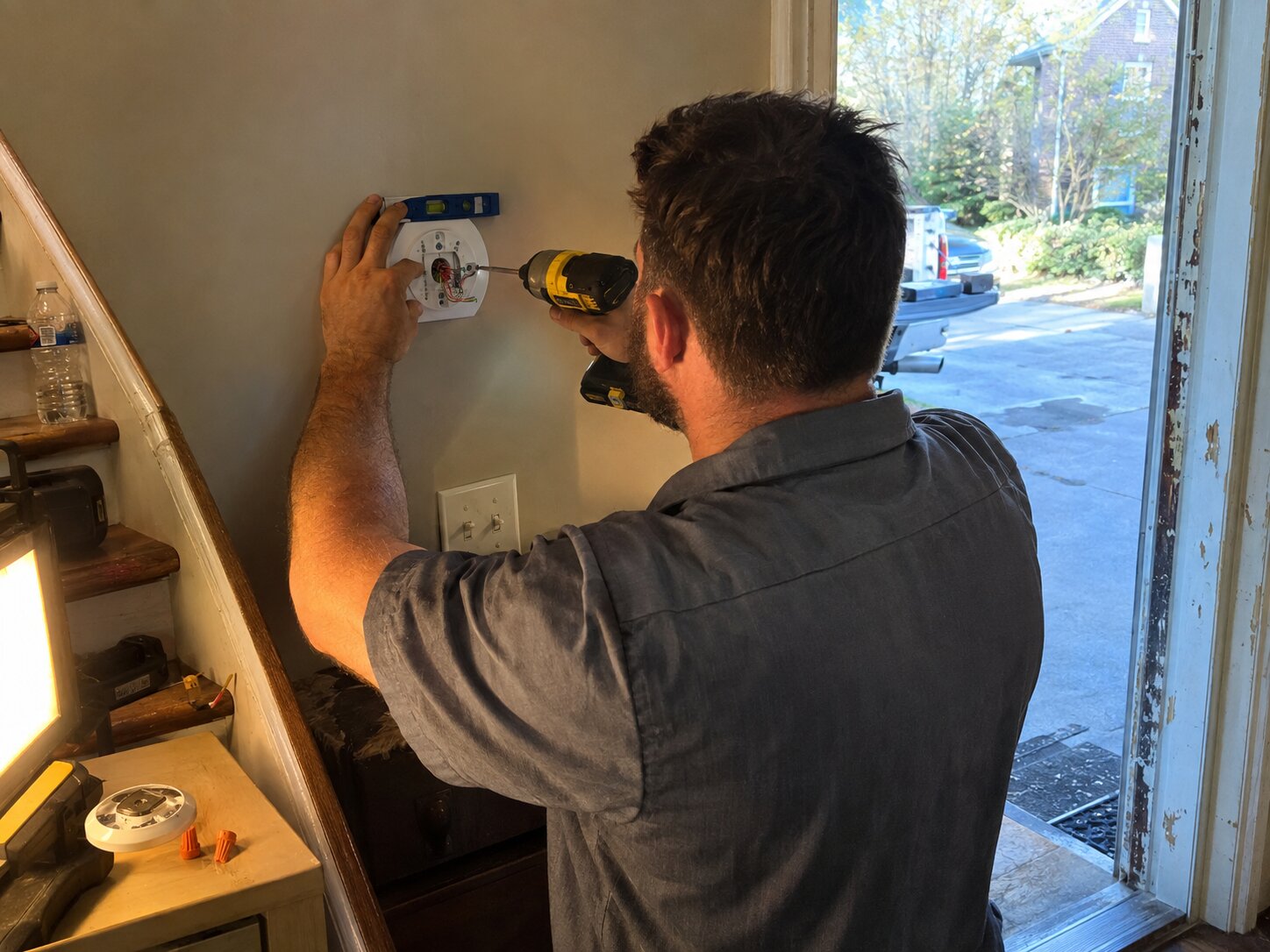
Thermostat Repair in Salt Lake County
Thermostat problems are often misdiagnosed as HVAC equipment problems. A furnace that won’t start, an AC that runs constantly, a heat pump that switches into auxiliary heat at the wrong times — these symptoms often trace to thermostat issues rather than equipment failures. The thermostat is the brain telling the equipment what to do, and when the brain is sending wrong signals, equipment doesn’t operate correctly regardless of how well it’s been maintained. Diagnosing thermostat issues correctly requires distinguishing between actual thermostat failures and equipment problems that are mimicking thermostat issues — a distinction that requires diagnostic measurements rather than guesswork.
The thermostat market complicates diagnosis. Mechanical thermostats (rare in modern homes), basic programmable thermostats, low-cost smart thermostats, premium smart thermostats with multi-stage equipment integration, multi-zone thermostat networks, and proprietary manufacturer thermostats all have different failure modes, configuration requirements, and integration considerations. A correct diagnosis depends on understanding which type you have and how it’s supposed to interact with your specific equipment. Generic troubleshooting from internet sources often produces incorrect diagnoses that lead customers to replace working thermostats while leaving actual equipment problems unaddressed.
Below are the common thermostat problems we diagnose and repair, how to distinguish thermostat issues from equipment issues, what proper repair involves, and when repair vs. replacement is the appropriate response.
Common Thermostat Problems
Thermostat Won’t Power On
Symptoms: blank display, unresponsive buttons, no Wi-Fi connection on smart thermostats. Possible causes:
- Dead batteries on battery-powered thermostats — typical first thing to check, often the entire problem
- Missing or damaged C-wire on hardwired thermostats — common on smart thermostats installed in homes without proper C-wire
- Tripped breaker at the HVAC equipment — thermostat draws power through the HVAC system in most installations
- Blown low-voltage fuse on the HVAC equipment control board — typically a 3 amp automotive-style fuse that can blow due to thermostat wire short or other electrical issue
- Thermostat hardware failure — display module or control circuitry has failed
Display Works But Equipment Doesn’t Respond
Thermostat shows current temperature and accepts setpoint changes, but heating or cooling doesn’t activate. Possible causes:
- Equipment-side problem (furnace, AC, or heat pump issue rather than thermostat problem) — common misdiagnosis, requires equipment diagnostic
- Wiring issue between thermostat and equipment — broken or disconnected wire, corroded terminal, miswired terminals
- Equipment type configuration error on programmable or smart thermostats — thermostat set up for wrong equipment type
- Mode setting wrong — thermostat in “Off” mode, set for cooling when heat is wanted, etc.
- Setpoint relationship — heat setpoint below current temperature, cool setpoint above current temperature
- Cycle limit configuration — thermostat preventing equipment activation due to recent shutdown timer
Equipment Runs Constantly
Heating or cooling never reaches setpoint, equipment runs continuously without satisfying. Possible causes:
- Equipment capacity inadequate for current conditions (extreme weather, equipment failure reducing output, ductwork problems) — equipment side issue rather than thermostat
- Setpoint unrealistic for current outdoor conditions — common during extreme heat or extreme cold
- Thermostat in wrong location — installed near heat source (sunny wall, kitchen, fireplace) producing incorrect temperature readings
- Thermostat calibration drift — temperature sensor reading consistently low or high compared to actual conditions
- Auxiliary heat misconfiguration on heat pump systems — heat pump unable to keep up but auxiliary heat not activating, or auxiliary heat activating too aggressively
- Stuck “always run” setting — thermostat fan setting on “On” rather than “Auto” causing blower to run continuously even when not heating or cooling
Equipment Short-Cycles
Equipment turns on and off rapidly, never running long enough to satisfy. Possible causes:
- Oversized equipment producing too much capacity for the load — equipment side issue, often requires equipment replacement to fix
- Differential setting too narrow on thermostat — temperature swing around setpoint too tight
- Thermostat in poor location — air handler return air sweeping past thermostat causing rapid temperature changes
- Equipment limit switch issues — equipment shutting itself down on safety, not actually thermostat problem
- Anticipator misconfiguration on older mechanical thermostats
Heat Pump Switches to Auxiliary Heat at Wrong Times
Heat pump triggers auxiliary heat (expensive electric resistance) when it shouldn’t, costing significant money on utility bills. Possible causes:
- Aggressive setback recovery — thermostat set to recover too quickly from setback, triggering auxiliary heat for fast warm-up
- Balance point set too high — auxiliary heat activating at outdoor temperatures where heat pump alone should be adequate
- Auxiliary heat staging wrong — auxiliary heat activating immediately rather than as backup after heat pump fails to keep up
- Heat pump capacity actually inadequate — equipment side issue requiring diagnosis
Wi-Fi Connection Issues (Smart Thermostats)
Smart thermostat works locally but loses cloud connection, app shows offline, schedules not updating. Possible causes:
- Wi-Fi router issues — router needs restart, password changed, network upgraded to different security protocol
- Signal strength issues at thermostat location — Wi-Fi too weak for reliable connection
- Manufacturer cloud service issues — temporary outage on Nest, Ecobee, Honeywell, or Sensi cloud platforms
- Account or app issues — manufacturer account problems, app permissions, multi-user configuration
- Thermostat firmware needs update — older firmware versions can lose connectivity over time
Inaccurate Temperature Reading
Thermostat displays temperature that differs from actual room temperature. Possible causes:
- Thermostat location issue — installed near heat source, in air path of supply register, on exterior wall, or in another location that affects readings
- Sensor calibration drift — temperature sensor in older thermostats can drift over time
- Battery low on battery-powered thermostats — low battery can affect sensor accuracy
- Damaged sensor — physical damage or contamination affecting sensor reading
Diagnosing vs. Replacing
Customers sometimes ask whether to repair an existing thermostat or replace with a newer model. The math:
When Repair Makes Sense
- Specific identifiable problem — wiring issue, configuration error, calibration drift — that can be fixed without component replacement
- Premium thermostat under warranty — manufacturer covers component replacement; repair is straightforward
- Recently installed thermostat with installation-related issues — configuration corrections, wiring fixes, equipment integration tuning
- Working thermostat with minor issues that don’t significantly affect operation
When Replacement Makes Sense
- Old mechanical thermostats being asked to control modern multi-stage equipment — typically can’t deliver proper staging regardless of repair
- Damaged or failing hardware beyond economical repair — display module failure, sensor failure, control board issues
- Inadequate functionality for current equipment — basic programmable thermostat trying to control two-stage or variable-speed equipment
- Significant features missing — customer wants smart thermostat capabilities the existing unit doesn’t have
- Out-of-warranty hardware with multiple problems indicating broader hardware failure
Sometimes repair is the right answer; sometimes replacement is. We diagnose the specific issue and recommend the appropriate response rather than defaulting to either approach.
Thermostat Diagnostic Process
Proper thermostat diagnostics include:
1. Symptom Verification
Observing what the system is actually doing rather than relying only on customer description. Sometimes the symptom isn’t what the customer described — what looks like a thermostat problem turns out to be an equipment problem, or vice versa.
2. Power and Wiring Check
Verifying the thermostat has proper power supply, wiring is intact, terminals are properly connected, and no shorts exist in the low-voltage circuit. Wiring issues at the thermostat or air handler can produce a wide range of symptoms that look like thermostat failures.
3. Configuration Verification
For programmable and smart thermostats, verifying that configuration matches the equipment being controlled — equipment type (gas furnace, heat pump, dual-fuel), staging (single, two-stage, variable), heat pump configuration (auxiliary heat staging, balance point), and other equipment-specific settings.
4. Sensor Calibration Check
Verifying the thermostat’s temperature sensor reads accurately. Comparison against calibrated reference thermometer in the same location identifies sensor drift or location problems.
5. Equipment Operation Verification
If thermostat appears to be operating correctly but equipment isn’t responding properly, diagnosing whether the issue is at the thermostat output, the wiring, or the equipment input. Multi-meter testing of voltage at thermostat output and at equipment input distinguishes these scenarios.
6. Smart Features Check
For smart thermostats, verifying Wi-Fi connection, app integration, cloud sync, schedule logic, geofencing setup, and other smart features. Some smart thermostat “problems” turn out to be configuration issues at the cloud or app level rather than thermostat hardware issues.
7. Written Findings
Diagnostic report documenting what was tested, what was found, what was repaired during the visit, and any recommendations for further work or replacement.
Common Repairs We Perform
C-Wire Installation
Many older homes have 4-wire thermostat connections without a dedicated C-wire (common wire). Smart thermostats need constant power, which they get from the C-wire. Without one, smart thermostats either won’t work properly, “power-steal” from heating wires (causing equipment damage), or run on batteries requiring frequent replacement.
C-wire installation requires running an additional wire from the thermostat location to the air handler, connecting at both ends to the appropriate terminals. Most installations take 1–2 hours depending on wiring distance and accessibility. Cost typically $150–$350.
Wiring Replacement
Thermostat wiring that’s degraded, damaged, or inadequately sized can produce intermittent operation, communication errors, and equipment problems. Wiring replacement involves running new low-voltage cable between thermostat and air handler, often easier than diagnosing intermittent wiring problems. Typical cost $150–$400 depending on accessibility.
Configuration Correction
Reconfiguring programmable or smart thermostats to match actual equipment — fixing equipment type misconfiguration, staging settings, heat pump configuration, recovery rate, cycle limits, and other settings. Often takes 30–60 minutes. Cost typically $99–$199.
Sensor Recalibration
Most modern thermostats include calibration offset adjustments to correct for sensor drift or location-related reading issues. Recalibration is straightforward when the issue is identified. Cost typically included in diagnostic visit if no component replacement is needed.
Hardware Replacement
Replacing failed thermostat with new equipment when repair isn’t economical. Includes equipment selection guidance (see smart thermostat page), proper configuration, and customer walkthrough. Cost depends on equipment selected; typical total $290–$680.
Smart Thermostat Reconfiguration
For smart thermostats that are installed and working but not properly configured for the equipment they’re controlling. Common scenarios: smart thermostat set up as single-stage when controlling two-stage equipment, heat pump configuration errors causing inappropriate auxiliary heat activation, schedule logic that doesn’t match household patterns. Cost typically $99–$199.
Thermostat Repair Pricing
- Diagnostic visit (identifying the specific problem): $99–$199, applied toward any repair work performed during the same visit
- Configuration correction (no component replacement): $99–$199 — often included in diagnostic visit fee
- C-wire installation: $150–$350 depending on wiring distance and accessibility
- Thermostat wiring replacement: $150–$400 depending on length and accessibility
- Low-voltage fuse replacement on HVAC equipment: $50–$125 (often other root cause needs identification)
- Thermostat replacement with new equipment: $290–$680 total (equipment plus installation)
- Smart thermostat reconfiguration on existing equipment: $99–$199
- Multi-zone thermostat troubleshooting on zoned systems: $175–$325 depending on zone count and complexity
What We DON’T Do
- Replace working thermostats unnecessarily — if your existing thermostat is functioning properly for your equipment and meeting your needs, we don’t recommend replacement just to upsell new equipment.
- Charge separately for diagnostic when configuration is the answer — if a 10-minute configuration correction solves the problem, we don’t charge separately for repair on top of the diagnostic visit.
- Recommend smart thermostats when basic functionality is adequate — some customers don’t want or need smart features. We recommend appropriate equipment for actual customer needs.
- Skip configuration when installing new thermostats — every new thermostat installation includes proper configuration for the specific equipment, not just hardware installation.
Frequently Asked Questions
- How much does thermostat repair cost?
- Diagnostic visit $99–$199, applied toward any repair performed. Configuration correction often included in diagnostic fee. C-wire installation $150–$350. Wiring replacement $150–$400. Hardware replacement $290–$680 total including new thermostat. Smart thermostat reconfiguration $99–$199.
- How do I know if it’s the thermostat or the equipment?
- Often hard to tell without diagnostic measurements. Symptoms that point to thermostat: display issues, configuration problems, mode switching issues, Wi-Fi connectivity problems on smart thermostats. Symptoms that often point to equipment: failure to heat or cool despite thermostat calling, short-cycling, capacity issues, strange noises. Diagnostic visit identifies the actual problem rather than guessing.
- Why does my smart thermostat keep losing Wi-Fi connection?
- Several possible causes: signal strength at thermostat location, router or network issues, manufacturer cloud service issues, account/app problems, firmware update needed. Most Wi-Fi issues are router-side or signal-strength issues rather than thermostat hardware. Diagnostic visit identifies the specific cause.
- Can I repair my own thermostat?
- Some issues yes — replacing batteries, checking that the breaker isn’t tripped, verifying basic settings. Most diagnostic and repair work requires HVAC knowledge: testing voltage at thermostat and equipment terminals, identifying wiring issues, configuring thermostats for specific equipment, working with smart thermostat manufacturer apps and configuration. Professional diagnosis is typically worthwhile when basic troubleshooting doesn’t resolve the issue.
- Should I just replace my old thermostat with a smart one?
- Sometimes — depends on equipment, current thermostat condition, and your needs. Modern equipment (two-stage, variable-speed, heat pump with auxiliary heat) benefits significantly from smart thermostat integration with proper configuration. Older equipment with single-stage operation gets less benefit. Customers who want app control, scheduling automation, or smart home integration benefit from upgrade. Customers who prefer simple operation and don’t want smart features can keep working basic thermostats.
- Will fixing my thermostat solve my high utility bills?
- Sometimes. Thermostat configuration errors (aggressive setback recovery on heat pumps triggering auxiliary heat, equipment running constantly due to thermostat issues) can produce significant utility bill increases. Fixing the underlying problem produces immediate savings. Other times the high bills are equipment-related (failing components, low refrigerant charge, ductwork issues) and thermostat fixes won’t change the picture meaningfully.
- How long does thermostat repair take?
- Most diagnostic and repair work completes in a single visit of 1–2 hours. C-wire installation typically 1–2 hours including running new wire. Hardware replacement with proper configuration typically 1.5–2 hours. Complex multi-zone troubleshooting can take longer.
Schedule Thermostat Service
Whether you have a thermostat that’s not working, smart thermostat connectivity issues, configuration problems, or simply want to upgrade an older thermostat, call (385) 250-0687. We diagnose the specific issue and recommend appropriate repair or replacement based on what we actually find.
- Phone: (385) 250-0687
- Email: info@aegisheatingandair.xyz
- Address: 4454 Manhattan Ct, West Valley City, UT 84120