
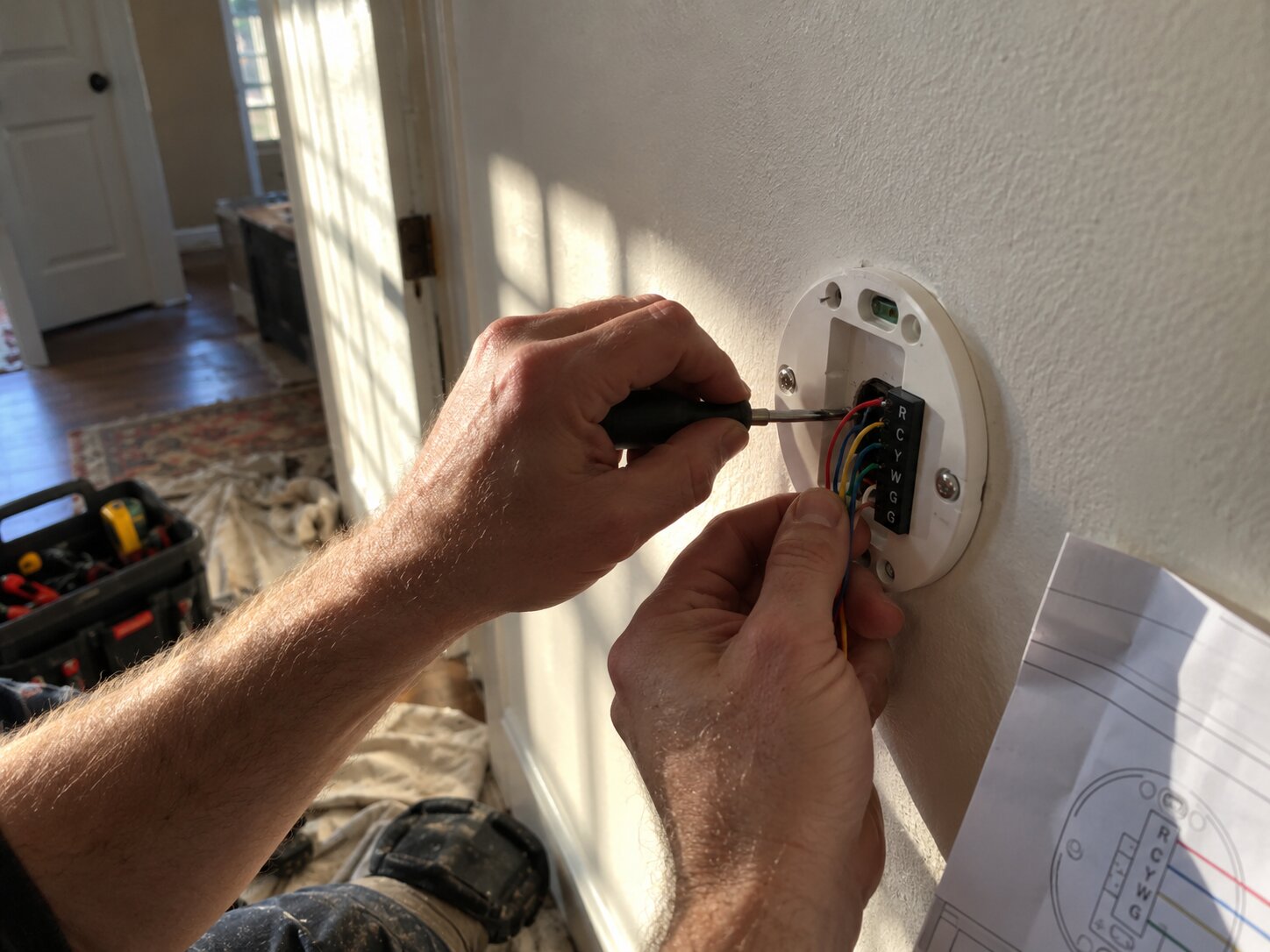
Smart Thermostat Installation in Salt Lake County
Smart thermostats are sometimes oversold and sometimes underconfigured. Manufacturers market them aggressively with promises of dramatic energy savings, and customers install them expecting their utility bills to drop 30% overnight. Reality is more modest — properly configured smart thermostats typically save 5–15% on heating and cooling costs, with the savings concentrated in specific patterns (away-from-home periods, sleep schedules) rather than across the board. The technology delivers real benefits but rarely the transformative savings claimed in advertising.
The bigger issue is configuration. Smart thermostats deliver their full benefit when configured correctly for the specific equipment they’re controlling — staging configuration matched to two-stage or variable-speed equipment, recovery rate settings appropriate for the home’s thermal characteristics, schedule logic that reflects actual occupancy patterns, integration with HVAC equipment to take advantage of equipment-specific features. Most DIY smart thermostat installations skip the configuration entirely, treating the smart thermostat like a fancy programmable thermostat with a smartphone app. The equipment works that way, but the benefits don’t materialize.
Below is what smart thermostats actually do well, when professional installation makes the difference between marketing-tier benefits and real-world benefits, what equipment we recommend across price tiers, and what proper installation involves.
What Smart Thermostats Actually Do
Remote Control and Monitoring
Smartphone apps allow adjusting temperature, viewing current conditions, and changing schedules from anywhere. Useful for situations like:
- Arriving home earlier than expected and wanting the home pre-conditioned
- Staying away longer than planned (vacation extension, business trip changes) and adjusting away setpoints
- Adjusting heating or cooling while moving between floors of a multi-story home
- Monitoring home conditions remotely (verifying heat is working during winter trips, confirming AC is keeping up during summer heat waves)
- Adjusting from bed when temperature isn’t quite right
Smart Scheduling
Beyond basic time-based programmable scheduling, smart thermostats can use multiple inputs to optimize operation:
- Geofencing — detecting when phones leave or approach the home, triggering away/home modes automatically
- Learning algorithms — observing patterns over time and adjusting schedules to match actual behavior
- Weather integration — adjusting setpoints or recovery times based on outdoor temperature forecasts
- Solar and seasonal adjustments — automatic seasonal transition handling
Equipment Integration
Properly configured smart thermostats integrate with HVAC equipment in ways basic thermostats can’t:
- Two-stage equipment staging — using low fire/cool when conditions allow, high fire/cool only when needed
- Variable-speed equipment modulation — communicating with equipment that has fine-grained capacity control
- Heat pump optimization — managing compressor operation, auxiliary heat staging, and balance point switching
- Humidification and dehumidification coordination — when smart thermostat is connected to humidity equipment
Reporting and Analytics
- Energy usage tracking — runtime hours, estimated energy use, comparison to similar homes
- Equipment performance monitoring — alerting to abnormal patterns that might indicate equipment problems
- Filter change reminders — based on actual runtime rather than calendar schedules
- Maintenance and service alerts
Smart Home Integration
- Voice assistant integration — Alexa, Google Assistant, Apple HomeKit
- Routine and automation triggers — coordinating with smart locks, lighting, security systems
- IFTTT (If This Then That) integration for advanced automation
Smart Thermostat Brands We Install
Nest (Google)
The most popular smart thermostat brand. Strengths: clean aesthetic design, simple user interface, learning algorithms that work reliably for typical households, good geofencing implementation, broad smart home integration.
- Models we install: Nest Learning Thermostat (premium tier), Nest Thermostat (basic tier)
- Best for: Customers who want clean design, learning-based operation, broad smart home compatibility
- Pricing: $130–$250 retail; installation typically $200–$400 with proper configuration
Ecobee
Higher-end smart thermostat with significant equipment integration capabilities and remote room sensors that allow multi-room temperature awareness from a single thermostat. Strengths: room sensor system for whole-home temperature awareness, advanced staging configuration, deeper integration with two-stage and variable-speed equipment, voice assistant built into thermostat.
- Models we install: Ecobee Smart Thermostat Premium, Ecobee Smart Thermostat Enhanced
- Best for: Customers with two-stage or variable-speed equipment, customers wanting room-by-room temperature awareness without full zoning, customers who appreciate detailed equipment monitoring
- Pricing: $170–$280 retail; installation typically $200–$400 with proper configuration
Honeywell
Long-established HVAC controls manufacturer with smart thermostats positioned for both basic and advanced applications. Strengths: deep HVAC engineering experience, reliable hardware, good compatibility across equipment manufacturers, professional-grade configuration options.
- Models we install: Honeywell T9, Honeywell T10, Honeywell Pro Series (professional-grade)
- Best for: Customers wanting traditional HVAC controls brand reliability, customers with complex multi-stage equipment, customers preferring simpler interfaces over learning algorithms
- Pricing: $150–$300 retail; installation typically $200–$400 with proper configuration
Sensi (Emerson)
Mid-range smart thermostat option from Emerson Electric. Strengths: lower cost than Nest/Ecobee, no-frills smart functionality, good reliability, full smartphone app and voice assistant compatibility.
- Models we install: Sensi Touch 2, Sensi Smart Thermostat
- Best for: Budget-conscious customers wanting smart functionality without premium pricing, customers comfortable with simpler interfaces
- Pricing: $90–$170 retail; installation typically $200–$400 with proper configuration
What Proper Smart Thermostat Installation Includes
Most customers who DIY their smart thermostat installations get it working in basic mode but never capture the equipment integration benefits. Proper installation includes:
Equipment Compatibility Verification
- Confirming the existing wiring supports the smart thermostat’s requirements
- Adding C-wire (common wire) connection if not present — typical issue in older homes
- Verifying equipment compatibility for two-stage or variable-speed control
- Checking heat pump configuration if applicable
Wiring
- Replacing existing thermostat wiring if degraded or inadequate
- Routing C-wire from air handler to thermostat location if missing
- Installing thermostat with proper backplate and clean wire termination
Configuration
This is the step DIY installations typically skip. Proper configuration includes:
- Equipment type setup — gas furnace + AC, gas furnace + heat pump (dual-fuel), all-electric heat pump, air handler with heat strips, etc.
- Staging configuration — single-stage, two-stage, variable-speed
- Heat pump configuration — auxiliary heat staging, balance point, emergency heat settings
- Recovery rate settings — how quickly the thermostat brings the home from setback to occupied setpoint
- Cycle limits — preventing short-cycling damage to equipment
- Differential settings — temperature swing tolerance around setpoint
- Humidification/dehumidification integration when applicable
Smart Features Setup
- Wi-Fi connection verification
- Smartphone app setup for primary household members
- Geofencing configuration with proper home/away triggers
- Schedule setup reflecting actual household occupancy patterns
- Smart home integration with voice assistants if requested
Customer Walkthrough
- Basic operation — adjusting temperature, changing schedules, switching modes
- App walkthrough — remote control, schedule management, energy reports
- Recommended setback patterns for optimal energy savings without comfort compromise
- What to expect from learning algorithms over the first few weeks
Configuration Errors We See in Existing Installations
Common configuration issues when we service homes with existing smart thermostats:
Equipment Type Misconfigured
Smart thermostat set up as single-stage when controlling two-stage equipment, set up as gas heat when controlling a heat pump, set up incorrectly for dual-fuel systems, etc. Result: equipment doesn’t run its proper stages, capacity is reduced, comfort suffers, equipment wears out faster.
No C-Wire
Many older homes have 4-wire thermostat connections without a C-wire. Smart thermostats need constant power, which they get from the C-wire connection. Without a C-wire, smart thermostats either don’t work at all, “power-steal” from the heating wires (causing equipment problems), or use battery power that requires frequent battery changes. Proper installation includes adding C-wire if needed.
Aggressive Setbacks Counter-Productive
Homeowners sometimes set very aggressive setbacks (10°F+ during away periods) thinking they’ll save more energy. In heat pump applications, aggressive setbacks can trigger auxiliary heat (expensive electric resistance) for recovery, costing more than the savings. Proper configuration includes recovery limits and balance point settings that prevent this.
Geofencing Not Configured
Geofencing requires connecting household member phones to the smart thermostat’s geofencing service. Many installations skip this step, leaving the thermostat operating on time-based schedules rather than actual occupancy.
Two-Stage Configuration Wrong
Two-stage equipment should run primarily on low fire (more efficient, longer cycles, better comfort) with high fire only when needed. Misconfigured smart thermostats sometimes default to high fire too aggressively, eliminating the efficiency benefit of two-stage equipment.
Smart Thermostat Installation Pricing
- Basic installation with existing C-wire and standard equipment: $200–$300 including configuration and walkthrough
- Installation requiring C-wire addition: $300–$500 depending on wiring distance and accessibility
- Complex equipment configuration (heat pump with auxiliary heat, dual-fuel systems, variable-speed equipment): $300–$450
- Multi-zone installations (one smart thermostat per zone): per-thermostat pricing with multi-thermostat discounts
- Thermostat equipment cost: $90–$280 retail depending on model selection (separate from installation)
- Combined installation + equipment: typically $290–$680 total for most residential installations
Frequently Asked Questions
- How much does smart thermostat installation cost?
- Installation labor $200–$300 for standard installations with existing C-wire. Adding C-wire if needed brings cost to $300–$500. Complex equipment configuration $300–$450. Thermostat equipment cost $90–$280 retail depending on model. Total typical residential installations $290–$680.
- Which smart thermostat should I buy?
- Depends on equipment and preferences. Nest for clean design and learning algorithms. Ecobee for two-stage/variable-speed equipment and room sensors. Honeywell for traditional HVAC controls reliability and complex multi-stage equipment. Sensi for budget-conscious smart functionality. We discuss specific recommendations during the installation visit based on your equipment.
- Will a smart thermostat really save money?
- Typically 5–15% on heating and cooling costs when properly configured. Savings come primarily from setback patterns during away periods and sleep hours, plus equipment staging optimization when integrated with two-stage or variable-speed equipment. Actual savings depend on existing thermostat habits — customers who already maintained setbacks see less improvement than customers replacing always-on thermostats.
- Can I install a smart thermostat myself?
- Mechanically yes for most installations. The challenges are: configuring the thermostat correctly for your specific equipment (most DIY installations skip this), adding C-wire if your home doesn’t have one, and verifying compatibility with two-stage or variable-speed equipment. We commonly service homes where DIY smart thermostats are installed but configured incorrectly, producing reduced comfort and equipment problems. Professional installation costs $200–$300 and typically captures the full benefit of the technology.
- What’s a C-wire and why does it matter?
- The “common” wire provides constant power to the thermostat. Smart thermostats need constant power to maintain Wi-Fi connection and display. Older homes often have 4-wire thermostat connections without a C-wire. Smart thermostats without C-wire either don’t work properly, “power-steal” from heating wires (causing equipment damage), or run on batteries requiring frequent replacement. We add C-wire as needed during installation.
- Will the smart thermostat work with my older HVAC equipment?
- Most cases yes. Smart thermostats work with single-stage and two-stage gas furnaces, AC condensers, heat pumps (with proper configuration), and most other residential equipment. Equipment that may not work well with smart thermostats: very old (30+ year) systems with non-standard control wiring, some boiler systems, or specialty equipment requiring specific manufacturer thermostats. We verify compatibility during the installation visit.
- What’s the warranty on a smart thermostat?
- Manufacturer warranties typically 1–3 years on hardware depending on brand and model. Most failures occur within the warranty period or are user-replaceable issues (battery problems, Wi-Fi reset, app reconfiguration). Aegis adds 2-year labor warranty on installation workmanship.
Schedule Smart Thermostat Installation
If you’re ready to upgrade to a smart thermostat, want help selecting the right model for your equipment, or have a smart thermostat that’s not working as expected, call (385) 250-0687. We can install most smart thermostats during a 1–2 hour service visit; complex installations or configurations take longer.
- Phone: (385) 250-0687
- Email: info@aegisheatingandair.xyz
- Address: 4454 Manhattan Ct, West Valley City, UT 84120