
Carbon Monoxide Testing in Salt Lake County
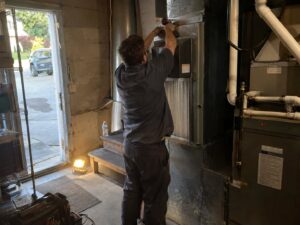
Carbon monoxide is the most dangerous indoor air quality hazard in homes with combustion appliances. Unlike particulates that produce gradual symptoms over years of exposure, CO can cause illness within hours and death within a day at sufficient concentrations. It’s colorless, odorless, and produces symptoms (headache, nausea, dizziness, drowsiness, confusion) that mimic flu or general malaise — which is why CO poisoning sometimes goes unrecognized until the exposure becomes severe. The CDC documents hundreds of unintentional CO deaths and tens of thousands of CO-related emergency room visits in the United States annually. Most of these incidents trace to malfunctioning or improperly vented combustion appliances in homes that didn’t have functioning CO detectors.
Home CO detectors are essential safety equipment in any home with gas furnaces, boilers, water heaters, ranges, dryers, fireplaces, or attached garages. But CO detectors have limitations — they alarm at concentrations that produce acute effects (typically 70 ppm for extended periods) but may not catch low-level CO problems that produce chronic symptoms (mild headaches, fatigue, malaise) without triggering alarm. Professional CO testing using calibrated combustion analyzers detects problems that home detectors miss, identifies low-level CO production from combustion equipment, and provides the technical detail needed to fix problems at their source.
Below is what professional CO testing involves, when it makes sense to schedule it, what we measure during testing, and what to do if elevated CO is found in your home.
When to Schedule Professional CO Testing
Annual During Furnace Tune-Up
Every furnace tune-up we perform includes combustion analysis at the flue and ambient CO testing in the mechanical room. This baseline annual testing catches developing combustion problems before they become safety issues. Most CO problems develop gradually — slightly drifting gas pressure, slowly accumulating burner deposits, gradually degrading heat exchanger condition — and annual testing identifies them while they’re still minor adjustments rather than safety emergencies.
After CO Detector Activation
If your CO detector has alarmed, even if it later cleared, professional testing is essential. CO detector activation indicates that CO reached levels sufficient to trigger the alarm — typically 70+ ppm for extended periods. Even if the source has cleared (open windows, equipment cycled off), the underlying cause needs to be identified and addressed to prevent recurrence. Testing identifies whether the source was equipment malfunction, venting failure, or external sources (vehicle exhaust, neighbor’s appliance).
When Family Members Report Symptoms
Headaches, nausea, dizziness, drowsiness, confusion, or general malaise that improves when family members are away from home and returns when they’re home should trigger investigation. These are classic chronic CO exposure symptoms. The pattern (better away, worse at home) is the diagnostic indicator that something in the home is the source rather than something the family member is encountering elsewhere.
After Combustion Equipment Service or Replacement
Any work on combustion appliances — gas valve service, burner adjustment, heat exchanger inspection, furnace installation, water heater replacement — should be followed by combustion analysis to verify the equipment is operating safely. Improper installation or service can produce CO problems that weren’t present before the work, and verification testing catches problems before they cause harm.
In Older Homes with Atmospheric-Vent Equipment
Pre-1990s homes with 80% AFUE atmospheric-vent furnaces, gas water heaters venting through chimneys, and other atmospheric-vent combustion appliances are more susceptible to CO problems than modern sealed-combustion equipment. Tight weatherization of older homes can starve atmospheric-vent equipment of combustion air, leading to incomplete combustion, elevated CO, and back-drafting of flue gases into living spaces. Older Salt Lake homes — particularly in the Avenues, Sugar House, older West Valley neighborhoods, and similar areas — benefit from periodic professional CO testing beyond what annual tune-ups provide.
Before Buying a Home with Combustion Appliances
Pre-purchase inspections rarely include thorough combustion analysis of HVAC and water heating equipment. Standalone CO testing as part of pre-purchase due diligence catches problems that home inspection reports often miss. We provide professional CO testing for real estate transactions, with written documentation suitable for use in purchase negotiations.
When CO Detector Replacement Is Needed
CO detectors have service lives of 5–10 years depending on technology and manufacturer specifications. Older detectors lose sensitivity over time and may fail to detect CO at concentrations that should trigger alarms. We check CO detector age and operation during every service visit; we recommend replacement when detectors are past their service life regardless of whether they still test functional.
What Professional CO Testing Measures
Combustion Analysis at the Flue
The primary diagnostic. Using a calibrated combustion analyzer ($800–$2,000 in equipment cost), we sample flue gas at the appliance and measure:
- CO ppm air-free in flue gas — target under 100 ppm, ideally under 50. Readings above 100 ppm indicate combustion problems; readings above 400 ppm indicate immediate safety concerns.
- CO2 percentage — verifies combustion completeness alongside CO measurement
- O2 percentage — typically 6–9% on properly tuned residential equipment; out-of-range readings indicate combustion air or fuel/air ratio issues
- Flue gas temperature — heat exchanger health indicator
- Combustion efficiency calculation — derived from the above measurements, indicates how effectively the equipment is converting fuel to heat
- Draft pressure at the inducer (induced draft equipment) or atmospheric draft hood (atmospheric vent equipment)
Combustion analysis at high-fire and low-fire (on staged equipment) provides the most complete picture of equipment operation. Patterns of CO change during firing rate transitions can indicate specific failure modes that single-point measurements would miss.
Ambient CO Testing
CO measurement in living spaces using calibrated portable analyzers. We measure:
- Mechanical room CO — where combustion equipment is located, baseline indicator of equipment leakage or back-drafting
- Adjacent living space CO — particularly rooms above or near the mechanical room
- Sleeping area CO — bedrooms where occupants spend extended periods, critical for chronic exposure assessment
- Kitchen CO — particularly with gas range operation, identifies appliance-specific problems
- Attached garage CO — verifies that vehicle exhaust isn’t migrating into living spaces
Ambient CO testing detects whether CO from combustion equipment is reaching occupied spaces, regardless of where the CO is being produced.
Flue and Venting Inspection
Visual and instrumented inspection of flue connections, venting paths, termination points, and combustion air supply:
- Flue connections — proper fit, no visible damage, no signs of CO leakage at connections
- Vent pipe condition — corrosion, damage, blockage
- Chimney condition on atmospheric-vent equipment — lining integrity, draft test, spillage test
- Termination clearance — proper distance from windows, doors, intake vents
- Combustion air supply — adequate fresh air for combustion equipment to operate cleanly
CO Detector Inspection
Verification of CO detector operation in the home:
- Detector age — most CO detectors have 5–10 year service lives; older detectors should be replaced regardless of test status
- Battery status on battery-powered units
- Test function — verifying the detector responds to its self-test
- Placement — proper installation on every level of the home and near sleeping areas
- Recommendations for additional detectors where coverage is inadequate
What Findings Mean
Normal Findings
- Flue CO under 100 ppm (ideally under 50) at high-fire and low-fire
- O2 within manufacturer specification (typically 6–9%)
- Ambient CO under 5 ppm in all living spaces
- Proper draft pressure at inducer or draft hood
- No visible flue or venting problems
- Functional CO detectors within service life
Normal findings on annual testing indicate the home’s combustion equipment is operating safely. We document findings, provide written report, and continue with normal annual testing schedule.
Elevated Findings Requiring Adjustment
- Flue CO 100–400 ppm — indicates combustion problems that need correction (gas pressure adjustment, burner cleaning, combustion air verification) but doesn’t indicate immediate safety emergency
- Slightly elevated ambient CO (5–10 ppm) — suggests minor combustion or venting issues
- Out-of-range O2 readings — indicates fuel/air ratio problems
These findings warrant prompt corrective work but typically don’t require immediate equipment shutdown. We provide written documentation of findings, recommended corrective actions, and quotes for repair work. Adjustments and minor repairs typically run $150–$450.
Serious Findings Requiring Equipment Shutdown
- Flue CO above 400 ppm — indicates significant combustion problems requiring immediate attention
- Ambient CO above 10 ppm in living spaces — indicates CO migration into occupied areas
- Confirmed cracked heat exchanger
- Severe back-drafting or flue gas spillage
- Confirmed CO source affecting sleeping areas
These findings require immediate corrective action — equipment shutdown until repair or replacement is completed, ventilation of affected spaces, and prompt corrective work. We provide red-tag notification for equipment that shouldn’t be operated, written documentation of safety concerns, and immediate scheduling for repair or replacement.
Common CO Sources We Identify
Heat Exchanger Cracks
The most serious common cause of CO problems in residential homes. Cracked heat exchangers allow combustion gases (including CO) to enter the supply air stream and distribute throughout the home. Symptoms include elevated supply-air CO during burner operation, CO patterns that change when the blower starts (indicating pressure-driven migration through cracks), and family members reporting flu-like symptoms that improve when away from home. See our heat exchanger repair page for detailed information.
Back-Drafting Atmospheric-Vent Equipment
Common in older Salt Lake homes that have been weatherized without adequate combustion air provisions. Atmospheric-vent furnaces and water heaters need enough air supply to push combustion gases up through the chimney. Tight homes can develop negative pressure (from kitchen exhaust, bathroom fans, clothes dryers, fireplace operation) that exceeds the natural draft, causing flue gases to spill back into the home instead of venting outside.
The fix is sometimes makeup air provisions, sometimes replacement of atmospheric-vent equipment with sealed-combustion alternatives.
Improperly Tuned Combustion
Furnaces running outside manufacturer-specified gas pressure, with incorrect altitude correction for our 4,300-foot elevation, or with deteriorated burners can produce elevated CO even without other failure modes. Combustion adjustment with proper analyzer-verified outcomes corrects these problems. This is one of the more common findings on first-time professional CO testing for homes where the original installer didn’t perform combustion analysis at commissioning.
Flue Venting Failures
Disconnected flue pipes, corroded vent connections, damaged chimney linings, blocked vent terminations (bird nests, debris, ice/snow blockages), or improperly installed venting can all cause flue gases to escape into the home rather than vent outside. Visual and instrumented inspection of venting catches these problems.
Gas Range Operation
Gas ranges can produce significant CO during cooking, particularly when operated without range hood exhaust ventilation to outside. This isn’t an equipment failure — it’s an inherent characteristic of gas cooking. The fix is range hood operation during cooking, possibly with range hood upgrade if existing exhaust is inadequate (recirculating-only hoods, undersized hoods, or hoods venting back into the kitchen rather than outside).
Attached Garage CO Migration
Vehicle exhaust from attached garages can migrate into living spaces through gaps in the garage-to-house wall, through air handler returns located in or near the garage, or through pressure differentials between the spaces. Idling vehicles in attached garages can produce dangerous CO levels in the home within minutes. We test garage-adjacent spaces and inspect for migration pathways.
CO Testing Costs
- CO testing during regular furnace tune-up: Included as standard; no additional charge
- Standalone professional CO assessment (comprehensive combustion analysis on all gas appliances, ambient CO testing throughout the home, flue and venting inspection, CO detector evaluation, written report): $175–$325
- Pre-purchase CO inspection for real estate transactions with written documentation: $200–$375
- Emergency CO response (after CO detector activation): treated as priority service, typically $99–$179 diagnostic fee applied toward any corrective work
- Combustion adjustment (correcting elevated CO through gas pressure, burner cleaning, or altitude correction): $150–$450 depending on equipment and scope
- Major corrective work (heat exchanger replacement, equipment replacement, venting modifications): priced per project, see relevant service pages
What to Do If Your CO Detector Activates
If your CO detector activates:
- Leave the home immediately. Take all family members and pets with you. Don’t waste time investigating or trying to identify the source.
- Ventilate on your way out if you can do so without significant delay — open doors and windows as you leave, but don’t stop to ventilate if it slows your exit.
- Call 911 or your local fire department from outside the home if anyone has symptoms (headache, dizziness, nausea, confusion, drowsiness, weakness). Treat symptoms as a medical emergency.
- Don’t re-enter the home for extended periods until emergency responders confirm it’s safe.
- After the immediate emergency is resolved, call us at (385) 250-0687 for HVAC inspection. We provide same-day response for confirmed CO problems and identify the source of the CO production. Cracked heat exchangers, venting failures, and combustion problems are common sources we can diagnose and correct.
Do not ignore CO detector activation, even if it cleared on its own or family members feel fine. CO problems can develop progressively, and an alarm that cleared today may produce a dangerous situation tomorrow without intervention.
CO Detector Recommendations
Every home with combustion appliances (furnace, boiler, water heater, gas range, gas dryer, gas fireplace) or an attached garage should have functioning CO detectors:
- One detector on every level of the home, including basements
- One detector near each sleeping area, ideally inside bedrooms or in hallways adjacent to bedrooms
- One detector near combustion appliances, particularly in mechanical rooms
- Battery-powered, hardwired, or combination smoke/CO detectors all work — choose based on your home’s existing electrical infrastructure and personal preference
- Replace detectors every 5–10 years per manufacturer specifications, even if they appear to still test functional
Quality CO detectors cost $20–$80 each — inexpensive insurance against a genuinely dangerous failure mode. Brands with good reputations include Kidde, First Alert, X-Sense, and Nest Protect (combination smoke/CO with smart home integration). We recommend specific models during testing visits when customers ask.
Frequently Asked Questions
- How much does professional CO testing cost?
- CO testing during regular furnace tune-up is included as standard ($99–$179 tune-up cost). Standalone comprehensive CO assessment $175–$325. Pre-purchase CO inspection for real estate $200–$375. Emergency CO response after detector activation typically $99–$179 diagnostic fee applied toward any corrective work.
- How is professional testing different from my CO detector?
- CO detectors alarm at acute exposure levels (typically 70 ppm for extended periods or higher for shorter durations) but may not detect low-level CO problems that produce chronic symptoms without triggering alarms. Professional combustion analysis with calibrated equipment measures CO at single-ppm sensitivity, identifies specific source equipment, and detects problems before they reach detector alarm levels.
- How often should I have CO testing performed?
- Annually during furnace tune-up is included as standard for our customers. Additional testing makes sense after CO detector activation, when family members report symptoms, after combustion equipment service or replacement, or in older homes with atmospheric-vent equipment that haven’t been recently tested. For most homes, annual testing during tune-up is sufficient.
- What CO levels are dangerous?
- Acute toxicity begins around 100 ppm for extended exposure; severe symptoms develop above 200 ppm; potentially fatal exposure above 400 ppm for extended periods. Chronic low-level exposure (15–35 ppm sustained for hours daily) can produce mild ongoing symptoms (headaches, fatigue, mild nausea). Healthy outdoor CO levels are typically 0–1 ppm; ambient indoor levels should be under 5 ppm in occupied spaces.
- Do I need CO detectors if I have an electric home?
- If you have an attached garage where vehicles are run, yes. Vehicle exhaust in attached garages can produce CO that migrates into living spaces. If your home is fully electric with no attached garage and no combustion appliances anywhere on the property, CO detection is less critical — but still recommended for the rare scenarios where CO might be produced (visiting vehicles, portable generators during power outages, wood-burning fireplaces).
- Can I test for CO myself?
- Consumer CO detectors provide alarm-level monitoring but not the technical detail of professional combustion analysis. Some hand-held CO monitors with digital readouts are available to consumers ($60–$150) and provide low-level CO measurement, which can be useful for spot-checking but doesn’t replace combustion analysis at the source equipment. For serious investigation of CO problems, professional testing with calibrated instruments and experienced technician interpretation is the right answer.
- What if testing finds elevated CO in my home?
- Depends on severity. Minor elevations (slightly above normal flue CO) typically respond to combustion adjustment — gas pressure correction, burner cleaning, altitude correction verification. Moderate elevations may require component replacement (gas valve, burner assembly, igniter). Severe elevations or confirmed equipment failures (cracked heat exchanger, venting failure) may require equipment replacement. We provide written findings with specific corrective recommendations and work with you to address the problem at the source.
Schedule Carbon Monoxide Testing
If your CO detector has activated, family members are reporting unexplained chronic symptoms, you’re concerned about combustion equipment safety, or you simply want professional verification that your home’s combustion appliances are operating safely, call (385) 250-0687 for testing. CO testing is included as standard with furnace tune-ups, available as standalone service, and provided as priority response for confirmed CO emergencies.
- Phone: (385) 250-0687
- Email: info@aegisheatingandair.xyz
- Address: 4454 Manhattan Ct, West Valley City, UT 84120
Active CO emergency (detector alarming or symptoms present): Leave the home immediately, call 911 if anyone has symptoms, and call us after the immediate emergency is resolved.