
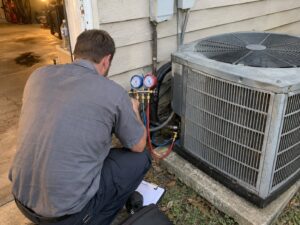
 AC Repair in Salt Lake County
An AC system that won’t cool on a 100°F afternoon isn’t really an HVAC problem — it’s a household emergency. We treat it that way. Same-day response under 2 hours for calls placed before noon during peak summer; same-day arrival on the vast majority of after-hours emergencies. The truck shows up with the parts that fix 80% of common no-cool calls already on board: capacitors in the most common sizes for residential equipment, contactors, fan motors for major brand lineups, refrigerant for both R-410A and R-454B systems, condensate pumps, and the diagnostic tools to identify the rest.
Most AC repair calls in this valley fall into a handful of patterns. We’ve seen most of them many times. Below is what we actually do when we show up, what the common failures look like, what they typically cost to repair, and when repair stops making sense relative to replacement.
What Happens on an AC Repair Call
Every diagnostic visit follows the same baseline, regardless of what you described on the phone:
- Visual inspection at the outdoor unit. Coil condition, fan blade integrity, lineset condition, disconnect, electrical service, condenser pad. Sometimes the diagnosis is visible from 6 feet away — a fan motor with the blade locked, a condenser coil packed with cottonwood seed, a lineset kinked by years of frost heave.
- Electrical readings at the outdoor unit. Disconnect voltage, contactor condition (pitting, voltage drop across the contacts), capacitor microfarad reading against rated value, compressor amp draw against nameplate, fan motor amp draw against nameplate.
- Refrigerant pressure and temperature readings. Suction and discharge pressures, suction line temperature for superheat calculation, liquid line temperature for subcool calculation. Refrigerant charge verified by superheat method on fixed-orifice systems or subcool on TXV/EEV systems — never by gauge pressure alone.
- Indoor unit inspection. Evaporator coil access (when possible), condensate pan and drain condition, blower compartment, filter condition, supply and return temperatures for delta-T calculation (typical target: 18–22°F across the evaporator coil).
- Static pressure measurement across the air handler. High static pressure (above 0.5″–0.7″ w.c.) usually points to a duct system problem that’s been slowly destroying the equipment for years — undersized return air, dirty filter, kinked flex duct, undersized supply trunk. This is the diagnostic most contractors skip, and the one that explains why an otherwise healthy system keeps failing components.
- Walk you through the findings. You see the meter readings as we take them. The diagnosis isn’t a verdict from a clipboard — it’s a conversation about what each measurement means and what the options are. Written repair quote before any work is performed.
Common AC Repair Calls We See
Failed Capacitor
The single most common no-cool call. A capacitor stores electrical charge needed to start the compressor and the condenser fan. As capacitors age, their actual capacitance drops below the rated value printed on the side. Below about 90% of rated value, motors struggle to start. Below about 70%, they don’t start at all.
- Symptoms: Outdoor unit hums but the fan doesn’t spin, or the compressor labors and trips on overload. Sometimes the fan starts but stalls quickly. AC cycles on but no cool air at the registers.
- Diagnosis: Capacitor microfarad reading against rated value. A 45/5 µF dual-run capacitor reading 38/4 µF is failing even though it hasn’t “failed” outright.
- Typical repair cost: $200–$400 depending on capacitor type and access. Most are completed in under an hour with parts stocked on our trucks.
Failed Contactor
The contactor is the relay that energizes the compressor and fan when the thermostat calls for cooling. Contactors fail in two ways: contacts weld closed (the unit runs constantly regardless of thermostat) or contacts pit and corrode (intermittent or no operation).
- Symptoms: Outdoor unit running with the thermostat off, intermittent no-cool calls that “fix themselves,” buzzing or clicking from the contactor without the unit starting.
- Diagnosis: Visual inspection of contact surfaces, voltage drop measurement across closed contacts (should be less than 0.5V).
- Typical repair cost: $250–$450. Often replaced preventatively when servicing other components if visible wear is significant.
Refrigerant Leak
Refrigerant doesn’t get “used up.” If your system is low on charge, it’s because refrigerant escaped somewhere. Common leak points: evaporator coil (particularly older formicary corrosion failures), refrigerant lineset connections, Schrader valve cores, condenser coil, brazed joints from the original install.
- Symptoms: System running constantly without holding temperature, ice formation on the suction line or evaporator coil, suction pressures below normal range, high superheat readings.
- Diagnosis: Electronic leak detector, soap bubble test at suspected joints, dye injection on intermittent leaks, sometimes nitrogen pressure test on isolated sections.
- Typical repair cost: $400–$1,400+ depending on leak location and quantity of refrigerant to recharge. R-454B and R-410A pricing varies; R-22 (on older systems) runs significantly higher due to phaseout.
- Important: We don’t recharge a leaking system without finding and repairing the leak. That practice — common in cheap service operations — wastes refrigerant, harms the environment, and leaves you paying for the same recharge again in 6 weeks.
Failed Compressor
The compressor is the most expensive component in a residential AC system. Failures usually trace to one of three causes: liquid floodback from undercharge or restriction, overheating from low refrigerant or high head pressure, or simple end-of-life mechanical failure on older equipment.
- Symptoms: Compressor trips on overload (clicks on and off), compressor draws high amperage above nameplate, compressor seized (no rotation, often verified by megohmmeter reading windings to ground), or compressor runs but produces no compression (high suction pressure, low discharge pressure).
- Diagnosis: Amp draw against nameplate, megohmmeter test of compressor windings to ground, suction-to-discharge pressure ratio check.
- Typical repair cost: $1,500–$3,500+ for compressor replacement plus refrigerant and labor. Often the trigger for repair-vs-replace consultation, particularly on systems over 10 years old where the compressor replacement cost approaches half the price of a new system.
Blower Motor Failure
The indoor blower moves conditioned air through the duct system. Failures show up as no airflow at the registers despite the outdoor unit running, motor seized or running at reduced speed, or the motor cycling on overload protection.
- Symptoms: Outdoor unit running but no cool air from the registers, weak airflow at supply registers, intermittent operation, or burning electrical smell from the air handler.
- Diagnosis: Amp draw against nameplate, ECM module diagnostic on variable-speed motors, motor bearing test.
- Typical repair cost: $500–$1,200 depending on motor type. ECM (variable-speed) motors are more expensive than PSC (single-speed) motors but typically last longer and run more efficiently.
Condensate Drain Blockage
The evaporator coil generates condensate (water) as it removes humidity from the air. If the drain line clogs, the condensate backs up — into the pan, then over the secondary drain pan, then into your ceiling or floor below the air handler. Float switches shut the system off before that happens, but the symptom (no cooling on a hot day) usually triggers the service call.
- Symptoms: Air conditioner not running despite thermostat call, water in the secondary drain pan, ceiling stains below the air handler, float switch tripped.
- Diagnosis: Visual inspection of drain line and pan, wet-vac test of drain line, float switch continuity check.
- Typical repair cost: $175–$350. Often combined with condensate pan tablet treatment to prevent re-clogging.
Frozen Evaporator Coil
An evaporator coil that’s iced over can’t transfer heat from the air. The system runs but doesn’t cool. Three primary causes: insufficient airflow across the coil (dirty filter, blower issue, undersized return air), low refrigerant charge (leak), or operating in conditions below the system’s design temperature (running AC when outside is 55°F).
- Symptoms: Visible ice on the suction line or visible through inspection ports on the indoor coil, AC running but no cool air, water leaking from the air handler as the ice melts after shutdown.
- Diagnosis: Visual inspection (after defrost), airflow measurement, refrigerant charge verification.
- Typical repair cost: Depends on root cause. Dirty filter is a $0 fix (we’ll show you how to prevent it). Airflow restriction or duct issue can range $200–$1,500. Refrigerant leak follows the leak repair cost structure above.
When Repair Stops Making Sense
The honest answer involves math, not a sales pitch. We use a simple framework:
- System under 8 years old: Repair almost always wins. Equipment has substantial useful life remaining; manufacturer warranty may cover the part.
- System 8–12 years old: Repair-vs-replace depends on the repair cost. If repair exceeds 30% of replacement cost, replacement starts to look better. If repair is under 30%, repair usually wins.
- System over 12 years old: Major component failure (compressor, evaporator coil, heat exchanger on the matched furnace) typically tips toward replacement. Minor repairs (capacitor, contactor, blower motor) still favor repair.
- System over 15 years old, on R-22 refrigerant: Replacement almost always wins. R-22 is phased out of production; recovered R-22 costs are high and rising. Repairs that require recharge become uneconomical.
When we run the math, you see the numbers — current repair cost, projected near-term repair costs, energy efficiency savings from a new system (modeled against your actual utility bills if you have them), and remaining equipment lifespan. You make the call. We don’t pressure either direction.
Same-Day and Emergency Response
During peak summer (June–September), our dispatch prioritizes:
- Emergencies — extreme heat with vulnerable household members (elderly, infants, medically vulnerable), suspected refrigerant leaks in occupied spaces, electrical issues with smoke or burning odor
- Same-day non-emergency — no-cool calls without immediate safety concerns, typically scheduled within 2–4 hours of the call
- Next-day scheduled — for less urgent issues or when same-day capacity is full
Our service trucks stock the parts that fix the majority of common no-cool calls — capacitors in standard sizes (45/5, 35/5, 40/5, 50/5 dual-run), contactors for 24V residential equipment, common condenser fan motors, condensate pumps, and refrigerant for both R-410A and R-454B systems. Most repairs complete on the first visit.
Brands We Service
We service most major HVAC brands — Trane, Carrier, Lennox, Goodman, Rheem, Mitsubishi, Bryant, Daikin, American Standard, York, Coleman, Heil, Tempstar, Comfortmaker, Amana, Ruud, Payne, Maytag, and Frigidaire HVAC equipment. For ductless systems we service Mitsubishi, Daikin, Fujitsu, LG, Samsung, and most major brands. Brand age and model don’t matter much for diagnostic work — the physics is the same. Parts availability for very old or obscure equipment can affect repair timelines; we’ll quote parts lead time before committing.
What We Don’t Do on Repair Calls
- We don’t condemn equipment that’s still functional. If your system is working and the diagnostic shows it’s healthy, we tell you that and leave. Some contractors find a “problem” on every service call. We don’t.
- We don’t recharge leaking systems without finding the leak. Cheap to do, dishonest, and bad for the environment.
- We don’t pressure-sell new systems on a $300 repair. If your system has 5 good years left and the repair makes economic sense, we recommend the repair.
- We don’t charge for diagnostic work that turns up nothing. If we can’t find a problem on your system (yes, it happens — sometimes a thermostat batteries issue or a tripped breaker is the answer), we don’t manufacture one.
Frequently Asked Questions
- How much does an AC repair cost in Salt Lake County?
- Most common repairs run $150–$650. Specific common ranges: capacitor replacement $200–$400, contactor replacement $250–$450, condensate drain clearance $175–$350, fan motor replacement $500–$900, refrigerant leak repair plus recharge $400–$1,400+. Compressor replacement runs $1,500–$3,500+ and often triggers a repair-vs-replace conversation on older systems.
- Do you charge a diagnostic fee?
- Yes — we charge a diagnostic fee to come out and properly assess the system with real measurements. The diagnostic fee is applied toward any repair work we perform that same visit. We quote the exact diagnostic fee when you call so there are no surprises.
- How fast can you get to me during peak summer?
- Same-day response under 2 hours for calls placed before noon during peak summer. Emergency calls with vulnerable household members (elderly, infants, medically vulnerable, extreme heat) are prioritized. After-hours emergency calls get same-day arrival on the vast majority of cases.
- Will my AC repair be covered by manufacturer warranty?
- Possibly. Most major manufacturers warrant compressor and major functional components for 10 years from installation when properly registered. The warranty covers the part itself, not labor for the repair. If your equipment is within the warranty window and the failed part is covered, we file the warranty claim with the manufacturer on your behalf and you pay only the labor portion.
- My AC was working last week and now it’s not. What happened?
- Most common causes for sudden no-cool failure: blown capacitor, tripped breaker, blocked condensate drain (which trips a float switch and shuts the unit down), failed contactor, or refrigerant leak that finally crossed the operational threshold. Less commonly: a power surge took out a control board, or the thermostat itself failed. A diagnostic visit identifies the actual cause in 30–60 minutes.
- Can I fix my AC myself?
- A few things, yes. Replacing the air filter, clearing leaves and debris from the outdoor coil, making sure the thermostat is properly set, and resetting a tripped breaker are reasonable homeowner tasks. Anything involving refrigerant, electrical components inside the equipment, or capacitors (which store dangerous charge even with power disconnected) should be left to a licensed and EPA 608-certified technician. DIY repairs that fail can void manufacturer warranty.
- What’s the difference between AC repair and AC tune-up?
- Repair addresses something that’s broken right now. Tune-up is preventive maintenance — coil cleaning, refrigerant charge verification, electrical inspection, condensate line flush — done annually before peak cooling season to catch marginal components before they fail. Tune-ups are scheduled and cheaper; repairs are reactive and more expensive. Customers who maintain annual tune-ups have fewer emergency calls.
Schedule AC Repair
If your AC isn’t cooling and you’re in Salt Lake County, we can almost certainly get to you today. Call (385) 250-0687 or email info@aegisheatingandair.xyz. For after-hours emergencies, the same number routes to our on-call technician.
- Phone: (385) 250-0687
- Email: info@aegisheatingandair.xyz
- Address: 4454 Manhattan Ct, West Valley City, UT 84120