
Furnace installation in Salt Lake City at a glance: Aegis Heating and Air, Utah DOPL S350 License 7482916-5501, has served Salt Lake City since 2017 from our shop at 4454 Manhattan Ct, West Valley City. Typical price $3,000–$7,000, with a free written estimate, usually within 24 hours of the visit. Emergency line answered live 24/7; arrival in Salt Lake City is typically under 60 minutes. Installs carry a 24-month workmanship warranty and up to 10 years of manufacturer parts coverage on eligible systems. Own W-2 technicians, never subcontractors.
- Typical furnace installation or replacement $3,000–$7,000. Free written estimate.
- 24-month installation workmanship warranty plus up to 10 years manufacturer parts on eligible registered systems (warranty)
- Arrival: typically under 60 minutes from our West Valley City shop (how arrival times work); emergency line answered live 24/7
- Utah DOPL S350 License 7482916-5501 · insured and bonded · NATE-certified and EPA 608 Universal technicians
(385) 250-0687 · All HVAC services in Salt Lake City · Pricing
Furnace installation in Salt Lake City covers more equipment scenarios than installation work in any other community we serve. The city’s century-plus housing stock means installation work includes everything from modulating condensing boiler replacement in historic Avenues homes through atmospheric-vent-to-sealed-combustion conversions in mid-century neighborhoods to current-generation modulating equipment replacement in newer construction and heat pump conversions across all eras. Some Salt Lake City installations involve boilers serving hot-water radiator distribution systems that have warmed the same homes for a century or more. Others involve modern equipment in homes built within the last few years. The right installation approach depends on what your home actually is, not on standard residential HVAC patterns.
Our installation work in Salt Lake City emphasizes appropriate solutions for each specific home and existing distribution system. Boiler installations preserve hot-water radiator distribution where it works well, with modern modulating condensing equipment that delivers efficiency improvements without distribution disruption. Rocky Mountain Power Wattsmart and Enbridge Gas ThermWise (formerly Dominion Energy) rebates may apply to qualifying equipment; the federal 25C tax credit ended on December 31, 2025. Mini-split heat pump installations provide cooling and supplemental heating for historic homes where central distribution isn’t practical. Documented commissioning with combustion analysis verifies safe and efficient operation across all installation types.
Below is what proper Salt Lake City furnace installation involves, common scenarios, equipment options across price tiers, and how to think about installation decisions.
Common Salt Lake City Installation Scenarios
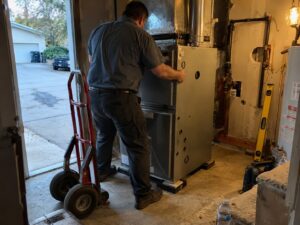
Boiler Installation/Replacement (Historic Homes)
Historic Salt Lake City homes with hot-water radiator distribution systems sometimes need boiler replacement when existing equipment reaches end of service life.
Equipment options:
- Cast iron atmospheric-vent boiler — replacement matching existing equipment style. Less efficient but appropriate when existing distribution is suitable
- Mid-efficiency induced-draft boiler — modest efficiency improvement, easier venting
- Modulating condensing boiler — best efficiency, requires lower supply temperatures for proper condensing operation
- Premium European modulating condensing — high-end equipment, best modulation and efficiency
- Combination boiler — boiler plus domestic hot water in one unit
Project considerations:
- Existing radiator system suitability — cast-iron radiators typically work well with modulating condensing boilers at appropriate supply temperatures
- System pressure verification (12–15 PSI cold, relief at 30 PSI)
- Expansion tank sizing and condition
- Circulator pump configuration
- Zone valves and zoning configuration
- Venting changes from atmospheric to direct-vent or PVC venting on condensing equipment
- Domestic hot water integration if installing combination boiler
Typical boiler installation pricing:
- Cast iron atmospheric-vent boiler: $7,500–$11,000
- Mid-efficiency induced-draft boiler: $8,500–$13,000
- Modulating condensing boiler: $10,000–$15,000
- Premium European modulating condensing: $12,000–$18,000
- Combination boiler: $11,000–$17,000
See our boiler installation page for detailed boiler information.
Multi-Zone Mini-Split Installation (Historic Homes Without Boilers)
For historic Salt Lake City homes without hot-water heating systems, mini-split heat pump systems provide both heating and cooling without requiring central duct installation that doesn’t fit historic homes.
Mini-split pricing:
- Single-zone mini-split: $4,500–$8,500
- 2-zone system: $8,500–$13,000
- 3–4 zone system: $13,000–$20,000
- 5+ zone system: $22,000–$32,000+
Rocky Mountain Power Wattsmart and Enbridge Gas ThermWise (formerly Dominion Energy) rebates may apply to qualifying equipment; the federal 25C tax credit ended on December 31, 2025.
Atmospheric-Vent to Sealed-Combustion Conversion (Mid-Century Homes)
Standard mid-century home scenario — 80% AFUE atmospheric-vent furnace replaced with 90–98% AFUE sealed-combustion condensing furnace. Project includes chimney venting evaluation, water heater venting resolution, PVC venting installation, combustion air intake provisions, condensate drainage installation, gas line verification, ductwork evaluation, and thermostat upgrade.
Typical pricing:
- 80% AFUE replacement: $4,500–$7,500
- 96% AFUE single-stage condensing: $5,500–$8,500
- 96% AFUE two-stage: $7,000–$11,000
- 96–98% AFUE modulating condensing: $9,500–$14,000
Heat Pump Conversion (All-Electric or Dual-Fuel)
Heat pumps as alternative to gas furnaces. Rocky Mountain Power Wattsmart and Enbridge Gas ThermWise (formerly Dominion Energy) rebates may apply to qualifying equipment; the federal 25C tax credit ended on December 31, 2025.
Heat pump pricing:
- Standard heat pump: $6,500–$10,500
- Two-stage heat pump: $9,000–$14,000
- Variable-speed heat pump: $14,000–$22,000
- Dual-fuel system: $14,000–$24,000
Modern Equipment Replacement
Replacing first-generation high-efficiency furnaces with current equipment. Simpler than atmospheric-vent conversions because sealed combustion infrastructure already in place.
Complete System Replacement
Both heating and cooling equipment replaced together.
Typical pricing:
- Standard combined system: $10,000–$16,000
- Two-stage combined system: $14,000–$22,000
- Variable-speed combined system: $18,000–$28,000+
What Proper Furnace Installation Includes
Manual J Load Calculation
Proper sizing based on home characteristics. Salt Lake City’s older housing stock often has different load characteristics than newer construction.
Altitude-Corrected Combustion
Salt Lake City elevation varies 4,200–5,000 feet across neighborhoods. Equipment specifications applied per manufacturer requirements for actual elevation. Gas pressures, combustion settings, and equipment selection all account for altitude.
Sealed-Combustion Venting
PVC venting through exterior walls with proper sizing, slope, termination clearances, and combustion air intake. For historic homes, venting routing accounts for architectural considerations and aesthetic preservation.
Water Heater Venting Resolution
Standard atmospheric-vent furnace replacement scenario — when furnace stops using chimney, water heater venting needs attention. We include this in every atmospheric-vent furnace replacement project.
Condensate Management
Primary drainage with proper trap and slope, secondary pan, neutralizer where required, condensate pump where no gravity drain available.
Gas Line Verification
Inlet pressure, manifold pressure adjustment to altitude-corrected specifications, capacity verification, leak testing. Gas line work performed by Travis Hollings under his Utah journeyman plumber endorsement.
Documented Commissioning
Written commissioning report including combustion analysis, gas pressures, temperature rise, static pressure, electrical readings, safety control verification, and indoor CO measurement. Boiler commissioning includes pressure verification, supply/return temperatures, circulator operation, and zone control verification.
Rebates and Tax Credits
- Federal 25C tax credit — up to $600 on qualifying furnaces, up to $2,000 on qualifying heat pumps (including mini-split heat pumps and qualifying boilers)
- Enbridge Gas ThermWise (formerly Dominion Energy) rebates on qualifying natural gas equipment
- Rocky Mountain Power Wattsmart rebates on qualifying heat pumps
- IRA Home Electrification rebates — up to $8,000 for income-qualified heat pump installations
Frequently Asked Questions
How much does furnace installation cost in Salt Lake City? Varies by equipment type. Gas furnace replacement $4,500–$14,000. Boiler installation $7,500–$18,000. Heat pump installation $6,500–$22,000. Dual-fuel system $14,000–$24,000. Mini-split installation $4,500–$32,000+. Combined system replacement $10,000–$28,000+.
How long does installation take in Salt Lake City? Modern equipment replacement typically 1 day. Atmospheric-vent conversion 1–2 days. Boiler replacement 1–2 days depending on distribution complexity. Heat pump installation 1 day. Mini-split installations 1–3 days depending on zone count. Combined system replacement 1–2 days.
Do you install boilers in historic Avenues and Capitol Hill homes? Yes. Salt Lake City’s historic housing stock with hot-water radiator distribution systems is an area where we have substantial installation experience. We install equipment across multiple tiers from cast-iron atmospheric-vent replacement through premium modulating condensing equipment. Project scope depends on existing distribution suitability and customer priorities.
Should I convert from boiler to forced-air heating? Generally no, unless you’re doing major renovation that justifies the disruption. Hot-water radiator distribution provides comfortable, quiet heating that many customers prefer over forced-air systems. The expense of converting from hydronic to forced-air heating (new ductwork installation, plus furnace and AC equipment) typically exceeds the benefits unless you’re doing major renovation anyway. Modern modulating condensing boiler replacement preserves the radiator distribution with significant efficiency improvements.
Can I add central AC during boiler replacement? Not directly, since boilers don’t provide cooling and your home doesn’t have central AC distribution. But you can add cooling capability through mini-split heat pump installation as a separate project. Mini-split systems work well with boiler heating systems — heating from boiler, cooling from mini-splits. We sometimes combine boiler replacement with mini-split installation as a coordinated project.
Should I get a heat pump? Rocky Mountain Power Wattsmart and Enbridge Gas ThermWise (formerly Dominion Energy) rebates may apply to qualifying equipment; the federal 25C tax credit ended on December 31, 2025. Dual-fuel systems eliminate concerns about severe cold performance.
What rebates apply? The federal 25C tax credit ended on December 31, 2025. Enbridge Gas ThermWise (formerly Dominion Energy) rebates on natural gas equipment. Rocky Mountain Power Wattsmart rebates on heat pumps. We model all incentives in installation quotes.
Schedule Furnace Installation in Salt Lake City
Call our shop at (385) 250-0687 for furnace and boiler installation in Salt Lake City. In-home estimates include Manual J load calculation, appropriate equipment recommendations across price tiers, boiler vs. forced-air evaluation for historic homes, modeled rebates and tax credits, and financing options.
- Phone: (385) 250-0687
- Email: info@aegisheatingandair.xyz
- Address: 4454 Manhattan Ct, West Valley City, UT 84120
Same service nearby: Furnace Installation West Valley City, UT · Furnace Installation Kearns, UT · Furnace Installation Magna, UT · Furnace Installation Taylorsville, UT · Furnace Installation West Jordan, UT
Book a visit in Salt Lake City, Utah
Aegis Heating and Air is a licensed HVAC contractor based in West Valley City. Our own technicians do the work. You see the price first.
- Free written estimate
- Manual J load calculation on every install
- Typical furnace installation: $3,000–$7,000
- Gas piping covered by our S350 license
- Typically under 60 minutes to Salt Lake City from our West Valley City shop
- Utah DOPL S350 License 7482916-5501 · insured and bonded
Helpful guides
Verify HVAC credentials
Our installation standards
- A free written estimate, with the equipment and price spelled out, usually in your inbox within 24 hours of the visit.
- A Manual J load calculation to size the system for your home.
- Permit filing and inspection coordination on every install.
- Installed by our own W-2 technicians, never subcontractors.
- Manufacturer warranty registration done for you, for up to 10 years of parts coverage on eligible systems.
- A 24-month installation workmanship warranty, transferable once, with an optional 10-year labor warranty available at install ($400–$1,200).
- A check-in 30 days after every install.
Furnace installation prices by system type
| System | Typical installed price |
|---|---|
| 80% AFUE single-stage furnace | $4,500–$7,500 |
| 96–98% AFUE two-stage furnace | $7,000–$11,000 |
| Modulating, variable-speed furnace | $9,500–$14,000 |
Enbridge Gas ThermWise rebates (formerly Dominion Energy) may apply to qualifying high-efficiency furnaces.
Prices are typical ranges for Salt Lake County homes; your free written estimate (usually within 24 hours of the visit) gives the exact price. Financing through Synchrony Bank and Service Finance Company, subject to credit approval.