
Air Filter Replacement in Salt Lake County
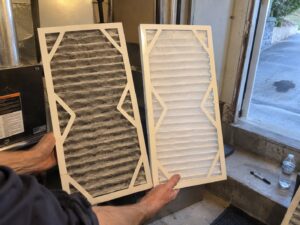
The air filter is the most-neglected component in residential HVAC. It costs $5–$25, gets replaced on a homeowner-managed schedule (or doesn’t), affects equipment performance more than almost any other variable, and produces problems ranging from elevated electric bills to premature equipment failure when it’s not handled correctly. The biggest performance issues we see during diagnostic visits — equipment overheating on limit switches, evaporator coils icing over, blower motors drawing excessive amperage, systems short-cycling — trace back to filter issues more often than to any other single cause. A correctly sized, properly chosen, regularly replaced filter is the most impactful thing most homeowners can do for their HVAC system.
And yet most homes are running the wrong filter. Either too restrictive (high-MERV 1″ filters that choke the system), too cheap (fiberglass that doesn’t actually filter anything), too small (filters that don’t seal properly in their slot), too old (filters that have been in service for 6 months when they should have been changed at 30 days), or simply absent (homeowners who didn’t realize they had a filter to change, or contractors who never told them where it was). Below is what right looks like — how to choose the right filter for your specific equipment, when to replace it, what sealing and sizing problems to watch for, and when to upgrade from a basic 1″ filter to a media filter cabinet that handles higher-MERV filtration properly.
Why Filters Matter More Than Most Homeowners Realize
Air filters perform two functions that the contractor industry has historically blended in confusing ways:
Equipment Protection
The original purpose of HVAC filters was protecting the equipment — keeping dust and debris from accumulating on the blower wheel, the evaporator coil, the heat exchanger, and the various internal surfaces where buildup degrades performance. Even a low-MERV filter (rated 5–8) provides adequate equipment protection for most residential systems.
What happens without adequate filtration: blower wheels accumulate visible dust buildup that reduces airflow and increases motor amp draw; evaporator coils develop dust film that reduces heat transfer; heat exchangers accumulate debris that affects combustion patterns. None of these failures happen quickly, but over years of operation, neglected filtration measurably degrades equipment and shortens useful life.
Indoor Air Quality
The secondary purpose, increasingly important in modern HVAC, is filtering particulates from the indoor air stream — pollen, dust mite particles, pet dander, mold spores, smoke particles, PM2.5 from outdoor pollution sources, and the various household particulates that accumulate in indoor air. This function requires higher-MERV filters (typically 11–16) that capture finer particulates than equipment protection alone needs.
What happens with inadequate IAQ filtration: indoor particulate levels track closely with outdoor levels, allergens and irritants stay in indoor air longer, household members with respiratory sensitivities experience more symptoms, and the home’s overall air quality during pollution events (Salt Lake’s winter inversions, summer ozone, wildfire smoke) becomes much worse than necessary.
Filter Types and What Each Does
Fiberglass Filters
The cheapest option — typically $1–$3 per filter. Rated MERV 1–4, which means they capture only the largest particulates (visible lint, large dust). They don’t significantly filter pollen, dander, smoke, or any fine particulates. They’re sometimes called “spun glass” or “throwaway” filters.
- Adequate for: Bare-minimum equipment protection on basic HVAC systems
- Not adequate for: Any indoor air quality goal, any high-efficiency HVAC equipment that requires better airflow consistency, homes with allergy concerns, or homes during inversion season
- Our recommendation: Upgrade. Even basic pleated filters provide much better filtration at modestly higher cost.
Standard Pleated Filters (MERV 5–8)
The most common residential filter — pleated synthetic media in a cardboard frame, typically $4–$10 per filter. Rated MERV 5–8 depending on specific product. These capture larger dust, pollen, mold spores, and pet dander adequately while maintaining reasonable airflow.
- Adequate for: Basic indoor air quality, standard HVAC equipment protection, homes without significant respiratory concerns
- Replacement schedule: Every 30–90 days depending on home conditions (more frequent in homes with pets, smokers, dusty conditions, or during inversion season)
- Our recommendation: The minimum we’d suggest for most homes. Reliable, widely available, modest cost.
Higher-MERV Pleated Filters (MERV 9–12)
Pleated filters with denser media or more pleats per inch, typically $8–$20 per filter. Rated MERV 9–12, capturing finer particulates including some bacteria-sized particles, smoke particles, and finer PM2.5.
- Adequate for: Improved indoor air quality, homes with mild allergy concerns, basic inversion-season filtration improvement
- Caution: Can create excessive static pressure on HVAC systems not designed for higher-MERV filtration. We verify static pressure before recommending MERV 9–12 in standard 1″ filter slots.
- Replacement schedule: Every 30–60 days due to faster loading from finer filtration
MERV-13 in Standard 1″ Slots
Possible but problematic. MERV-13 in a 1″ filter creates significant airflow restriction — the dense filtration media necessary to capture PM2.5 produces substantial pressure drop that most residential HVAC systems aren’t designed to handle. Symptoms include reduced cooling capacity, increased blower motor amp draw, evaporator coil freezing in summer, and limit switch trips in winter.
If you want MERV-13 filtration (the right answer for inversion-season PM2.5 reduction), you should install a 4–5″ deep media filter cabinet rather than trying to force MERV-13 into a standard 1″ slot. We address this in detail on our air purifier page.
4–5″ Deep Media Filters
The sweet spot for residential air filtration. A 4–5″ deep media filter has dramatically more surface area than a 1″ filter at the same nominal dimensions — typically 6–10 times more. This allows MERV-13 (and even MERV-16 in some configurations) without the airflow restriction problems that 1″ high-MERV filters create.
- Captures: PM2.5 and finer particulates, pollen, dander, mold spores, smoke particles, allergens — meaningful inversion-season filtration
- Replacement schedule: Every 6–12 months due to the high surface area providing extended service life
- Installation requirement: Replacing the standard 1″ filter slot with a 4–5″ deep cabinet (typically $450–$900 installed)
- Filter cost: $40–$80 per replacement filter
- Lifetime cost: Often lower than maintaining MERV-13 in 1″ slots because the longer service intervals offset the higher per-filter cost
Washable Filters
Sometimes marketed as “permanent” or “lifetime” filters that you wash rather than replace. Typically MERV 6–8 equivalent. Theoretically environmentally appealing but practically problematic:
- Washing rarely removes embedded particulates completely
- Improperly dried filters reintroduce moisture and possible biological growth into the HVAC system
- Cleaning compliance is poor — most customers don’t wash filters as often as they should
- Performance degrades over time even with washing
We don’t typically recommend washable filters for residential HVAC. The marginal environmental benefit doesn’t offset the practical filtration compromise.
How Often to Replace Filters
The “monthly filter change” advice common in homeowner literature is sometimes right and sometimes overstated. Actual replacement schedule depends on filter type and home conditions:
Standard 1″ Pleated Filters (MERV 5–8)
- Typical residential conditions: Every 60–90 days
- Homes with pets: Every 30–60 days
- Homes with multiple pets or significant shedding: Every 30 days
- Homes with smokers: Every 30–45 days
- During Salt Lake inversion season (typically November–February): Every 30 days regardless of other conditions
- During wildfire smoke events: Every 15–30 days
Higher-MERV 1″ Filters (MERV 9–12)
- Typical conditions: Every 30–60 days
- Inversion season: Every 30 days minimum
4–5″ Media Filters (MERV 13+)
- Typical conditions: Every 6–12 months
- Inversion-heavy homes or homes with pets: Every 4–6 months
Visual Inspection Guide
If you’re uncertain about your filter’s status, pull it out and look at it. Replace when:
- The filter media is visibly gray or dark gray with accumulated particulates (clean filters are bright white or light tan depending on media color)
- You can see particulate buildup on the surface from a normal viewing distance
- Light visibly fails to pass through the filter when held up to a window or bright light
- The filter feels heavier than a new equivalent filter
- You see any visible mold spots, water staining, or biological growth
Filters that show any of these signs are past due for replacement.
Common Filter Mistakes We See
Wrong Size
Filters that don’t fit properly allow air to bypass around the filter rather than passing through it. Most common version: customers buying “close enough” filter sizes (a 20×25 when the slot is actually 20×24, or a 16x25x1 when the slot is sized for 16x25x4). The filter looks like it fits but leaves gaps where unfiltered air bypasses the media. We verify exact slot dimensions and recommend correct filter sizes.
Wrong MERV for the System
MERV-11 or higher in a 1″ slot can create static pressure problems on systems that weren’t designed for it. Symptoms develop slowly — slightly reduced cooling capacity, slightly higher blower amp draw, eventually evaporator freezing or limit switch trips. We check static pressure when customers ask about high-MERV upgrades and recommend filter cabinet replacement when the system can’t handle higher-MERV in 1″ format.
Improper Orientation
Most pleated filters have a directional indicator (arrow showing airflow direction). Installed backwards, the filter still works but the cardboard frame faces the dirty side, where it’s more vulnerable to debris loading and frame degradation. Filters installed with the airflow arrow pointing the wrong way fail prematurely. We verify proper orientation during installation.
Poor Seal at the Filter Slot
Filter slots that leak air around the filter (rather than through it) bypass the filtration entirely. Common causes: damaged filter rack hinges, missing slot covers, oversized filter slot openings, or cabinet panels that don’t seal properly. Bypass air loaded with particulates accumulates on the blower wheel and evaporator coil despite the filter being in place. We inspect and repair filter slot sealing as part of filtration upgrades.
Skipping Replacements
Filters that should have been replaced 6 months ago and are still in service. The filter is restricting airflow significantly, the blower is working harder, and the system is operating outside design conditions. We sometimes find filters in HVAC systems that have visibly been there for 18+ months — heavily loaded, partially collapsed from negative pressure, and completely compromised. Replacement is overdue.
Air Filter Service We Provide
Standard Filter Replacement
We can replace your filter during any service visit (tune-up, repair, or scheduled maintenance). For maintenance plan customers, we stock common filter sizes at our shop and include replacement during scheduled visits.
Media Filter Cabinet Installation
Replacing the standard 1″ filter slot with a 4–5″ deep media filter cabinet that handles MERV-13 properly. The most impactful single IAQ upgrade for most homes. Installation runs $450–$900 depending on cabinet selection and existing duct configuration. See our air purifier page for detailed information.
Filter Slot Repair
For filter slots that leak air around the filter (compromising filtration regardless of filter quality), we can repair or replace the slot to eliminate bypass air. Typically $150–$400 depending on damage.
Bulk Filter Supply for Maintenance Plans
Maintenance plan customers can include filter replacement in their service plan. We stock filters at our shop, replace during scheduled visits, and customers don’t need to remember filter purchase or schedule independently.
Air Filter Service Costs
- Standard pleated filter replacement (during service visit): Filter cost only ($5–$25 retail) — typically included in service visit fee, not separately billed
- Media filter cabinet installation (replacing 1″ slot with 4–5″ media cabinet): $450–$900 installed
- Replacement media filter: $40–$80 every 6–12 months
- Filter slot repair (bypass elimination): $150–$400 depending on damage
- Custom filter sizing for non-standard installations: priced case-by-case
- Maintenance plan filter service: included in some maintenance plans, otherwise filter cost plus minimal service charge during regular visits
Frequently Asked Questions
- How often should I change my air filter?
- Standard 1″ pleated filters (MERV 5–8) every 60–90 days under typical conditions; every 30 days during Salt Lake inversion season, with pets, or during wildfire smoke events. Higher-MERV 1″ filters every 30–60 days. 4–5″ media filters every 6–12 months. Visual inspection is the best guide — replace when filters are visibly loaded with particulates.
- What MERV rating should I use?
- For standard 1″ filter slots: MERV 8 for basic equipment protection; MERV 11 for improved IAQ if your system can handle the static pressure. For meaningful indoor air quality improvement during inversion season: install a 4–5″ media filter cabinet that handles MERV-13 properly. Going beyond MERV-13 typically requires HEPA bypass installation.
- Can I use a high-MERV filter in my existing 1″ slot?
- Sometimes yes, sometimes no — depends on your specific HVAC system’s design and current static pressure. We can measure static pressure to verify whether higher-MERV filtration is safe for your system. If it isn’t, the better solution is a 4–5″ media filter cabinet that delivers high-MERV filtration without the airflow restriction problems that 1″ high-MERV filters create.
- Where is my air filter located?
- Most residential systems have the filter at the return air intake — either at a wall or ceiling-mounted return grille, or in a filter slot at the air handler itself. Some systems have multiple filters at multiple return grilles. If you can’t locate your filter, we can identify it during any service visit and show you the filter location and proper size.
- Will a higher-MERV filter help with my allergies?
- Likely yes, if installed properly. MERV-11 filters capture pollen, dander, and many allergens that MERV-8 doesn’t capture as effectively. MERV-13 (in proper 4–5″ media cabinet) captures even finer allergens and PM2.5. For severe allergy sufferers, MERV-13 plus HEPA bypass typically delivers the best results. We assess your specific situation and recommend appropriate filtration.
- Do fancy filters with extra features (antimicrobial, charcoal, etc.) work better?
- Mostly no. “Antimicrobial-treated” filters add marginal value if any — most pathogens captured in the filter aren’t going anywhere whether or not the filter has antimicrobial coating. Carbon-impregnated filters provide modest odor reduction but quickly become saturated. Pay attention to MERV rating (which measures actual filtration efficiency) more than to marketing claims about added features.
- Should I have someone replace my filter or do it myself?
- Most homeowners can replace filters themselves — it’s a 2-minute task with no special tools needed. For maintenance plan customers, we replace filters during scheduled service visits as part of the plan. If you’d prefer not to handle it yourself or want assurance the right filter is being installed correctly, we can include filter replacement in any service visit.
Schedule Air Filter Service
If you’re not sure what filter your system needs, when it was last replaced, or whether your current filter is the right type for your equipment, call (385) 250-0687. We can check during any service visit, recommend correct filter size and type, install a media filter cabinet for improved IAQ, or just confirm you’re using the right filter on the right schedule.
- Phone: (385) 250-0687
- Email: info@aegisheatingandair.xyz
- Address: 4454 Manhattan Ct, West Valley City, UT 84120