
AC Tune-Up in Salt Lake County
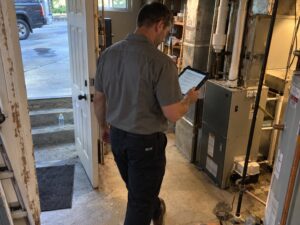
Most central air conditioning failures don’t happen randomly — they happen at the worst possible moment. A capacitor that was reading 38 µF instead of its rated 45 µF in April finally fails on a 103°F afternoon in July. A condensate drain that was 60% blocked all spring finally clogs over a holiday weekend and trips the float switch. A refrigerant charge that was drifting low all winter finally crosses the threshold where the system can’t maintain temperature on the first 95°F day. Each of those failures was visible to anyone measuring with the right tools. Each of them is what a spring AC tune-up is designed to catch.
The math is straightforward. A $130 tune-up that catches a marginal capacitor before it fails saves you a $400 emergency service call. A flush of the condensate line prevents a $500 ceiling repair from water overflow. A refrigerant top-off after we’ve found and fixed a small leak prevents a compressor failure that could run $2,000+. Beyond the immediate savings, most manufacturer warranties require documented annual professional maintenance to remain valid — skip the tune-up, and a 10-year compressor warranty can become a denied claim.
Below is what’s included in an Aegis AC tune-up, when to schedule it, what we’re looking for, and what we’ll do if we find something that needs attention.
What’s Included in an Aegis AC Tune-Up
An AC tune-up is more than a coil rinse. Every tune-up we perform includes the following measurements and services:
Outdoor Condenser Service
- Coil cleaning — fin straightening where bent, full coil rinse with appropriate cleaner for the coil type (aluminum mic-channel coils require different chemistry than copper-aluminum slab coils), debris removal from coil and unit interior
- Fan motor inspection — bearing condition, blade balance and alignment, amp draw against nameplate
- Capacitor test — microfarad reading on each side of dual-run capacitors against rated value; replacement recommended if reading drops below 90% of rated
- Contactor inspection — visual check of contact surfaces for pitting or burning, voltage drop measurement across closed contacts
- Compressor amp draw against nameplate; abnormal readings flagged for further diagnostic
- Electrical connections — tightness check on all field-wired connections, surge protector inspection if present
- Refrigerant line insulation — visual check on suction line insulation; degraded insulation causes efficiency loss and condensation problems
- Disconnect inspection — proper sizing, correct fusing, weatherproof condition
Refrigerant System Verification
- Suction and discharge pressure readings at actual operating conditions
- Superheat measurement (fixed-orifice systems) or subcool measurement (TXV/EEV systems) — the only reliable methods to verify refrigerant charge
- Suction line and liquid line temperature readings
- Leak inspection at exposed brazed joints, flares, and Schrader valves; electronic leak detection if charge is low
Indoor Air Handler Service
- Evaporator coil inspection through access panel — visual check for ice formation patterns, biological growth, debris accumulation
- Blower motor amp draw against nameplate
- Blower wheel inspection for dirt accumulation (a common cause of reduced airflow on neglected systems)
- Static pressure measurement across the air handler — the single best indicator of duct system health and the diagnostic most contractors skip
- Supply and return temperature differential measurement (typical target: 18–22°F across the evaporator coil)
- Filter inspection and replacement if needed (standard pleated filters typically included; high-MERV media filters are an add-on)
Condensate System Service
- Drain line flush with wet-vac and chemical treatment to clear partial blockages before they cause overflow
- Condensate pan inspection — checking for cracks, corrosion, biological growth, proper pitch toward drain
- Float switch test on systems with secondary drain pan protection — verifying the switch actually disables the system if water rises
- Drain trap inspection — proper depth, no dry-out, no algae blockage
Thermostat and Controls Verification
- Thermostat calibration check against actual room temperature
- Staging configuration verified for two-stage and variable-capacity equipment
- Programmable schedule review (if you want our help optimizing it)
- Communication verification on smart thermostats with cloud connectivity
Documentation
- Tune-up report emailed to you with all measurements recorded
- Photos of any findings (coil before/after cleaning, capacitor reading, static pressure gauge reading)
- Recommendations for any issues identified, with written quotes if you’d like repair work performed
- Maintenance record added to your customer file — useful for warranty claims later
When to Schedule AC Tune-Up
Spring is the right answer — before the first 90°F day. Specifically:
- April through early May is ideal. The weather is mild, our schedule is open, and any repairs identified by the tune-up can be completed before peak cooling demand.
- Late May and June work too but our schedule starts filling as the first heat wave approaches.
- July and August are when most customers call for tune-up — usually right after their AC has an issue. By that point, repairs and emergency calls dominate the schedule and tune-up appointments are harder to book quickly.
For heat pumps that run year-round, we recommend two tune-ups per year — spring for cooling-side verification, fall for heating-side verification. The system runs as both an AC and a heater, so it sees twice the hours and benefits from twice the maintenance.
What We Look for in the Salt Lake Valley Specifically
Cottonwood Seed Accumulation
Late May and June drop massive amounts of cottonwood seed across the valley. The fluffy seed packs into outdoor condenser coils and severely restricts airflow. A tune-up in early May, before the cottonwood drops, catches the unit clean. A tune-up in July often involves significant coil cleaning to clear accumulated seed that’s been baking onto the coil for weeks. We recommend a coil rinse mid-summer for properties near cottonwood-heavy areas — particularly West Valley, Magna, and parts of Kearns where mature trees are common.
Hard Water Deposits on Swamp Cooler Pads
For homes with evaporative coolers (still common in older Salt Lake County homes), Salt Lake’s hard water leaves significant mineral deposits on cooler pads. Annual pad replacement and pump inspection is the standard service. We bundle swamp cooler service with central AC tune-ups for customers with both systems.
Inversion-Driven Coil Soil
Persistent winter inversions deposit fine particulate matter throughout the valley. Outdoor condenser coils show measurable accumulation by spring — typically not enough to dramatically affect performance, but enough that annual cleaning is worth the time. PM2.5 also accumulates inside the home and clogs filters faster than in cleaner-air climates; we usually recommend monthly filter changes during inversion months even on premium pleated filters.
Elevation-Corrected Pressure Readings
Sea-level refrigerant pressure charts don’t apply directly at our 4,300-foot elevation. Suction and discharge pressure readings need to be interpreted against altitude-corrected references. We use the right charts for our valley — many out-of-state-trained technicians use sea-level references and call systems “low” that are actually charged correctly for our altitude.
What Happens If We Find a Problem
Most tune-ups complete with the system in good condition — that’s the normal outcome on a properly installed and regularly maintained system. When we do find an issue, we handle it three ways:
- Minor adjustment included in the tune-up — tightening a loose electrical connection, adjusting refrigerant charge by a quarter pound, clearing a partial condensate blockage, replacing a standard pleated filter. No additional charge.
- Repair recommendation with written quote — a marginal capacitor, a worn contactor, a refrigerant leak we found during inspection. We give you the written quote and the math on why the repair makes sense; you decide whether to authorize the work, either same-visit or scheduled later.
- Major issue requiring further diagnostic — rare on a routine tune-up, but occasionally we find something that needs more time than a tune-up appointment allows (a suspected compressor issue, an evaporator coil leak requiring access work). We document findings and schedule a follow-up service call.
You’re never pressured into work you don’t want. The tune-up itself is the service we contracted for; everything else is your call.
Tune-Up Pricing
- Single AC tune-up — typically $99–$179 depending on system type and accessibility
- Heat pump tune-up (covers both cooling and heating systems on a single unit) — typically $149–$229
- Spring + fall combo for AC plus furnace — typically $189–$289 if scheduled together
- Maintenance plan — twice-yearly tune-ups, priority emergency scheduling, parts and repair discounts, waived diagnostic fees — runs $189–$329/year depending on equipment and coverage level. See our maintenance plans page for details.
Maintenance plan customers typically save money in their first emergency repair call — the waived diagnostic fee alone is often enough to pay back the plan, and parts discounts apply on any repairs needed during the year.
Why Manufacturer Warranties Require It
Most major HVAC manufacturers (Trane, Carrier, Lennox, Goodman, Rheem, Mitsubishi, Bryant, Daikin) include language in their warranty terms requiring documented annual professional maintenance to maintain coverage. The reasoning is fair — equipment that’s not maintained develops issues that cause major component failures, and the manufacturer doesn’t want to cover failures caused by neglect.
In practice, this matters when a major component fails in year 7 or 8 of a 10-year warranty. The manufacturer reviews maintenance records before approving the warranty claim. Customers without records get claims denied; customers with documented annual maintenance get claims paid. We keep maintenance records on every customer in our system — if you ever need to substantiate maintenance history for a warranty claim, we can produce documented service records on request.
Frequently Asked Questions
- How long does an AC tune-up take?
- A typical residential AC tune-up runs 60–90 minutes on-site. Systems that require significant coil cleaning, condensate work, or that have multiple zones can run longer. We don’t rush — the value of the tune-up is in the diagnostic measurements, not the speed of completion.
- Do I need to be home for the tune-up?
- Most tune-ups need access to both the outdoor condenser and the indoor air handler, which usually means someone needs to let us into the house. If you’ve authorized us to enter in your absence (key holder arrangement, garage code, etc.) we can complete tune-ups without you present and email the report at completion.
- What’s the difference between a tune-up and an inspection?
- A tune-up includes cleaning, minor adjustments, and preventive service in addition to inspection. An inspection is observation-only — measurements taken, findings reported, but no service performed. Tune-ups are what most homeowners actually need; inspections are typically requested before real estate transactions or warranty claims.
- Will the tune-up improve my AC’s performance?
- Often, yes. A dirty condenser coil reduces capacity 5–15%. Refrigerant charge that’s 10% low reduces capacity by a similar margin. A blower wheel coated with dust reduces airflow. Cleaning these and verifying charge typically restores the system to specified performance. On a system that’s been neglected for years, the improvement after tune-up can be substantial.
- Can I do my own AC tune-up?
- Some elements yes — keeping the area around the outdoor unit clear, changing filters monthly, cleaning visible debris off the outdoor coil. The measurements that drive a real tune-up (refrigerant charge, static pressure, capacitor microfarads, amp draws, combustion analysis on gas equipment) require professional tools and EPA 608 certification for refrigerant work.
- How often should I have my AC tuned up?
- Once a year for AC-only systems, in spring before peak cooling. Twice a year for heat pumps (spring and fall), since they run year-round. Some manufacturers require twice-yearly maintenance to maintain warranty even on AC-only systems — check your specific warranty terms or ask us.
- Are AC tune-ups worth the money?
- For most homeowners, yes — but the math depends on your situation. On a newer system in good condition, an annual tune-up costs $99–$179 and may not produce dramatic immediate savings, but it maintains warranty validity and catches small issues before they become emergencies. On an older or neglected system, a tune-up often immediately pays for itself in caught failures or efficiency improvements. Maintenance plan customers typically save the most because the bundled pricing and parts discounts compound over multiple years.
Schedule AC Tune-Up
Spring scheduling fills up quickly. The best time to book is March or April for an April or May appointment, before the first warm stretch creates demand for emergency service.
- Phone: (385) 250-0687
- Email: info@aegisheatingandair.xyz
- Address: 4454 Manhattan Ct, West Valley City, UT 84120