
Whole-Home Humidifier Installation in Salt Lake County
Salt Lake winters produce some of the driest indoor air in any major U.S. metropolitan area. The combination of cold outdoor temperatures (which hold very little moisture), forced-air heating (which doesn’t add moisture, only removes it by mass effect), and tightly weather-sealed modern homes (which prevent the moisture infiltration that loosely-built older homes naturally received) drives indoor relative humidity well below the 30–45% range generally considered comfortable and healthy. Measurements in typical Salt Lake homes during heating season frequently show 15–25% indoor RH without humidification — drier than the Sahara Desert at midday.
The symptoms of chronic low humidity are familiar to anyone who has lived in this valley through a winter: dry cracking skin, persistent sinus irritation, frequent nosebleeds, static electricity that shocks you every time you touch a doorknob, gaps opening in wood floors and furniture, piano and instrument tuning that drifts continuously, increased susceptibility to respiratory viruses (which survive longer in dry air), and degraded sleep quality. None of these symptoms are inevitable consequences of winter — they’re consequences of indoor air being too dry, and they respond predictably to humidification.
Whole-home humidifiers integrated with your HVAC system address these problems at the source: adding measured amounts of moisture to the air stream as it circulates, maintaining target indoor RH automatically through a humidistat, and treating every room of the home rather than just whichever room you happen to put a portable unit in. Below is how these systems work, what the major types are, what sizing and installation involve, and what your investment buys in terms of comfort, health, and home preservation.
How Whole-Home Humidifiers Work
The basic mechanism is simple: water is introduced to the moving air stream in the HVAC system, where it evaporates and humidifies all the air passing through. As the air handler distributes conditioned air throughout the home, it carries the added moisture with it. The humidistat (a humidity-sensing thermostat) controls when the humidifier operates, maintaining your target RH automatically.
Three main types of whole-home humidifiers, distinguished by how they introduce water to the air stream:
Bypass Humidifiers
The most common and lowest-cost whole-home humidifier type. A water-soaked evaporation pad sits in a small cabinet mounted to either the supply or return duct of the air handler. A “bypass” duct routes a portion of the heated air through the humidifier cabinet, where it passes over the evaporation pad and picks up moisture. The humidified air then merges back into the main supply stream.
- How they work: Hot air from the supply duct circulates through the wet pad; water evaporates into the air stream; humidified air re-enters the distribution system
- Pros: Low cost (typically $400–$700 installed), no electricity needed for operation beyond the solenoid valve, no fan noise, simple to maintain
- Cons: Capacity is limited because the bypass duct only handles a portion of the airflow; only operates when the furnace is running (less effective during mild weather when the furnace runs less frequently)
- Best for: Smaller homes (under 2,500 sq ft), homes with adequate duct space for the bypass installation, customers wanting reliable performance at the lowest cost
- Common brands: Aprilaire 600, Honeywell HE100/HE105, GeneralAire 1042
Fan-Powered Humidifiers
Similar to bypass humidifiers in operating principle but with an integrated fan that draws air through the evaporation pad rather than relying on duct pressure differential. The internal fan increases water absorption rate, giving the unit roughly 50% more capacity than equivalent-size bypass units.
- How they work: Same pad-based evaporation as bypass, but powered fan increases airflow through the pad
- Pros: Higher capacity than bypass for similar size, can operate independently of furnace fan in some configurations, performs better in larger homes
- Cons: Higher cost than bypass ($600–$1,000 installed), slight fan noise during operation, requires power connection in addition to water supply
- Best for: Medium to larger homes (2,500–4,500 sq ft), homes where bypass duct routing isn’t practical, customers willing to pay moderately more for capacity
- Common brands: Aprilaire 700, Honeywell HE300, GeneralAire DS25
Steam Humidifiers
The highest-capacity residential humidifier type. Steam humidifiers electrically heat water to produce actual steam, which is then injected directly into the supply air duct. Steam injection produces high humidification output and operates independently of the furnace’s heating cycle.
- How they work: Built-in electrode chamber heats water to boiling; steam is delivered through a distribution manifold into the supply duct
- Pros: Highest capacity of any residential type (can humidify homes up to 6,500+ sq ft); operates independently of furnace cycling; no mineral residue on pads (steam unit has its own self-cleaning cycle); precise humidity control
- Cons: Highest cost ($1,400–$2,400 installed); requires substantial electrical capacity (typically dedicated 240V circuit); higher operating cost than evaporative types; requires periodic cylinder replacement on most models
- Best for: Larger homes (4,500+ sq ft), homes where humidity control precision matters (homes with humidors, art collections, fine instruments), homes with hard water that quickly fouls evaporative pad systems
- Common brands: Aprilaire 800/865, Honeywell HM700, GeneralAire RS-25
How to Choose the Right Humidifier
Several factors drive equipment selection:
Home Size
Manufacturers publish humidification capacity ratings in gallons per day (GPD) — the amount of water the humidifier can evaporate into the air stream in a 24-hour period. Required capacity scales with home size:
- Under 2,000 sq ft: Bypass humidifier (Aprilaire 600 or equivalent) typically adequate, ~12 GPD capacity
- 2,000–3,000 sq ft: Larger bypass or smaller fan-powered humidifier (Aprilaire 700 or equivalent), ~17 GPD capacity
- 3,000–4,500 sq ft: Larger fan-powered humidifier, ~20–22 GPD capacity, or smaller steam humidifier
- 4,500–6,500+ sq ft: Steam humidifier typically required, ~20–35 GPD capacity
Home construction tightness also matters. Tighter homes (post-2000 construction with good air sealing) hold humidity longer; looser homes (pre-1990 construction) lose humidity faster through infiltration and require higher capacity to maintain target RH. We account for both factors during equipment selection.
Water Hardness
Salt Lake water is generally hard (high mineral content). Hard water causes mineral buildup on evaporation pads in bypass and fan-powered humidifiers, requiring more frequent pad replacement and occasional water panel cleaning. Steam humidifiers handle hard water better because the mineral residue stays in the steam cylinder rather than coating the air-contact surfaces — but the cylinders themselves require periodic replacement.
For homes with particularly hard water, we sometimes recommend steam humidifiers over pad-based units even when the home size doesn’t strictly require steam capacity, because the maintenance trade-off favors steam.
Existing Equipment
The humidifier must integrate with your existing HVAC system. Considerations:
- Supply duct or return duct mounting — most humidifiers can install on either, but installation specifics differ
- Available space at the air handler — bypass humidifiers require enough duct space to route the bypass loop
- Existing humidifier removal if you’re replacing an old unit
- Water supply accessibility — most humidifiers connect to the home’s cold water line, which means a nearby water supply point is needed
- Drain accessibility on flow-through humidifiers and on steam humidifiers — these require a drain connection for water that doesn’t get evaporated
Budget
Installed costs range from $400 for basic bypass installations to $2,400+ for premium steam installations. The right choice depends on home size, water quality, and your priorities. For most Salt Lake Valley homes, a quality bypass or fan-powered humidifier in the $500–$1,000 installed range provides excellent performance at reasonable cost.
Installation Process
1. In-Home Assessment
Equipment selection visit takes 30–45 minutes. We measure your home, inspect the air handler and surrounding duct space, verify available water supply and drain locations, check electrical service for steam installations, and discuss your specific concerns (Are you trying to address dry-skin symptoms? Protect specific items like a piano or wine collection? Reduce static electricity? Improve sleep quality?). Quote arrives in your inbox within 24 hours.
2. Installation Day
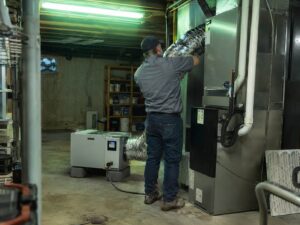
Typical residential humidifier installation runs 3–5 hours on-site:
- Cabinet mounting on supply or return duct per manufacturer specification
- Bypass duct fabrication on bypass-type humidifiers — sheet metal work to route a small portion of supply air through the humidifier cabinet
- Water supply connection — typically saddle valve or proper compression fitting on the home’s cold water line, with shutoff valve and copper or PEX supply tubing to the humidifier
- Drain connection on flow-through and steam humidifiers — typically routed to a nearby floor drain or condensate drain
- Electrical connection — line voltage and low-voltage control wiring
- Humidistat installation — either as an integrated control on a smart thermostat or as a dedicated humidistat near the air handler. We typically recommend a wall-mounted humidistat in a central location of the home for accurate humidity readings.
- Initial fill and pad wetting — water supply opened, humidifier cabinet fills, evaporation pad is fully wetted before first operation
3. Commissioning and Setup
- Humidistat setting — typically 30–35% during initial operation, sometimes higher (40%) after the home adjusts
- Operational test — verify humidifier operates when humidistat calls, water flows properly, no leaks at connections
- Initial humidity reading — measure starting RH and explain expected timeline for the home to reach target humidity (typically 24–72 hours depending on home volume and initial dryness)
- Walk-through — show you the humidistat operation, how to adjust setpoint seasonally, when to change the evaporation pad, when to clean components
Humidifier Maintenance
Whole-home humidifiers require modest annual maintenance:
- Evaporation pad replacement — once per heating season for typical use, more frequently in homes with very hard water. Replacement pads cost $25–$60 depending on humidifier model.
- Water panel cleaning — scale buildup on the water distribution system; cleaning takes 15–30 minutes during the annual pad replacement
- Steam cylinder replacement (on steam humidifiers) — every 1–3 years depending on water quality; cylinders cost $100–$300
- Drain line inspection on flow-through and steam models — clearing any algae or mineral buildup
- Pre-season function test — verifying operation before each heating season begins
We include humidifier service in our annual furnace tune-ups for maintenance plan customers and offer standalone humidifier service for non-plan customers ($125–$225 per service visit including pad replacement).
Common Concerns and How We Address Them
“I’m worried about mold from added humidity”
Valid concern, but easily managed. Mold grows on damp surfaces when RH stays above 60% for extended periods. We target 30–45% indoor humidity — well below the mold-risk range. The humidistat automatically reduces or stops humidifier operation when target humidity is reached, preventing over-humidification. Proper sizing also matters — oversized humidifiers can drive humidity higher than intended if the humidistat isn’t responsive. We size conservatively and program controls to prevent over-humidification.
“I tried a portable humidifier and it didn’t help”
Portable humidifiers have capacity limitations that prevent them from humidifying entire homes. Even the largest console-style portable units typically max out around 5–8 GPD — adequate for a single room but inadequate for a whole house. They also require regular tank refilling (often daily) and frequent cleaning to prevent biological growth. Whole-home humidifiers don’t have these limitations because they connect directly to the water supply, draining and refilling automatically, and they have capacity to humidify the entire home through the duct distribution system.
“Does the humidifier add noise or affect my heating?”
Bypass humidifiers add essentially no noise — water flows quietly through the system. Fan-powered humidifiers add modest fan noise (similar to a small bathroom exhaust fan) only when actively operating. Steam humidifiers add minimal noise. None significantly affects heating performance — the moisture being added represents a small fraction of the air stream’s heat content.
“Will adding humidity raise my heating bills?”
Marginally yes, but offset by something most customers don’t expect: humidified air feels warmer at the same actual temperature. Most customers reduce their thermostat by 1–2°F after installing a humidifier and report equivalent or better comfort. The thermostat reduction offsets the small additional heating cost of bringing humidification water to temperature. Net heating cost impact is typically near-zero.
“My old humidifier never worked well”
Most poorly-performing whole-home humidifiers fall into one of three categories: undersized for the home (common when contractors install a small unit on a large home to save cost), maintenance-neglected (pads not replaced, mineral buildup blocking water flow, water supply turned off), or humidistat malfunction. We properly size new installations, demonstrate correct maintenance during walkthrough, and use quality humidistats that maintain calibration over time.
Humidifier Installation Costs in Salt Lake County
- Bypass humidifier installation (Aprilaire 600, Honeywell HE100, GeneralAire 1042 class): $400–$700 installed
- Fan-powered humidifier installation (Aprilaire 700, Honeywell HE300, GeneralAire DS25 class): $600–$1,000 installed
- Steam humidifier installation (Aprilaire 800/865, Honeywell HM700, GeneralAire RS-25 class): $1,400–$2,400 installed
- Add-ons that affect price: dedicated 240V electrical circuit for steam units ($300–$700), water line extension if no nearby supply ($150–$400), drain line installation if no nearby drain ($200–$500), wall-mounted humidistat upgrade ($150–$300), smart thermostat integration ($0–$200 depending on existing thermostat)
- Annual maintenance: $125–$225 per service visit including pad replacement
Available financing through Synchrony Bank and Service Finance Company for larger projects. No specific rebates currently available for residential humidifier installations in the Salt Lake market — these are typically a comfort/health investment rather than an energy efficiency upgrade.
Frequently Asked Questions
- How much does whole-home humidifier installation cost?
- Bypass humidifier installation $400–$700; fan-powered humidifier installation $600–$1,000; steam humidifier installation $1,400–$2,400. Final cost depends on water supply and drain accessibility, electrical capacity (for steam units), and any required modifications.
- What’s the right humidity level for my Salt Lake home?
- 30–40% indoor RH is the typical target during heating season — comfortable for occupants, protective for wood furniture and floors, and well below the 60%+ range where mold and dust mite proliferation become concerns. The exact setting depends on outdoor temperatures (lower outdoor temps require lower indoor humidity to prevent window condensation) and your home’s window quality. We set initial targets at installation and discuss seasonal adjustment guidance.
- Will a humidifier protect my hardwood floors?
- Yes, significantly. Hardwood floors contract during dry winters, opening gaps between boards and sometimes causing permanent dimensional issues. Maintaining 30–40% indoor humidity through heating season keeps the wood at moisture content close to its installed condition, eliminating most dimensional movement and the gap problems that come with it. Hardwood floor manufacturers typically recommend 30–50% indoor RH year-round, which whole-home humidification makes achievable in our climate.
- Will my windows get condensation if I add a humidifier?
- Possibly, depending on your window quality and outdoor temperatures. Single-pane windows develop condensation at relatively low indoor humidity (sometimes as low as 25–30% when outdoor temps drop into single digits). Double-pane windows tolerate higher indoor humidity before condensation. Triple-pane and high-performance windows tolerate the highest humidity without condensation. We set initial humidistat settings conservatively and adjust based on your specific window performance — sometimes lowering the setpoint during the coldest periods to prevent condensation.
- How often does the humidifier need maintenance?
- Annual pad replacement is the main maintenance item — typically once per heating season for evaporative-pad types (bypass and fan-powered). Steam humidifiers require cylinder replacement every 1–3 years depending on water quality. We include humidifier service in our annual furnace tune-up for maintenance plan customers; standalone service is $125–$225 per visit.
- What’s the difference between a humidifier and a vaporizer?
- Vaporizers (sometimes called “warm mist humidifiers”) boil water to produce steam, similar to portable cool-mist humidifiers but with heated output. They’re portable, single-room devices like cool-mist portables. Whole-home humidifiers integrate with the HVAC system and humidify the entire home through duct distribution. Whole-home installations always outperform portable units for any application beyond a single small room.
- Can I install a humidifier myself?
- Technically possible for handy homeowners, but several factors typically make professional installation worthwhile: proper integration with existing HVAC system, sheet metal work for bypass duct fabrication, correct water supply connection (saddle valves can fail and cause leaks), proper drain connection, electrical work on fan-powered and steam units, and humidistat installation and configuration. DIY installations sometimes work fine; many produce poor humidification due to incorrect sizing or improper installation.
Schedule Humidifier Installation
If you’re tired of dry winter air, static electricity, dry skin and sinuses, or watching your hardwood floors gap each winter, call (385) 250-0687 for a free in-home assessment. Best installation timing is before heating season begins (typically August through October), but we can install year-round.
- Phone: (385) 250-0687
- Email: info@aegisheatingandair.xyz
- Address: 4454 Manhattan Ct, West Valley City, UT 84120