
Whole-Home Dehumidifier Installation in Salt Lake County
The Salt Lake Valley’s overall climate is dry, so dehumidification gets less attention than humidification in this market. But that aggregate statistic hides significant exceptions. Finished basements throughout the valley develop chronic humidity problems because concrete walls and floors transmit moisture from surrounding soil — particularly during spring snowmelt and after wet winters. Homes in lake-effect zones on the west side of the valley (Magna, parts of West Valley City, communities closer to the Great Salt Lake) experience higher summer humidity than the rest of the valley due to moisture transport from the lake. Homes with poor exterior drainage, homes with high water tables, homes that have experienced flooding or water intrusion events, and homes with chronic biological growth issues all benefit from dehumidification beyond what residential HVAC systems naturally provide.
Whole-home dehumidifiers integrated with HVAC systems address these problems more effectively than portable dehumidifiers because they treat the whole home through ducted distribution, run quietly in a mechanical space rather than producing the constant fan noise of a portable unit in living areas, drain continuously to a plumbing connection rather than requiring tank emptying, and operate automatically through a humidistat without manual attention. For homes with chronic humidity issues, the integrated approach typically pays back in mold prevention, comfort, and operational convenience compared to ongoing portable-unit operation.
Below is how whole-home dehumidifiers work, when they make sense for Salt Lake Valley homes, what installation involves, and what your investment buys in terms of moisture control and indoor air quality.
When Whole-Home Dehumidification Makes Sense
Finished Basements with Chronic Humidity
The most common reason customers in this valley install whole-home dehumidifiers. Symptoms include:
- Musty smell that persists despite cleaning, ventilation, and air-freshening
- Visible condensation on basement windows or exterior walls during humid periods
- Mold spots on walls, ceilings, or in closets — particularly in basement bedrooms or closets where air circulation is limited
- Damp feeling on walls, furniture, or stored items
- Hygrometer readings consistently above 55% RH in basement spaces
- Dust mite proliferation evidence (allergy symptoms that worsen in basement spaces)
Basement humidity problems often trace to a combination of factors: concrete walls transmitting soil moisture, inadequate exterior drainage, sump pump systems that don’t run frequently enough, leaky window wells, or simply the natural humidity differential between basements and upper floors. Whole-home dehumidification doesn’t fix the root causes — those typically require waterproofing or drainage work — but it manages the indoor air consequences regardless of source.
Lake-Effect Humidity (West Side)
Communities near the Great Salt Lake — Magna, parts of West Valley City, areas close to the lake’s eastern shore — experience meaningfully higher summer humidity than east-bench locations. Lake-effect moisture transport adds humidity to summer air that already carries thunderstorm activity. Homes in these areas sometimes find that air conditioning provides inadequate humidity reduction during the wettest summer periods — the AC removes some moisture as part of cooling, but not enough to maintain comfortable indoor RH when outdoor humidity is high.
A whole-home dehumidifier integrated with the air handler runs independently of cooling demand, removing moisture even when the AC isn’t running. This allows precise humidity control during summer regardless of cooling load.
Post-Water-Intrusion Drying
Homes that have experienced flooding, plumbing leaks, water heater failures, or other water intrusion events sometimes need extended dehumidification to dry out building materials and prevent mold growth. While severe water damage typically requires professional remediation with industrial drying equipment, whole-home dehumidifiers provide ongoing humidity management to prevent recurrent moisture problems in homes that have a history of water issues.
High-Performance Tight Construction
Modern very-tight construction (Passive House standards, deep retrofit projects) can create humidity issues that older looser construction never had. When natural air infiltration is minimized, indoor moisture from cooking, bathing, breathing, and other household activities accumulates more than in leaky older homes. Mechanical ventilation with energy recovery (ERV systems) addresses some of this, but in homes with high occupant density or significant indoor moisture sources, supplemental dehumidification may be needed.
Specific Humidity-Sensitive Applications
Some specific uses require tight humidity control that residential HVAC alone can’t provide reliably:
- Wine cellars and storage spaces requiring 50–70% RH year-round
- Indoor pool rooms requiring controlled humidity to prevent condensation
- Music studios with valuable instruments requiring stable 40–50% RH
- Art collections, fine furniture, or other humidity-sensitive valuables
- Health applications where humidity control matters for medical conditions
These applications usually benefit from dedicated dehumidification systems with precise control rather than rough whole-home equipment.
How Whole-Home Dehumidifiers Work
Whole-home dehumidifiers are essentially small air conditioning systems optimized for moisture removal rather than space cooling. They contain a compressor, evaporator coil, and condenser coil in a self-contained cabinet. Air drawn through the unit:
- Passes over the cold evaporator coil, where moisture condenses out of the air stream and drains away
- Passes over the warm condenser coil, where the air is reheated to approximately the same temperature it entered (so the dehumidifier doesn’t significantly cool the space it’s working in)
- Exits the unit dryer than it entered
Integration with the HVAC system allows the dehumidified air to be distributed throughout the home via ductwork. Most installations duct the dehumidifier’s intake from the return air stream and its output to the supply air stream, so the unit treats the entire home’s air during operation.
Whole-Home vs. Portable Dehumidifiers
Comparison for customers considering the alternatives:
Whole-Home Dehumidifiers
- Coverage: Entire home through ducted distribution
- Capacity: 65–130 pints per day typical residential range
- Drainage: Continuous gravity or pump drain to plumbing connection — no tank emptying
- Noise: Located in mechanical space, minimal noise transmission to living areas
- Control: Integrated humidistat maintains target humidity automatically
- Operating cost: Lower per pint of moisture removal due to better efficiency than portable units
- Installation cost: $2,000–$4,500 installed
- Service life: 10–15 years typical
Portable Dehumidifiers
- Coverage: One room or area where positioned
- Capacity: 30–70 pints per day typical residential range
- Drainage: Tank requiring manual emptying (typically 2–3 gallons, sometimes more), or gravity drain hose if positioned near a floor drain
- Noise: Continuous fan and compressor noise in living areas where positioned
- Control: Onboard humidistat with limited accuracy and frequent setpoint drift
- Operating cost: Higher per pint of moisture removal
- Purchase cost: $200–$500 for quality residential units
- Service life: 3–7 years typical
For chronic whole-home humidity issues, the whole-home dehumidifier almost always wins on cost-of-ownership over a 10-year horizon. For temporary or localized humidity problems (a single problem room, post-flooding drying), portable units often make more sense.
Sizing Considerations
Whole-home dehumidifier capacity is rated in pints of water removal per day (PPD) under specific conditions. Required capacity scales with:
- Square footage — larger homes require higher capacity
- Severity of humidity problem — moderate problems require less capacity than severe chronic moisture
- Indoor humidity sources — homes with high occupant density, cooking volume, or moisture-generating activities require more capacity
- Outdoor humidity exposure — homes near the lake or in chronically humid microclimates need more capacity than dry-microclimate homes
- Building envelope tightness — paradoxically, tighter homes need more capacity because moisture accumulates rather than exfiltrating naturally
Typical sizing:
- Moderate humidity issue in basement only (under 2,000 sq ft of conditioned space): 65 PPD unit typical
- Whole-home moderate humidity (2,000–4,000 sq ft): 90–100 PPD unit
- Whole-home severe humidity or larger homes (4,000–6,500 sq ft): 105–130 PPD unit
- Very large homes or extreme humidity: 130+ PPD or multiple units
Installation Process
1. In-Home Assessment
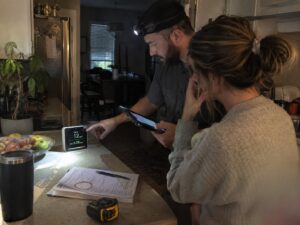
Installation visits start with humidity measurement and source identification. We use a calibrated hygrometer to measure baseline humidity in different areas of the home, identify the highest-humidity zones, and discuss your specific symptoms or concerns (mold, mustiness, allergies, basement comfort). We assess the air handler space and surrounding ductwork to determine the best installation approach for ducted integration. We discuss whether portable or whole-home dehumidification is the right approach for your specific situation — we don’t push whole-home installations when portable would solve the problem adequately.
2. Equipment Selection
Based on the assessment, we recommend specific equipment. Major brands we install:
- Aprilaire E-series (E070, E080, E100, E130) — quality residential whole-home dehumidifiers in capacities from 70 to 130 pints/day
- Honeywell DH series — comparable capacity range with various integration options
- Santa Fe Compact and Ultra series — high-quality dehumidifiers particularly suited for basement applications
- Ultra-Aire (manufactured by Therma-Stor) — premium whole-home dehumidifiers with high-capacity and high-efficiency options
3. Installation Day
Typical residential whole-home dehumidifier installation runs 4–8 hours depending on integration complexity:
- Equipment placement — typically located near the air handler, mounted on a stand or hung from joists. Some installations are placed in attic or crawl space, but mechanical room placement is preferred for accessibility.
- Ducted integration — return air pulled from main return duct via a dedicated branch; supply air delivered to main supply duct via a dedicated branch. Some installations use the main blower for distribution; standalone systems have their own internal blower.
- Drain connection — continuous gravity drain to a floor drain or condensate pump connection. Most installations include a condensate pump to allow drainage to higher points if needed.
- Electrical connection — typically dedicated 120V circuit for smaller units, 240V for larger high-capacity models
- Humidistat installation — wall-mounted in a central location of the home for accurate humidity sensing, or integrated with smart thermostat where compatible
- Initial operation and testing
4. Commissioning and Setup
- Humidistat setting — typically 45–50% during initial operation, sometimes lower (40%) for homes with persistent mold concerns
- Operational verification — confirm proper drain operation, no leaks at connections, expected moisture removal rate
- Performance measurement — measure starting humidity, predict expected timeline to target (typically 24–72 hours for moderate cases, longer for severe situations)
- Walk-through — show you the humidistat operation, how to adjust setpoint seasonally, filter replacement schedule, drain inspection
Maintenance
Whole-home dehumidifiers require modest annual maintenance:
- Filter replacement — typically annually or as indicated by the unit’s filter monitor
- Drain line inspection — clearing any algae or mineral buildup, condensate pump operation verification
- Coil cleaning — periodic cleaning of evaporator and condenser coils to maintain efficiency
- Refrigerant charge verification — same as small AC system, charge verification every few years or when performance degrades
- Humidistat calibration — verifying setpoint accuracy against a known-good reference
We include dehumidifier service in our annual HVAC maintenance for maintenance plan customers and offer standalone dehumidifier service for non-plan customers.
Whole-Home Dehumidifier Installation Costs
- 65–80 pints/day capacity (smaller homes, basement-focused applications): $2,000–$2,800 installed
- 90–100 pints/day capacity (medium homes, moderate humidity issues): $2,500–$3,500 installed
- 105–130 pints/day capacity (larger homes, severe humidity issues): $3,200–$4,500 installed
- Premium models with high-efficiency operation and advanced controls: $3,500–$5,000+ installed
- Add-ons that affect price: dedicated 240V electrical circuit for larger units ($300–$700), condensate pump if no gravity drain available ($200–$400), ductwork modifications for integration ($300–$800), humidistat upgrades ($150–$300)
- Annual maintenance: $150–$275 per service visit including filter, coil cleaning, and drain inspection
Frequently Asked Questions
- How much does whole-home dehumidifier installation cost?
- $2,000–$2,800 for smaller capacity (65–80 PPD); $2,500–$3,500 for medium capacity (90–100 PPD); $3,200–$4,500 for high capacity (105–130 PPD); $3,500–$5,000+ for premium models. Final cost depends on installation complexity, electrical needs, and ductwork modifications required.
- What humidity level should I target?
- 45–50% indoor RH during summer is typical for general comfort and mold prevention. Some homes with chronic basement humidity issues target lower (40%) to provide more margin against mold proliferation. Targets below 35% in summer aren’t typically recommended — excessively dry air creates other problems and the energy cost of pulling moisture below 40% rises rapidly. Winter targets are typically not relevant for dehumidification (winter air is naturally dry in Salt Lake; the issue is usually too little humidity rather than too much).
- Will a dehumidifier prevent mold growth?
- It significantly reduces mold risk by maintaining humidity below the range where most mold species can grow (typically 60%+ RH). Active mold growth in your home isn’t typically eliminated by dehumidification alone — existing mold needs to be remediated separately. But once active mold is removed, maintaining proper humidity prevents recurrence. Customers with mold history often pair professional remediation with whole-home dehumidification installation.
- Can I just use a portable dehumidifier?
- For localized humidity in a specific room or temporary drying situations, portable units work fine. For chronic whole-home humidity issues or homes where the problem affects multiple areas, whole-home dehumidifiers typically deliver better results at lower long-term cost. Portable units require constant tank emptying, produce noise in living spaces, have shorter service life, and have higher operating cost per pint of moisture removal. We help customers assess which approach is right for their specific situation.
- Will the dehumidifier cool my home like an air conditioner?
- No, by design. Dehumidifiers include a reheat coil that warms the air after moisture removal, so they don’t significantly cool the spaces they treat. This is intentional — a dehumidifier shouldn’t be doubling as inefficient air conditioning. The temperature output is typically within 1–2°F of input temperature. Air conditioning provides some incidental dehumidification during cooling cycles, but dedicated dehumidification provides much more precise humidity control without the cooling side effect.
- Will adding a dehumidifier raise my electric bill?
- Modestly. A typical whole-home dehumidifier uses 500–800 watts during operation, similar to a refrigerator. Operating cost depends heavily on how often the unit runs — homes with severe humidity issues may see $20–$50/month additional electric cost during peak humid periods; homes with moderate issues may see $10–$25. The math typically favors whole-home installation over portable operation when chronic humidity issues exist.
- How long does whole-home dehumidifier installation take?
- Most installations complete in 4–8 hours on-site. Installations requiring significant ductwork modifications or electrical upgrades take longer. We confirm timeline in the written quote and again at scheduling. Most installations finish in a single day.
Schedule Dehumidifier Installation
If your home has chronic basement humidity, summer comfort issues despite working air conditioning, mold history, or any other signs of excess indoor moisture, call (385) 250-0687 for a free in-home assessment. We measure baseline humidity, identify source areas, and recommend appropriate solutions — sometimes whole-home dehumidification, sometimes other approaches.
- Phone: (385) 250-0687
- Email: info@aegisheatingandair.xyz
- Address: 4454 Manhattan Ct, West Valley City, UT 84120