
AC Capacitor Replacement in Salt Lake County
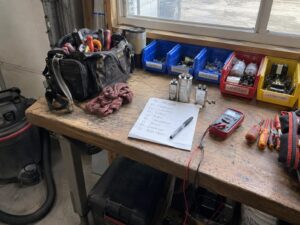
If your outdoor AC unit is humming but the fan isn’t spinning — or the compressor is clicking on and off without the system cooling — there’s roughly a 60% chance the problem is a failed capacitor. It’s the single most common cause of summer no-cool service calls in the Salt Lake Valley, and one of the cheapest, fastest repairs in residential HVAC. A working capacitor costs $25–$75 in parts. A failed capacitor that takes out the compressor along with it costs $2,000+. Catching the failure early, before it cascades, is the entire point.
We stock the most common dual-run capacitor sizes on every service truck — 35/5 µF, 40/5 µF, 45/5 µF, 50/5 µF, and 55/5 µF — along with a range of single-run sizes for older equipment and condenser fan motors. Most capacitor replacement calls complete in under an hour from arrival to a working system. Below is how we diagnose capacitor failure, what the symptoms actually mean, why capacitors fail in the first place, and what to expect on the service call.
What a Capacitor Does
An air conditioning capacitor is an electrical component that stores energy and releases it in a controlled burst to start and run electric motors. In a residential AC system, the capacitor serves two motors: the compressor (which moves refrigerant through the system) and the condenser fan (which moves air across the outdoor coil to reject heat). Both motors need a momentary surge of starting torque to overcome the inertia of a stopped state, and the capacitor provides it.
Most modern residential AC units use a single “dual-run” capacitor that handles both motors — a metal cylindrical can with three terminals labeled HERM (compressor), FAN, and C (common). The number printed on the side — for example “45/5 µF, 370/440V” — indicates the rated capacitance for each motor circuit (45 microfarads for the compressor, 5 microfarads for the fan) and the maximum voltage rating.
How Capacitors Fail
Capacitors don’t fail randomly. They degrade gradually under heat stress, voltage stress, and the cumulative effect of millions of charge-discharge cycles over years of operation. The failure mode looks like this:
- Year 1–3: Capacitor reads at or above its rated value. Healthy operation.
- Year 4–6: Capacitance starts dropping. Reading might fall from 45 µF to 42 µF — still within tolerance and the system still works normally.
- Year 7–8: Capacitance drops below 90% of rated value. Motors take slightly longer to start, draw slightly more amperage during startup. Most homeowners don’t notice anything.
- Year 9–10: Capacitance drops below 80% of rated value. Motors struggle visibly to start. On a hot afternoon, the compressor may trip on its internal overload protector and shut down. This is when service calls start.
- End of life: Capacitance drops below 70% of rated value, the capacitor case bulges from internal pressure, or the capacitor short-circuits internally. Motors won’t start at all. No cooling.
Hot weather accelerates failure. A capacitor that would have lasted 10 years in a moderate climate may last only 7–8 in Salt Lake summers, where outdoor temperatures above 100°F push electrolyte temperatures inside the capacitor case to extremes. Capacitors that bulge visibly should be replaced immediately regardless of microfarad reading — a bulged capacitor is structurally compromised and can vent or explode if it fails completely.
Symptoms of a Failing Capacitor
Compressor Capacitor Failure
- Outdoor unit hums loudly but the compressor doesn’t start, then shuts off after 10–30 seconds
- System cycles on and off rapidly without cooling
- Compressor trips its internal overload protector (clicks audibly off after attempting to start)
- “Hard start” symptoms — compressor labors to start on hot afternoons when motor torque demand is highest
- Cooling reduced or absent despite the outdoor unit appearing to run
Fan Capacitor Failure
- Outdoor unit hums but the condenser fan blade doesn’t spin
- Fan starts intermittently or runs at reduced speed
- System tries to cool but rapidly trips on high pressure (because the condenser coil can’t reject heat without airflow)
- Compressor runs but the system can’t maintain temperature
- Condenser coil becomes hot to the touch from heat that isn’t being rejected
Combined Symptoms (Dual-Run Capacitor Total Failure)
- Outdoor unit hums but neither the fan nor the compressor starts
- Audible “click” or “snap” from inside the capacitor case
- Visible bulging of the capacitor top (the can should be flat or only very slightly convex)
- Oily residue around the capacitor terminals indicating internal electrolyte leak
How We Diagnose Capacitor Failure
The diagnostic takes 5–10 minutes. Every capacitor diagnostic includes:
- Power disconnect at the outdoor unit — capacitors store dangerous electrical charge even with power off. Never touch a capacitor without first verifying it’s discharged.
- Visual inspection — bulged case, oily residue, swollen terminals, burned or discolored wiring, signs of overheating. Visible damage usually means replacement regardless of meter reading.
- Capacitor discharge — using an appropriate resistor to safely discharge stored energy before testing. Skipping this step is how technicians get hurt.
- Microfarad reading on each side — using a digital multimeter with capacitance measurement function. On a dual-run capacitor, we test both the HERM-to-C and FAN-to-C circuits separately against the rated value printed on the can.
- Interpretation against rated value:
- Within 6% of rated value — healthy, no replacement needed
- 6–10% below rated value — marginal, replacement recommended at next service interval
- 10–15% below rated value — failing, replacement recommended now
- Below 85% of rated value — failed, replacement required
- Reading 0 or “open” — capacitor is completely failed, motor will not start
- Verification of replacement size and voltage rating against the equipment manufacturer’s specification. We don’t substitute mismatched capacitors — using a 35 µF when 45 µF is specified leads to motor failure within months.
You see the meter reading. The diagnosis is straightforward and verifiable — there’s no judgment call involved in “your capacitor is reading 32 µF when it should be 45 µF.” Replacement is the only correct answer at that point.
How Capacitor Replacement Is Performed
- Power disconnected at the outdoor unit via the pull-out disconnect or breaker, verified with a non-contact voltage tester
- Capacitor discharged through an insulated resistor before any contact is made with terminals
- Old capacitor removed after photographing or noting wire positions (HERM/FAN/C terminals must be matched on the replacement)
- New capacitor installed with verified matching microfarad rating, matching or higher voltage rating, and proper terminal connections
- Wire connections inspected for tight termination and proper polarity (capacitor terminals are typically non-polarized for AC use, but proper terminal matching matters)
- Capacitor secured in the bracket — loose capacitors can vibrate and chafe wire insulation
- Cover replaced, power restored
- System operational test — verify compressor and fan start within 1–2 seconds of cooling call, monitor running amp draw against nameplate, confirm proper cooling
- Documentation — model number, microfarad rating, voltage rating, and installation date recorded in your customer file for warranty tracking
Capacitor Replacement Cost
- Standard dual-run capacitor replacement (35–55 µF range, common residential sizes): $200–$400 installed, including diagnostic, capacitor, and labor
- Specialty or oversized capacitor (commercial equipment, older systems with non-standard sizes): $275–$525
- Hard-start kit installation (when added as a preventive measure alongside capacitor replacement on aging compressors): adds $80–$175
- Capacitor replacement during regular tune-up when discovered marginal: typically $150–$300 since the diagnostic time is already covered by the tune-up service
Same-day service is standard. Capacitor replacement is the kind of repair where the diagnostic, the part, and the installation can all happen in a single 45–60 minute visit. We carry standard sizes on every truck.
Why You Shouldn’t Replace a Capacitor Yourself
Capacitor replacement looks like a simple swap on YouTube videos. The physical procedure is straightforward, but two real risks make this a job for licensed technicians:
Electrical Shock Hazard
A charged capacitor stores enough energy to deliver a serious or fatal shock long after power is disconnected. Capacitors don’t naturally discharge on their own — they hold charge for minutes, sometimes hours, depending on internal leakage. Multiple HVAC technicians have been killed by capacitor shock. Proper discharge through a resistor is mandatory before any work, and the right resistor matters — a wrong-value resistor can damage the capacitor while still leaving it dangerously charged.
Wrong Replacement Damages the Motor
Capacitor sizing isn’t approximate. A 40 µF capacitor in a system designed for 45 µF will cause the motor to run hotter, draw more amperage, and fail prematurely — sometimes within weeks. A 50 µF in a 45 µF system causes similar issues. Voltage ratings matter too — replacing a 440V capacitor with a 370V capacitor risks dielectric breakdown and a capacitor that fails dramatically (or violently). Hardware store “universal” capacitor kits are usually wrong for specific equipment.
The cost difference between professional replacement ($200–$400) and DIY ($25–$75 in parts) doesn’t account for the cost of getting it wrong — a damaged compressor from a wrong-size capacitor can run $2,000+ in replacement cost. The math doesn’t favor DIY on this one.
Preventive Replacement: When It Makes Sense
Some HVAC contractors recommend replacing capacitors preventively at fixed intervals (every 5 years, for example) regardless of measured condition. We don’t. The reasoning:
- Healthy capacitors don’t need replacement. A capacitor reading within 6% of rated value will likely last another 2–4 years. Replacing it prematurely is unnecessary cost.
- Marginal capacitors should be replaced. A capacitor reading 8–15% below rated will fail within 12–18 months in our climate. Replacing it during an existing service call is cheaper than the future emergency call.
- Visibly compromised capacitors should be replaced immediately. Bulging cases, oily terminals, or any visible damage means the capacitor is structurally failing regardless of meter reading.
The honest standard is “test, then decide based on the reading.” We measure during every AC tune-up and during every diagnostic visit, and we recommend replacement only when the reading or visual inspection warrants it.
What to Do Until the Technician Arrives
If you suspect a capacitor failure (outdoor unit humming but not running, or cycling rapidly without cooling), the safest action is:
- Turn the thermostat off entirely — repeated start attempts on a failed capacitor can damage the compressor
- Switch the breaker for the outdoor unit to off if you can identify it in your panel
- Don’t open the access panel on the outdoor unit — even with power off, capacitor charge is dangerous
- Call us at (385) 250-0687
If you can’t reach us and the situation is an emergency (extreme heat with vulnerable household members), set up portable cooling in a single room until the AC is repaired. Most capacitor failures are same-day fixes once a technician arrives.
Frequently Asked Questions
- How do I know if my AC capacitor is bad?
- The most reliable indicators: outdoor unit hums but fan or compressor won’t start, system cycles on and off rapidly without cooling, capacitor case is visibly bulged on top, or oily residue is visible around capacitor terminals. The only definitive diagnostic is a microfarad reading with a multimeter — anything below 90% of rated value indicates failure or imminent failure.
- How much does AC capacitor replacement cost?
- Typically $200–$400 installed in the Salt Lake market for standard residential capacitor sizes (35–55 µF dual-run capacitors). The price includes diagnostic, parts, labor, and operational testing. Specialty or oversized capacitors for commercial or older equipment can run $275–$525.
- How long does it take to replace an AC capacitor?
- Most capacitor replacements complete in 45–60 minutes from technician arrival to a working system. The actual physical replacement takes 10–15 minutes; the rest is diagnostic, safety procedure (discharge), testing, and documentation. We stock standard sizes on every service truck so most replacements happen on the first visit without waiting for parts.
- How often do AC capacitors fail?
- Residential AC capacitors typically last 7–10 years in the Salt Lake climate. Capacitors on systems running 24/7 or in extreme heat may fail in 5–7 years. Premium capacitors with higher temperature ratings (105°C versus the standard 70°C or 85°C) typically last longer — sometimes substantially longer.
- Can a failed AC capacitor damage the compressor?
- Yes. Repeated start attempts with a failing capacitor cause the compressor to draw excessive amperage during startup, which generates heat and accelerates compressor wear. A capacitor that has failed completely should be replaced before further start attempts are made — running the system with a known-failed capacitor risks compressor damage that costs many times more than the capacitor replacement.
- What’s the difference between a single-run and dual-run capacitor?
- Single-run capacitors serve only one motor (typically just the condenser fan, or just the compressor on older units). Dual-run capacitors serve both the compressor and the fan from a single capacitor with three terminals (HERM, FAN, C). Most residential AC equipment installed in the last 20 years uses a single dual-run capacitor. Replacement must match the original configuration.
- Should I upgrade to a higher-rated capacitor when replacing?
- Voltage rating yes; microfarad rating no. We always replace with a capacitor rated at the manufacturer’s specified microfarad value. Voltage rating can be equal to or higher than the original (a 440V capacitor can replace a 370V capacitor, but never the reverse). Some technicians recommend premium capacitors with higher temperature ratings (105°C versus 85°C) for longer service life in hot environments — this is reasonable in our climate and we’ll discuss the option when relevant.
Schedule Capacitor Replacement
If your AC is showing capacitor failure symptoms, call (385) 250-0687. Same-day service is standard during peak summer; most repairs complete in under an hour.
- Phone: (385) 250-0687
- Email: info@aegisheatingandair.xyz
- Address: 4454 Manhattan Ct, West Valley City, UT 84120