
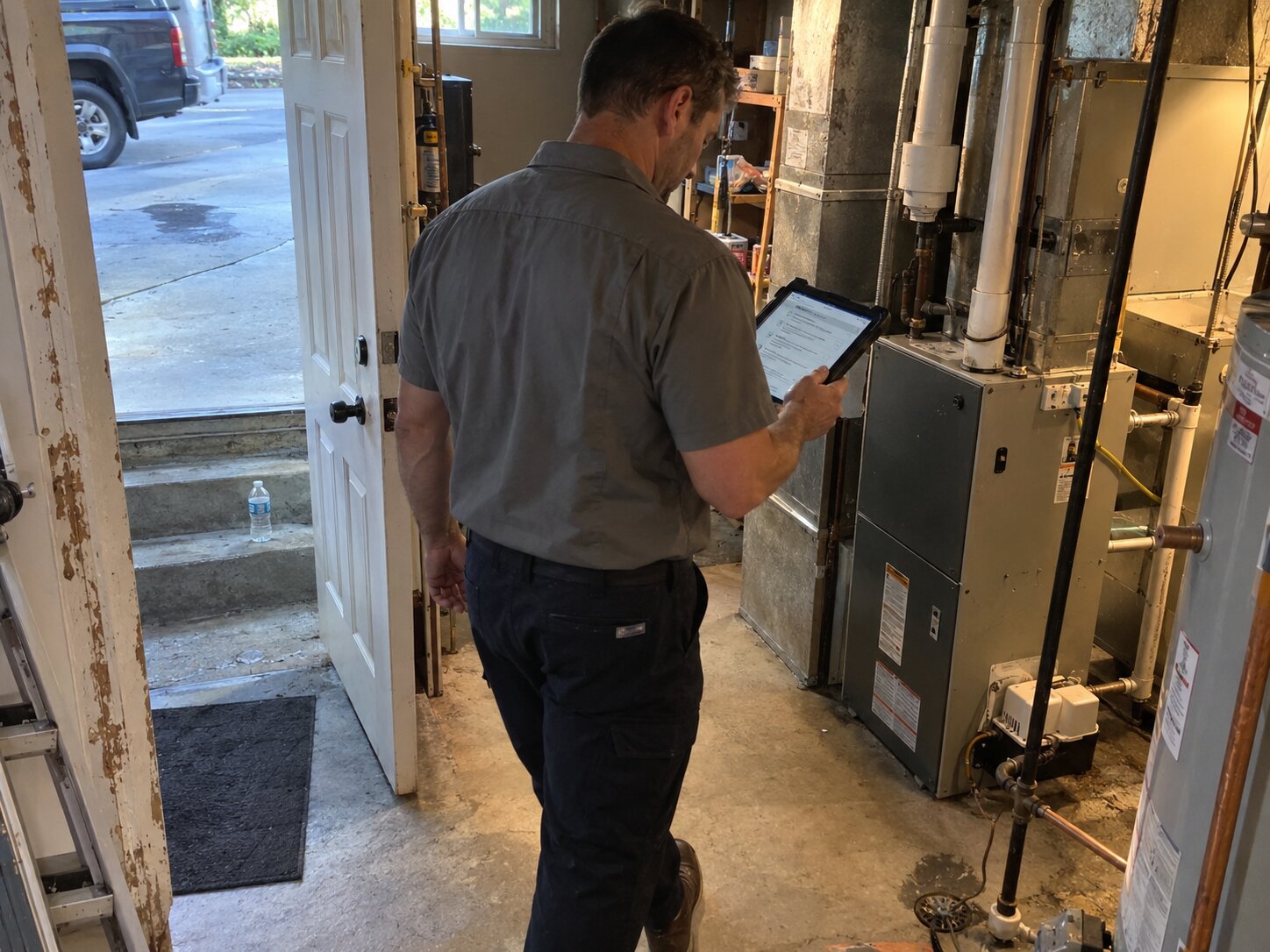
Commercial HVAC Maintenance in Salt Lake County
Commercial HVAC maintenance gets neglected for the same reason commercial HVAC failures hurt so much — facility managers and business owners are busy running their operations, and HVAC maintenance sits on a long to-do list until something breaks. The result is a predictable cycle: equipment runs without preventive service until catastrophic failure, then emergency calls happen at the worst possible time, then repairs cost more than maintenance would have, then the cycle resets until the next failure. Most commercial HVAC failures we respond to on emergency calls are failures that would have been caught and prevented by routine maintenance — flame sensors degrading over months before finally dropping below detection threshold, refrigerant leaks developing slowly before causing compressor damage, belt drives wearing visibly before snapping, condenser coils accumulating debris until cooling capacity collapses.
The commercial maintenance services we provide reverse this cycle. Quarterly or biannual scheduled visits catch developing issues before they become emergencies. Documented service records support manufacturer warranty claims, insurance compliance, tenant communications, and property management reporting. Priority emergency response for maintenance customers means faster turnaround when problems do occur. Bundled pricing on parts and labor makes the math work for customers who use the service. Most commercial customers who establish maintenance programs find that the program pays for itself in caught failures and avoided emergency calls within the first year — often within the first quarter.
Below are the commercial maintenance programs we offer, what each visit includes, how documentation works for commercial customers, and how multi-property contracts work for property management companies and multi-location businesses.
Why Commercial Maintenance Matters More Than Residential
Equipment Operating Hours
Commercial HVAC equipment runs significantly more hours per year than residential equipment. A restaurant rooftop unit typically operates 14–18 hours per day; retail equipment operates 10–12 hours; office equipment operates 10–12 hours with weekend operation often included. Annual operating hours on commercial equipment frequently double or triple residential operating hours, accelerating component wear and increasing the value of preventive maintenance that catches wear before failure.
Failure Cost Impact
HVAC failures at commercial properties have direct business cost beyond just the repair price. A restaurant losing cooling during summer service loses customers, food, and reputation in addition to repair cost. A retail store with HVAC problems during peak shopping hours loses sales. A medical office with HVAC problems may need to cancel patient appointments. Office buildings with HVAC problems cause productivity loss across all tenants. Preventive maintenance that prevents failures during business hours has business-level value beyond just the repair savings.
Documentation Requirements
Commercial customers need maintenance documentation for several purposes that residential customers rarely face:
- Manufacturer warranty claims on commercial equipment — manufacturers typically require documented annual maintenance to maintain warranty coverage on light commercial equipment, with similar requirements at premium commercial tiers
- Commercial insurance compliance — many commercial property insurance policies require documented HVAC maintenance, with claim denials possible without records
- Tenant communications on multi-tenant properties — documented maintenance supports communications with tenants about HVAC service work
- Property management reporting — facility managers need consolidated reports across multiple properties for budget planning, capital improvement decisions, and asset management
- Real estate transactions — commercial property sales include HVAC documentation as part of due diligence packages
- Code compliance on certain commercial occupancies (restaurants, medical facilities) where regular HVAC service is required by jurisdictional requirements
Equipment Warranty Preservation
Commercial equipment manufacturer warranties are often less generous than residential — typical 1–5 year coverage on light commercial equipment, compared to 10-year compressor warranties common on residential. Maintaining warranty validity through documented service is even more important for commercial equipment than residential, because warranty denial on commercial equipment typically represents a larger financial hit due to higher equipment costs.
Maintenance Program Tiers
We offer three commercial maintenance program tiers based on visit frequency and service depth:
Annual Maintenance Program
Single annual maintenance visit covering basic preventive service. Appropriate for:
- Smaller commercial properties with light operating loads
- Budget-constrained commercial customers
- Properties where major maintenance work is performed separately from the annual program
- Single-tenant office buildings with predictable schedules
Includes:
- Combustion analysis on gas equipment
- Refrigerant charge verification on cooling equipment
- Electrical inspection (capacitor testing, contactor inspection, motor amp draws, electrical connection tightening)
- Coil cleaning (outdoor coil for RTUs and split systems)
- Condensate drain service
- Filter replacement
- Belt and pulley inspection on belt-drive equipment
- Static pressure verification
- Written service report
Typical pricing: $250–$500 per unit per year
Biannual Maintenance Program
Two scheduled maintenance visits per year — typically spring (pre-cooling season) and fall (pre-heating season). The most common commercial maintenance configuration for light commercial customers.
Spring visit includes:
- Pre-cooling season cooling system preparation
- Outdoor coil cleaning
- Refrigerant charge verification
- Capacitor and contactor testing
- Compressor amp draw verification
- Condenser fan motor service
- Static pressure verification
- Filter replacement
- Condensate drain flush
- Belt and pulley service on belt-drive equipment
- Written service report
Fall visit includes:
- Pre-heating season heating system preparation
- Combustion analysis on gas equipment
- Heat exchanger inspection
- Burner cleaning
- Igniter and flame sensor service
- Gas pressure verification
- Limit switch and safety control testing
- Inducer motor service
- Filter replacement
- Belt and pulley service if applicable
- Static pressure verification
- Written service report
Typical pricing: $400–$850 per visit per unit; $800–$1,700 per unit per year
Quarterly Maintenance Program
Four scheduled maintenance visits per year (approximately every 90 days). Appropriate for:
- Restaurants and food service with continuous heavy HVAC duty cycles
- Medical facilities with strict temperature and humidity requirements
- Properties with high-value equipment requiring more frequent oversight
- Properties where downtime cost makes more frequent inspection economically appealing
- Older commercial equipment requiring more attention as it approaches end of service life
Each visit includes:
- Equipment-specific inspection per season (cooling-focused or heating-focused depending on timing)
- Filter inspection and replacement as needed
- Refrigerant charge spot-check
- Electrical inspection
- Belt and pulley service on belt-drive equipment
- Coil cleaning when needed
- Condensate drain service
- Written service report
Typical pricing: $300–$650 per quarter per unit; $1,200–$2,600 per unit per year
What Maintenance Visits Cover
Pre-Visit Coordination
Maintenance visits are scheduled in advance with property contacts. We work around business operations whenever possible:
- Restaurants — early morning before opening, mid-afternoon between meal services, or after closing
- Retail — early morning before opening or after closing
- Offices — typical business hours, scheduled to minimize disruption to specific spaces
- Multi-tenant properties — coordinated with property management for tenant communications
- Medical and dental — typically mornings before patient appointments or evenings after closing
Diagnostic Measurements
Each visit includes the diagnostic measurements that turn a visual inspection into a real evaluation of equipment condition:
- Combustion analysis on gas equipment — CO ppm air-free, O2 percentage, flue gas temperature, combustion efficiency, draft pressure
- Refrigerant charge verification by superheat or subcool method at actual operating conditions
- Electrical readings — capacitor microfarads, motor amp draws, contactor voltage drop, system voltages
- Static pressure across the air handler at all operating modes
- Temperature differentials through the coils
- Gas pressures at inlet and manifold on gas equipment
- Belt tension and pulley alignment on belt-drive equipment
- Filter condition assessment
- Drain flow verification on condensate systems
Service Work
Beyond diagnostic measurements, maintenance visits include preventive service:
- Filter replacement
- Coil cleaning (outdoor coils — chemical cleaning when needed, water rinse routinely; indoor coils when accessible)
- Condensate drain flushing
- Burner cleaning on gas equipment
- Flame sensor cleaning
- Electrical connection tightening
- Capacitor and contactor service
- Belt tension adjustment on belt-drive equipment
- Lubrication of bearings where applicable
- Setting verification on controls
Documentation
Every commercial maintenance visit produces written documentation:
- Service report with all measurements taken and service work performed
- Combustion analyzer printout on gas equipment
- Photos of any findings worth documenting
- Recommendations for any work identified but not performed during the visit
- Equipment-specific notes for future reference
- Maintenance record added to customer file
Issue Identification and Quoting
When maintenance visits identify issues warranting repair work beyond the scope of standard maintenance:
- Issues categorized as safety-related, performance-related, or aesthetic-only
- Written quotes for any recommended work
- Discussion with property contact about priority and timing
- Same-visit repair if parts are available and scope allows
- Follow-up scheduling for repairs requiring parts ordering or extended work
Multi-Property Service Contracts
Property management companies and multi-location businesses benefit from consolidated commercial maintenance contracts covering multiple properties under unified management:
Contract Structure
- Single annual contract covering all properties and units
- Per-unit pricing with multi-property discount applied
- Coordinated scheduling across all properties
- Consolidated billing — single monthly or quarterly invoice rather than separate per-property billing
- Unified reporting — quarterly or annual reports covering all properties with property-by-property breakdowns
- Single point of contact at Aegis for portfolio management
Property Management Reporting
Multi-property contracts include reporting tailored for property management needs:
- Quarterly service summary — all maintenance visits and findings across the portfolio
- Capital improvement recommendations — equipment approaching end of service life or showing deteriorating condition
- Budget projections for upcoming maintenance and likely repair needs
- Equipment inventory — make, model, age, condition, capacity for every unit under contract
- Emergency call summary — all emergency service calls with cause, resolution, and prevention recommendations
- Annual portfolio review — strategic review of equipment condition, capital improvement priorities, and contract renewal terms
Multi-Property Pricing
- 2–5 properties: 5% discount from single-property pricing
- 6–15 properties: 10% discount from single-property pricing
- 16+ properties: negotiated pricing based on portfolio scope
Emergency Response for Maintenance Customers
Commercial maintenance customers receive priority emergency response benefits:
- Same-day response during business hours on confirmed emergency calls
- After-hours response for true emergencies (no-heat with vulnerable occupants, no-cool affecting food safety, suspected gas leaks)
- Waived diagnostic fee on emergency calls — saves $125–$250 per call compared to non-contract pricing
- Parts and labor discounts of 10–15% on emergency repair work
- Priority parts inventory access for common commercial repair parts
Most commercial maintenance customers find that a single emergency call during the contract year covers the difference between maintenance contract pricing and pay-as-you-go service pricing through the bundled emergency benefits alone.
What’s NOT Included in Maintenance Contracts
Standard maintenance contracts cover scheduled preventive service and ongoing operational benefits. Several categories require separate quotes:
- Major component replacement (compressors, heat exchangers, control boards, gas valves, ECM motors) — discounted at contract rate but not included in contract price
- Equipment replacement — failed units replaced as separate installation projects with contract customers receiving priority quoting
- Ductwork modifications beyond minor adjustments
- Refrigerant beyond minor top-offs — significant recharges after leak repair
- Major cleaning work — chemical coil cleaning, blower wheel cleaning, severe biological remediation
- Code upgrades — bringing existing equipment into compliance with current code requirements
- Building Automation System integration work beyond simple thermostat connections
Maintenance contract customers receive discounts on this work but pricing is quoted separately so customers see exactly what each project costs.
Maintenance Contract Pricing Summary
Per-Unit Pricing
- Annual program: $250–$500 per unit per year
- Biannual program: $800–$1,700 per unit per year ($400–$850 per visit)
- Quarterly program: $1,200–$2,600 per unit per year ($300–$650 per visit)
Capacity Factors
- Up to 5 tons: lower end of pricing range
- 5–10 tons: mid-range pricing
- 10–15 tons: upper-mid range pricing
- 15+ tons: upper end of pricing range
Add-On Services Available
- Filter replacement program — bulk filter pricing with replacement during scheduled visits, beyond what’s included in standard contracts
- Belt replacement program — scheduled belt replacement on belt-drive equipment based on hours of operation
- Refrigerant verification program — annual EPA Section 608 leak detection inspection where required by code
- Indoor air quality service — added scope for filter cabinet, humidifier, dehumidifier, or UV equipment service
Frequently Asked Questions
- How much does commercial HVAC maintenance cost?
- Annual program $250–$500 per unit per year; biannual program $800–$1,700 per unit per year; quarterly program $1,200–$2,600 per unit per year. Pricing varies by equipment capacity, type, and accessibility. Multi-property contracts receive 5–10% discounts depending on property count.
- How often should commercial HVAC be maintained?
- Depends on equipment, occupancy type, and operating intensity. Restaurants and high-duty-cycle equipment benefit from quarterly maintenance. Office buildings and lighter commercial typically use biannual maintenance. Annual maintenance is the minimum we recommend for any commercial equipment. Specific guidance based on your operations.
- What’s included in commercial maintenance visits?
- Diagnostic measurements (combustion analysis on gas, refrigerant charge verification on cooling, electrical readings, static pressure), preventive service (filter replacement, coil cleaning, drain flushing, electrical connection tightening), written documentation with all measurements, and recommendations for any identified issues with separate quotes for repair work beyond maintenance scope.
- Do you maintain HVAC for property management portfolios?
- Yes — multi-property contracts with consolidated billing, unified reporting, coordinated scheduling, and multi-property pricing discounts. Property management companies and multi-location businesses benefit from single-vendor HVAC management with portfolio-level reporting and budget projections.
- Will the maintenance contract save money?
- Almost always yes if you would maintain regular service anyway. Bundled pricing on tune-ups is modest discount over pay-as-you-go. Bigger savings come from waived diagnostic fees on emergency calls ($125–$250 per call), 10–15% parts and repair discounts on any repair work, and priority emergency response avoiding extended downtime costs. Most contract customers see payback within the first emergency call.
- What documentation do I receive?
- Written service report after each visit with all measurements taken and service work performed. Combustion analyzer printout on gas equipment. Photos of any findings worth documenting. Recommendations for additional work with written quotes. Quarterly or annual summary reports for multi-property customers. All records maintained in our customer files for future reference.
- Can I add or remove properties from a multi-property contract?
- Yes, with pro-rated adjustments. Property management portfolios change as buildings are added or removed; contract structures accommodate these changes. Discount tier adjustments apply based on final property count after additions or removals.
Schedule Commercial Maintenance Consultation
Whether you need to establish a commercial maintenance program for a single property, set up a multi-property contract, or evaluate the right service frequency for your specific equipment, call (385) 250-0687 for an initial consultation. We provide written contract proposals after reviewing your specific equipment and operational requirements.
- Phone: (385) 250-0687
- Email: info@aegisheatingandair.xyz
- Address: 4454 Manhattan Ct, West Valley City, UT 84120